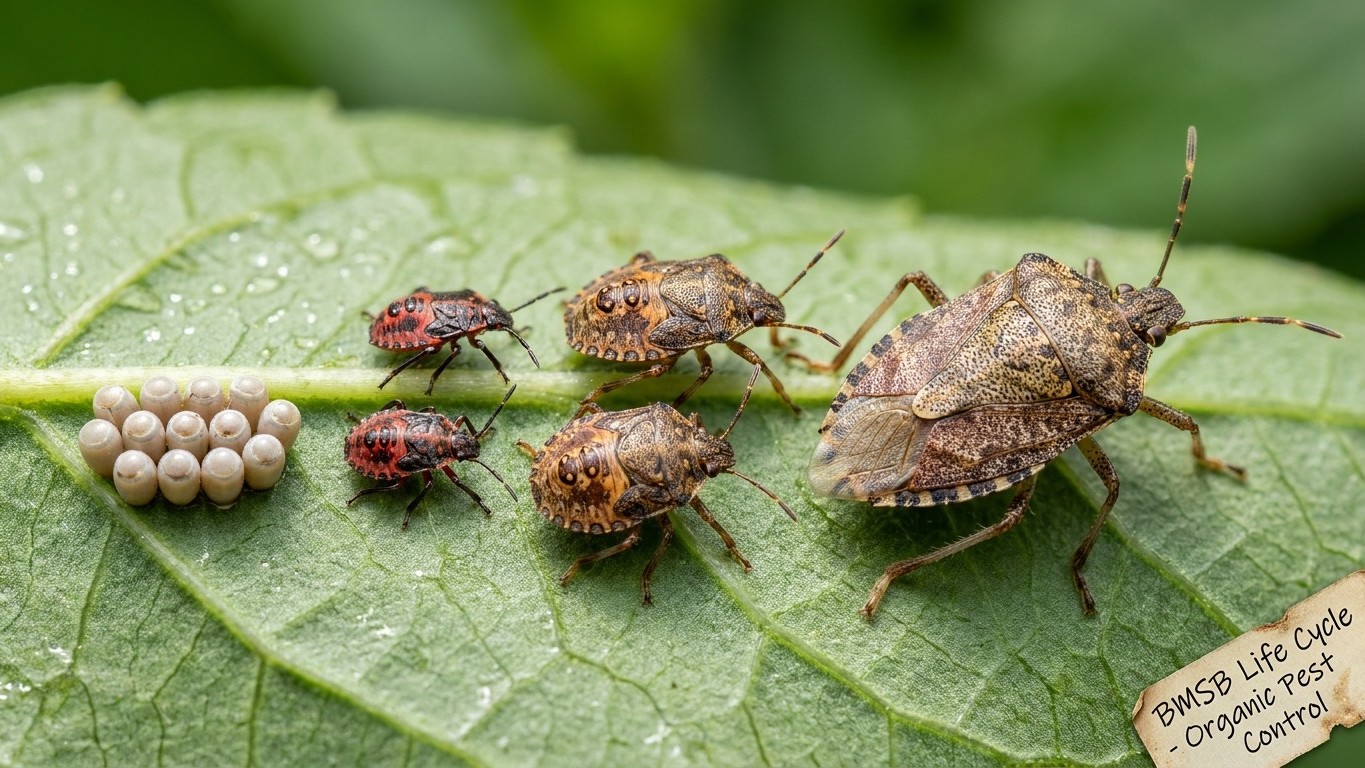

The brown marmorated stink bug (Halyomorpha halys) runs through one life cycle per year across most of its range, moving from egg to nymph to adult between spring and fall, then spending winter as an adult tucked into a dry, sheltered space. That adult is the stage homeowners actually see indoors. Nymphs stay outside on host plants and rarely move inside. Knowing which stage is active, and when, explains both the summer garden damage and the fall invasion this insect is known for.
The stages, in order

Unlike moths or beetles, the brown marmorated stink bug skips a pupal stage entirely. Its life cycle has three parts: egg, nymph, adult. That matters because it means every juvenile you see already looks roughly like a small, wingless version of the thing it will become, not a caterpillar-like larva that transforms later.
Eggs are laid in tight clusters on the underside of leaves, usually somewhere between 20 and 30 pale, barrel-shaped eggs per cluster. Most gardeners never spot them, since they’re hidden on foliage and only about the size of a pinhead. From there, the insect passes through five nymphal instars. Early instars are small, round, and marked with red and black; later instars grow larger and start showing the mottled brown pattern that gives the species its name. Nymphs are wingless, which is the fastest way to tell them apart from adults at a glance, and they feed exactly the way adults do, by piercing plant tissue and sucking out fluids from fruit, seeds, and stems.
The adult is the shield-shaped, mottled gray-brown insect most people recognize, roughly five-eighths of an inch long, with distinctive light bands on the antennae and alternating dark and light patches along the edge of the abdomen. Both nymphs and adults feed and both cause the dimpled, discolored damage seen on tomatoes, peppers, apples, and soybeans. The difference that matters for identification is location: nymphs stay outdoors on their host plants through the growing season, while adults are the ones that go looking for a way inside a house, shed, or garage once temperatures drop.
One natural enemy worth knowing about at this stage is the samurai wasp (Trissolcus japonicus), a tiny parasitoid that lays its own eggs inside brown marmorated stink bug eggs, killing the developing bug before it hatches. Where samurai wasp populations are established, they can meaningfully reduce local numbers over several seasons. Broad-spectrum insecticide applications timed to egg-laying periods kill this wasp along with the pest, which is one reason many extension entomologists now recommend targeted, well-timed treatment over routine spraying.
| Stage | What it looks like | Where it’s found | Feeds/damages plants? |
|---|---|---|---|
| Egg | Pale, barrel-shaped, in clusters | Underside of leaves | No |
| Nymph (5 instars) | Wingless, red-black to mottled brown as it grows | On host plants, outdoors | Yes |
| Adult | Mottled brown, shield-shaped, winged | Host plants in season, structures in fall/winter | Yes |
When it appears, and why that varies
Overwintering adults don’t wake up on a fixed date. They become active once accumulated warmth crosses a biological threshold, a running total of heat exposure over consecutive days rather than a spot on the calendar. This is the same logic behind degree-day models used for dozens of insect pests: a string of mild days in late winter can trigger early activity even if the calendar says it’s still technically winter, while a cold snap can delay things by weeks even in a region with a normally early start.
That single mechanism is why the answer to “when does it appear” is never one date for the whole country. A population in a warmer, southern state accumulates its seasonal heat total weeks before a population at higher latitude or higher elevation. Urban and suburban areas complicate this further, since pavement, buildings, and reduced tree cover create localized warm pockets, sometimes called urban heat islands, where insects near structures can become active earlier than the same species in a nearby rural field. Adults that overwintered inside a warm wall void or attic sometimes emerge on unseasonably mild winter days indoors, well before outdoor populations stir at all, which is why homeowners occasionally report seeing one in January.
Because the trigger is cumulative warmth rather than a fixed week, the only reliable way to know the practical emergence window for a given yard is to check the degree-day thresholds and typical activity dates published by the local land-grant university’s cooperative extension service. Those figures are recalculated by researchers each season using local weather station data, and they differ enough between neighboring states that a national date would be more misleading than useful.
What stays constant everywhere is the sequence: overwintering adults emerge, feed briefly, mate, and begin laying the eggs that start the first generation of nymphs for the year. Everything downstream of that first emergence, including how many generations follow, depends on how much growing season remains once it happens.
One generation or several
This is the detail that separates a manageable pest from a season-long one. A single-generation insect gives a gardener one identifiable window of vulnerability, one stretch of weeks to watch closely, and then a long stretch of relative calm. A multi-generation insect means the threat resets every few weeks, because a new wave of eggs is hatching while the previous wave is still feeding as nymphs or maturing into adults.
Brown marmorated stink bug falls into the second category in much of its range, though the number of generations depends heavily on climate. In cooler, northern parts of its distribution, populations typically complete one full generation per year, with overwintered adults producing offspring that mature into the adults which will overwinter again the following season. In warmer regions with a longer growing season, a partial or full second generation is possible, meaning eggs laid by that first generation’s adults have enough time and warmth to develop all the way through nymphal stages into new adults before fall.
The practical result is that this isn’t a pest you can treat once and forget. In areas with two generations, nymphs and adults from different cohorts can overlap on the same plants by mid to late summer, so a garden that looked clean in June can show fresh nymph damage in August from an entirely new batch of eggs. Even in single-generation areas, the feeding window still stretches across most of the growing season, because nymphs pass through five instars over multiple weeks and adults continue feeding right up until they seek overwintering shelter in the fall.
For anyone growing fruit, vegetables, or soybeans, that means monitoring can’t stop after the first sign of nymphs disappears. Checking host plants periodically through summer, rather than assuming one early scouting pass covers the season, catches the second wave before it does real damage to a late crop.
Where it spends the winter
Adults are the only stage that survives winter. Eggs and nymphs don’t overwinter; they either mature into adults before cold weather sets in or they don’t survive the season at all. That single fact is what makes fall cleanup relevant to next year’s population, and it’s the reason this species behaves so differently from pests that overwinter as eggs in soil or bark.
In natural settings, overwintering adults look for dry, sheltered spots that buffer them from temperature swings: under loose bark, inside dead or dying trees, in leaf litter, and among rock piles or debris. Around homes, that same instinct for tight, dry shelter is what drives the fall invasions people notice, since attics, wall voids, sheds, garages, and gaps around siding or window frames offer the same protection with the added benefit of being warmer than anything outdoors. Once inside a structure, adults become inactive through the coldest stretch of winter, but a run of unusually mild days can rouse some of them, which explains occasional midwinter sightings indoors even in regions where outdoor activity is still months away.
This is also why fall yard cleanup does more than tidy up appearances. Removing leaf piles, clearing brush and woodpiles away from the foundation, and sealing obvious gaps around siding, utility penetrations, and window frames reduces the number of nearby hiding spots before adults start searching for shelter in earnest. It won’t eliminate the population, since wild overwintering sites in trees and debris well away from any house remain available regardless of how tidy a yard is, but it does reduce how many adults end up choosing that specific structure over the alternatives nearby.
Come spring, whichever adults survived the winter, indoors or out, are the ones that restart the cycle described above. Fewer adults making it through winter near a given property generally means a smaller first wave of egg-laying come spring, which is the closest thing to leverage a homeowner has over a pest whose broader population is shaped mostly by regional climate and habitat.
Common questions
Does the brown marmorated stink bug lay eggs indoors?
No. Eggs are laid outdoors on the underside of host plant leaves during the growing season. Adults that come indoors in fall are seeking shelter for winter, not a place to reproduce; mating and egg-laying resume outdoors the following spring.
Can I tell the life stage from color alone?
Not reliably in early instars, since young nymphs are mostly red and black rather than brown. By the later nymphal instars the mottled brown pattern starts to resemble the adult, but the clearest tell at any stage is wings: nymphs are wingless, adults have fully developed wings.
Why do I see adults in my house in the middle of winter?
Adults overwintering inside wall voids, attics, or other warm structural spaces can become briefly active during a stretch of mild indoor temperatures, even though outdoor populations remain dormant. It’s a sign of an established overwintering site in the structure, not a new infestation starting.
Does one generation per year mean the risk period is short?
Not necessarily. Even where only one generation occurs, the feeding window spans most of the growing season because nymphs take weeks to pass through five instars, and adults keep feeding until they head for overwintering shelter in fall. In regions with a second generation, that window extends further, into late summer.