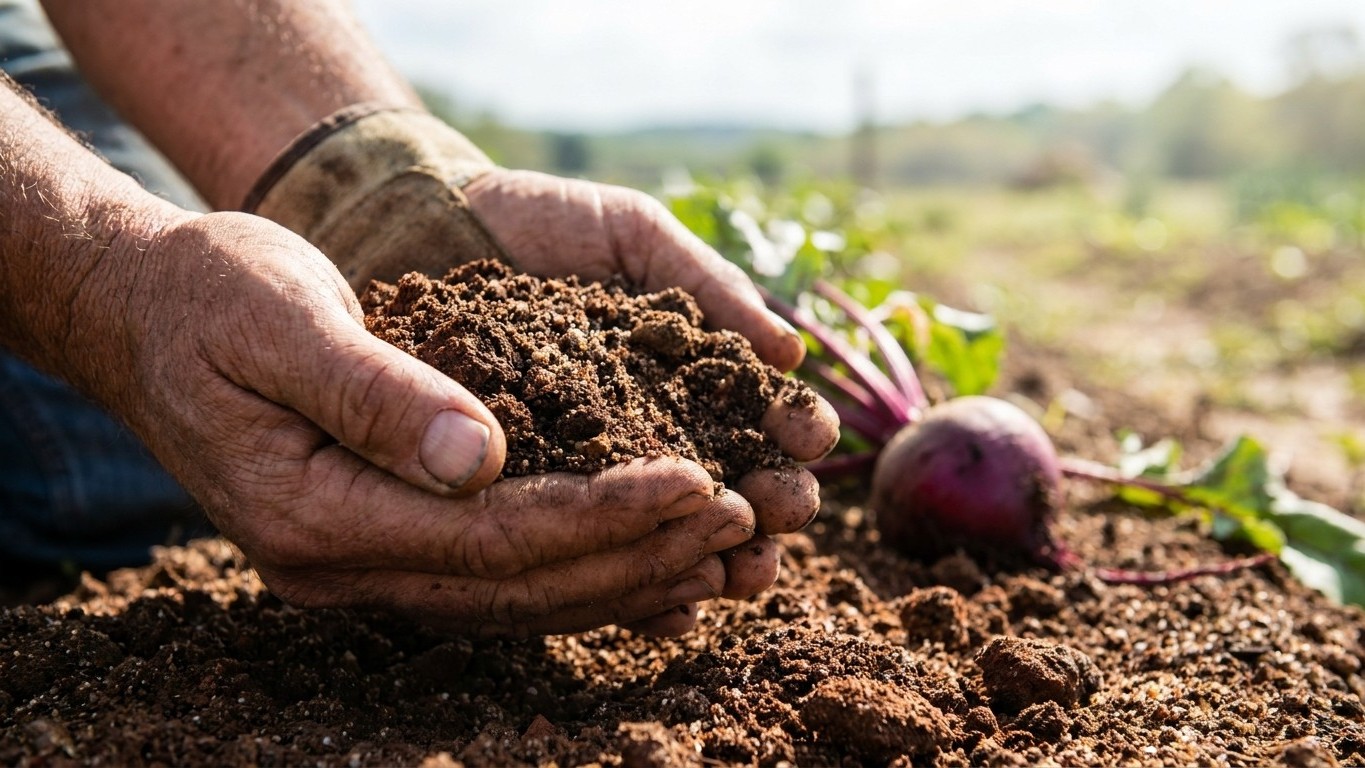

Prince Edward Island’s ground defaults to something beets don’t love: strongly acid, imperfectly drained, sandy soil built under conifers rather than farmland. That doesn’t rule out a beet bed, but it means the built-in advantage of a sandy texture comes bundled with a drainage problem and thin organic matter that need addressing before seed goes into the ground. The rest of this page works through what that soil profile does to sowing timing, bolting risk and root texture, and where the failures tend to show up.
The short answer
Across the province’s mapped agricultural soils, the most common profile is a Podzol, the acid, leached soil type that forms under conifer cover once rain has stripped the bases out of the topsoil. It covers roughly a third of the mapped surface, with Gleysolic soils coming next, and the median reading at the surface sits at pH 4.8, strongly acid, on a texture of 66 percent sand, 7 percent clay and 27 percent silt, with organic matter around 2.2 percent and a drainage class rated imperfect. That reading comes from Agriculture and Agri-Food Canada’s Canadian Soil Information Service, drawn from 542 mapped soil components across the province’s agricultural regions.
Texture and drainage: one point for the root, one against it
The sand fraction is good news on paper. Beets want deep, well-drained soil, and a texture that’s two-thirds sand should shed water fast and let a taproot push down without fighting compaction. The catch is the drainage class itself: imperfect drainage means water doesn’t move through the profile as freely as the sand percentage suggests, usually because a denser layer sits below the surface or the water table rides higher than it looks. That combination, loose on top and slow underneath, is what turns an ordinary rain into standing water around the crown, and it’s also what makes the low organic matter reading, 2.2 percent, below where beets do best, worth correcting before the first seed goes down. Utah State University Extension caps that correction at 1 inch of composted organic matter per 100 square feet, worked into a bed that’s already been checked for drainage rather than guessed at.
Heat, water stress and the missing number
Utah State’s guidance on beets is specific about the failure mode: water stress in the first six weeks pushes the plant into premature flowering, and heat above 85 F combined with that same water stress is what turns a root woody. Prince Edward Island’s own count of days above 90 F for a reference station isn’t published in the data behind this page, so no figure appears here. What can be said is that the drainage problem above, sand on top, slower movement below, makes soil moisture harder to read by eye than the texture alone suggests, which is the variable worth tracking directly with a finger in the soil rather than a thermometer on the porch.
None of this describes any one garden. Prince Edward Island’s agricultural soils span those 542 mapped components in the underlying survey, and a Podzol median is a starting point for a conversation with a soil test, not a substitute for one.
The six weeks that decide it here
Beet seed goes in 2 to 3 weeks ahead of the last frost, and on Prince Edward Island that frost date averages May 16 at the Charlottetown A station, the reference point Environment and Climate Change Canada uses for the province’s climate normals. Work back from that date and the sowing window lands in late April to mid-May, which puts the first six weeks of the crop, the window Utah State flags for bolting risk, running from around the end of April into mid-June.
A mean date, not a promise
That May 16 figure is a mean drawn from the 1981-2010 normals, not a probability threshold. In one year out of two, frost arrives later than the average, sometimes by a wide enough margin to matter for seed already in the ground. A gardener who plants strictly to the mean date is planting into a coin flip, and the six-week clock that follows inherits that uncertainty: a cold, slow start pushes the whole window later without changing the calendar the beet is actually working against.
Where that leaves the bolting risk
The bolting mechanism itself has nothing to do with cold, according to Utah State’s guidance: it’s water stress, not temperature, that triggers premature flowering in the first six weeks. What the frost variability does is compress or stretch the calendar around that window, which changes when a gardener starts counting. A late-frost year means the six weeks run later into a stretch when the sandy topsoil over PEI’s imperfectly drained subsoil is more likely to swing between quick drying and standing water after rain, exactly the unevenness that raises bolting risk. The fix isn’t a different sowing date so much as watching the bed itself: consistent moisture through those six weeks matters more than which week of May the seed went in.
What goes wrong here
Put the soil profile and the frost variability together and a short list of predictable failures shows up.
Five failures to watch for
- Standing water around the crown after rain. The imperfect drainage class means water can sit even in a sandy topsoil. Raise the bed above grade so the root zone drains independently of whatever is happening in the layer below.
- Strongly acid topsoil. A median surface pH of 4.8 is low enough to affect nutrient availability for most vegetables. Test the bed directly rather than assume the provincial median applies, and correct with lime only against that test result.
- Thin organic matter. At roughly 2.2 percent, the province’s median soil sits below where beets do best. Work in compost ahead of sowing, capped at 1 inch per 100 square feet per Utah State University Extension, rather than guessing at a heavier application.
- Premature flowering from uneven early watering. Because the six-week window can land later in a cold-spring year, and because sandy topsoil over slow-draining subsoil dries and floods unevenly, water stress in that window is the direct trigger for bolting. Water on a schedule tied to soil moisture, not the calendar.
- Woody roots from a hot, dry stretch after establishment. Heat above 85 F combined with water stress at any point in the season coarsens the root’s texture. Since no local count of days above 90 F is published here, treat any stretch of hot, dry weather as a cue to check soil moisture directly rather than wait for a forecast threshold.
Common questions
Does the province’s median soil describe my garden?
Not necessarily. The Podzol profile described here comes from 542 mapped soil components across Prince Edward Island’s agricultural regions, and it’s the most common reading, not a universal one. River bottoms, low-lying muskeg, and any yard a builder has scraped or filled will read differently, sometimes completely differently, on texture, drainage and pH. A soil test of the actual bed is the only way to know where it sits.
How many days does it take to grow a beet in Prince Edward Island?
Beets are sown directly in place, never transplanted, and the standard timeline runs 60 to 80 days from seeding to harvest. That count starts the day seed goes into the ground, which on Prince Edward Island means the harvest window shifts with however late or early the sowing date lands relative to the average May 16 frost.
Is the May 16 frost date safe to plant around?
Treat it as the midpoint of a range, not a safe line. It’s a mean drawn from Environment and Climate Change Canada’s 1981-2010 normals for the Charlottetown A station, and in one year out of two the actual last frost falls later than that average. Sowing 2 to 3 weeks ahead of it is standard practice, but a gardener in a colder pocket of the province, or in a year running behind normal, should expect the real date to drift later.
Does Prince Edward Island’s soil need lime for beets?
Possibly, but that call belongs to a soil test, not to the provincial median. The mapped surface soils run strongly acid at a median pH of 4.8, low enough that many vegetable crops respond to lime, but the correct amount depends on the actual reading in the bed and on how far off it sits from what the crop needs, not on the province-wide figure alone.