
Set sweet potato slips out on Prince Edward Island in early June, once the soil has warmed, and plan on one planting per year. The average last spring frost at Charlottetown is May 16 and the average first fall frost is October 17. That is a short but workable season. Black plastic, raised ridges and an early-maturing type make the difference between a thin harvest and a good one.
When the soil is warm enough in Prince Edward Island

Gardeners ask for a date, so here it is. Environment and Climate Change Canada’s 1981-2010 normals put the average last spring frost at the Charlottetown A station on May 16. That is a mean date, which means that in one year out of two the last frost falls later. Northern and upland districts of the Island run weeks behind the airport, so a garden in the east or on higher ground should wait longer.
A frost date only tells you when freezing stops. Sweet potatoes wait for warm soil, and the soil warms after the frost risk has ended. A bed that has been frost-free for a week can still be cold three inches down, and a slip planted into cold ground sits there without growing. It can rot before it roots. In practice, early June is the usual planting window on the Island, and late May is a gamble in all but the mildest years.
How can you tell the soil is ready for sweet potato slips?
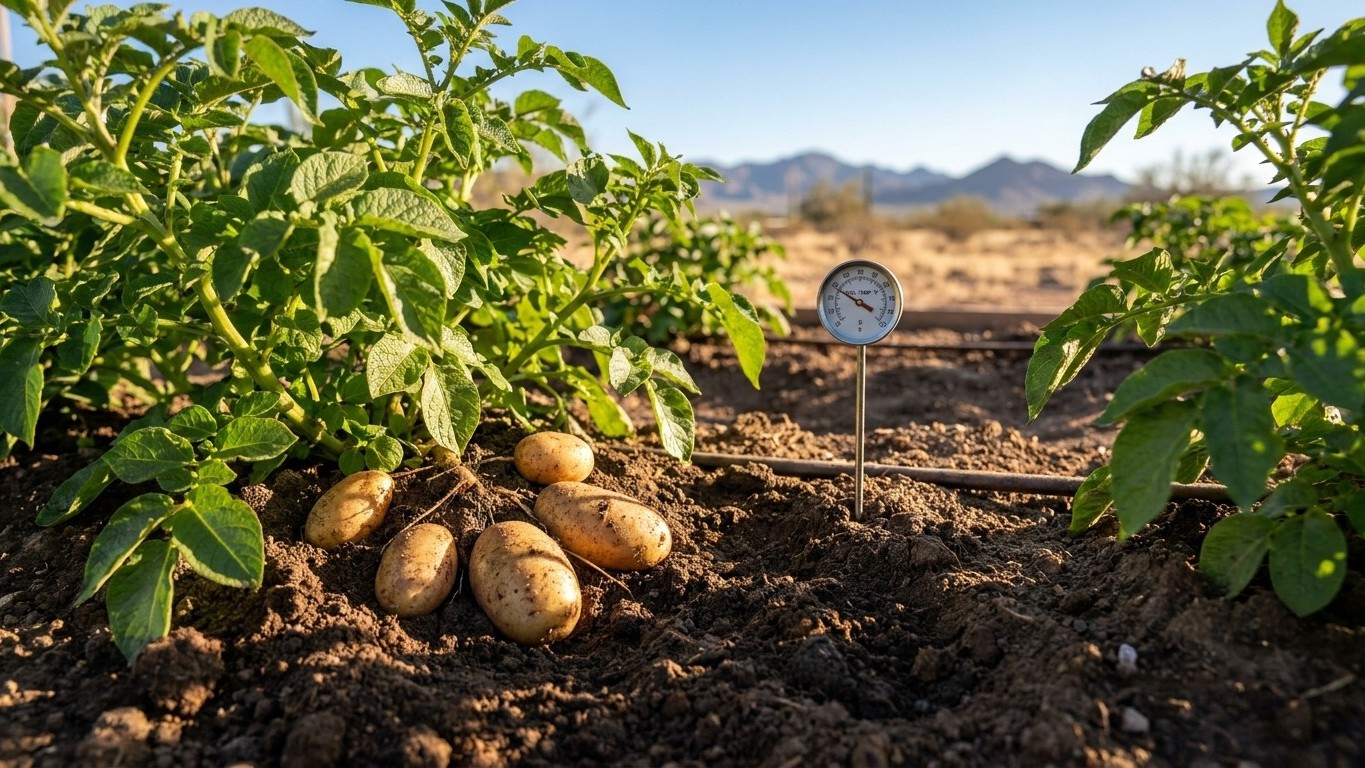
Use a soil thermometer pushed in at planting depth, in the morning when the ground is at its coolest. Read it over several days and wait for a steady warm reading, not one sunny afternoon. The slip supplier’s planting instructions give the figure to aim for. If you have no thermometer, wait for a run of mild nights and a bed that feels warm to the hand when you dig a hole.
Black plastic laid over the bed one to two weeks ahead of planting gives the soil a head start. Row cover over the slips adds a little protection on a cool night. Both are worth the effort in a climate this far north, and the planting date moves earlier only by days, never by weeks.
Is a sweet potato a yam or a potato?
Neither. The supermarket label “yam” is wrong, since true yams are an unrelated tropical crop. Sweet potato belongs to the morning glory family, so it is not a nightshade and shares none of the potato’s rotation rules. A bed that grew potatoes last year is no problem for sweet potatoes, and the reverse is just as true. Sweet potatoes are started from rooted cuttings called slips, and nobody plants a tuber piece the way they would with a seed potato.
How long the season lasts here
The station has about 154 frost-free days between the mean last spring frost of May 16 and the mean first fall frost of October 17. Both dates come from the Charlottetown A station and both are midpoints, so the true window in any single year can be a couple of weeks shorter or longer. A garden away from the water, or in a frost pocket, will have fewer days.
What does a window this size allow?
One planting. Sweet potatoes need the whole warm stretch to bulk up their roots, and a second sowing in midsummer would run out of season before it made anything worth digging. Succession planting works for beans and lettuce, where you can sow every couple of weeks and harvest in pieces. Here the first slips in the ground are the only slips. A planting delayed by three weeks costs a real share of the growing time. That is why the date matters, and why the full guide to growing sweet potatoes puts so much weight on slips and heat.
The short window also changes how much trouble the slips are worth. Buying rooted slips from a nursery or grower saves weeks compared with sprouting your own in the house, so most Island gardeners are better off buying. Whichever route you take, check each slip before it goes into the ground. You want a sturdy stem, a few white roots and no dark, mushy patch at the base. A weak slip that struggles for ten days in cool soil wastes a large part of an already short season. Neighboring provinces face the same arithmetic, as growing sweet potatoes in New Brunswick shows.
What should you do before the first fall frost?
Frost blackens the vines, and the roots should come out of the ground soon after. Dig gently, because the skin bruises easily, and lift the roots on a dry day. Sweet potatoes then need curing in a warm, humid spot, and afterward they keep best at room temperature in a dry, ventilated place. Never store them in a refrigerator or a cold cellar. Cold injury below their storage range is permanent, and it ruins more home crops after harvest than any disease does. Before you store any root, inspect it:
- The skin should be intact, with no cuts or gouges.
- The flesh should be firm all over, with no soft patch.
- No spot should be weeping or damp.
- There should be no sour or off smell.
A soft patch or a weeping spot ends the question. A root that looks sound is no proof that it is safe to keep or eat, so any root with those signs goes out.
Heat and water in Prince Edward Island

Sweet potatoes want accumulated warmth and warm nights, and summer here does not supply them freely. At Charlottetown A the mean number of days reaching 32 °C is 0.03 a year, about one day in thirty years. Days above 30 °C come to 0.93 a year, under one a summer. Those are counts at the airport station. They describe how rare extreme heat is and say nothing about the whole Island. A seaside garden and an inland one will differ.
These counts should not be read as a verdict. What decides success for a warm-season crop is the length of the frost-free period and the summer mean temperatures. A short run of scorching days contributes little. On the Island the crop is a project and not a routine. Black plastic holds heat in the soil overnight, raised ridges drain and warm faster than flat ground, and an early type finishes before the fall chill arrives. In Indiana, where summers are hotter and longer, growing sweet potatoes asks for none of that.
What does a cool, damp summer bring?
Slow growth first, since roots bulk up slowly when the nights stay cool. A damp canopy then invites leaf mildew and other foliage diseases, and roots in poorly drained ground can rot. A late, slow ripening leaves the crop exposed to the first fall frost. Good airflow between plants, well-drained ridges and a bed in full sun are the practical answers.
How much rain do sweet potatoes get here?
The Charlottetown A normals for 1981-2010 show about 274 mm (10.8 inches) of rain across June, July and August, out of 1,158 mm (45.6 inches) over the year. July is the driest summer month at 80 mm (3.15 inches), June brings 3.89 inches and August 3.77 inches. That is usually enough for steady growth, but the same rain acts differently by soil. A sandy bed lets an inch of rain through within the day, so a wet summer on sand can still mean watering every second day. A clay bed holds it for a week. A single thunderstorm mostly runs off rather than soaking in.
| Measure | Charlottetown A | What it means for the crop |
|---|---|---|
| Mean last spring frost | May 16 | Planting waits until the soil warms, usually early June |
| Mean first fall frost | October 17 | Roots must be dug soon after the vines blacken |
| Days reaching 32 °C | 0.03 a year | Extreme heat is almost absent |
| Days reaching 30 °C | 0.93 a year | Under one such day a summer |
| Rain, June to August | 274 mm (10.8 inches) | Usually enough, with July the driest month |
Even moisture matters most late in the season. A long dry spell followed by a heavy soaking is what splits roots at the end, and a layer of mulch or plastic evens out the swings. Easing off the watering as harvest nears also helps.
Which sweet potatoes suit Prince Edward Island
Choose by type, and let local trials name the variety. A short season favors the earliest-maturing types, the ones bred to size up before cool weather returns. A damp summer makes disease resistance the first criterion, with leaf health and rot resistance ahead of any other trait. Hot-climate traits like deep roots and heavy vines matter less on the Island. If a type is bred for long Southern summers, it will probably still be small when frost arrives.
A name that thrives in Georgia or Indiana tells you little about a bed in Queens or Prince County, and the only recommendation that means anything comes from varieties trialled on Island soils and in Island summers. The Prince Edward Island Department of Agriculture is the place to ask, along with local growers and nurseries that sell slips to northern gardeners. Ask what has finished in your area and which type has stood up to a wet season.
The Canadian hardiness zone for the city is 5b, according to Natural Resources Canada’s Plant Hardiness Site (1991-2020 normals). It is a Canadian zone, built on seven climate variables, and it does not translate to a USDA zone. It also describes perennials surviving winter. Sweet potatoes are grown as an annual and killed by the first frost, so the zone says little about this crop, and the frost dates and soil warmth matter far more.
Common questions
Can you grow sweet potatoes on Prince Edward Island?
Yes, with an early-maturing type and a warmed bed. The frost-free stretch at Charlottetown A is about 154 days, which fits one crop if the slips go in on time. Plastic and raised ridges improve the odds in a cool year.
When should you plant sweet potato slips on PEI?
Early June is the usual window, once the soil has warmed. The mean last frost at Charlottetown A is May 16, but half of all years see a later frost, and the soil takes longer than the air to warm. Gardeners in northern or upland districts should wait a bit longer.
Do you need black plastic?
It is strongly advised. Plastic warms the soil before planting and holds heat overnight, which is where the Island’s cool summers fall short. Row cover adds protection on cold nights, and raised ridges help drainage.
How should you store sweet potatoes after harvest?
Cure them first in a warm, humid place, then keep them somewhere dry, ventilated and at room temperature. Never use a refrigerator or a cold cellar, since cold injury is irreversible. Check every root before storing, and discard any with a soft patch or a weeping spot.