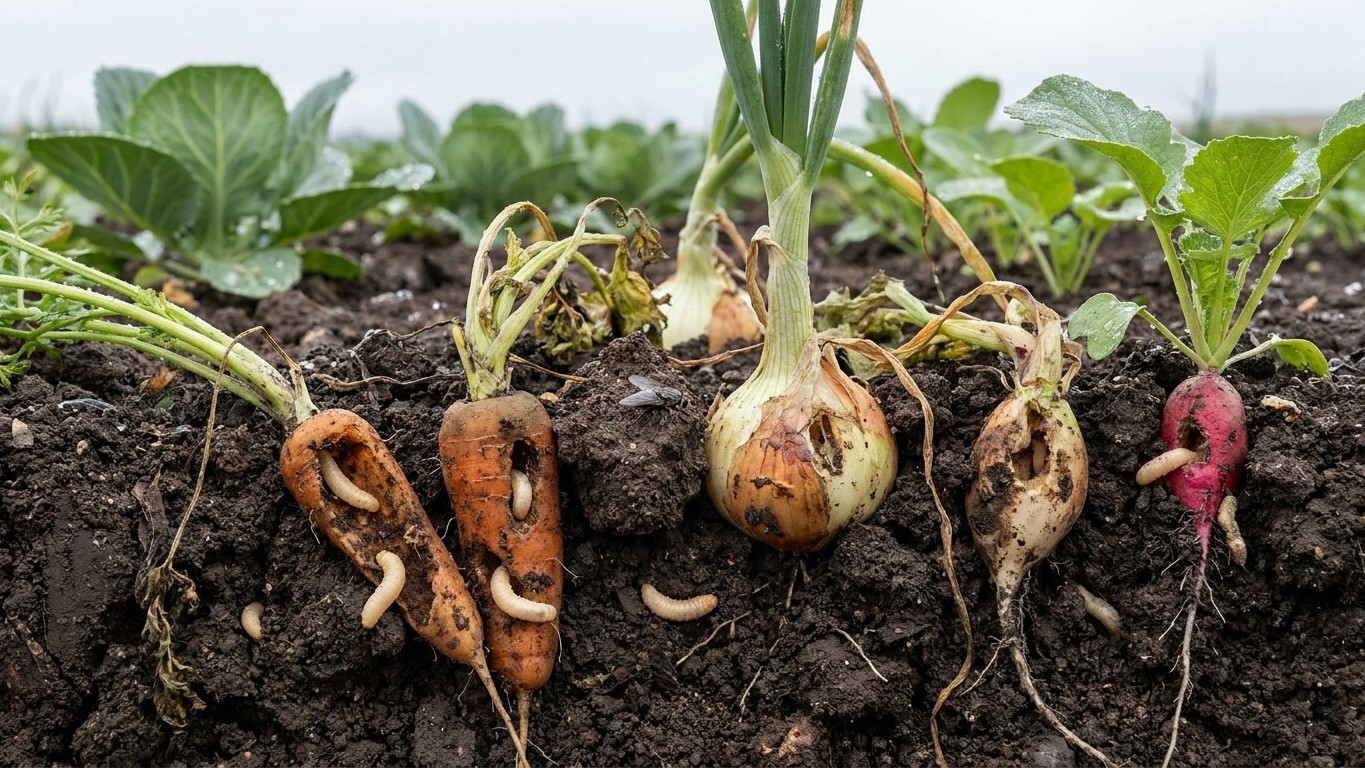

On Prince Edward Island, wait for warm soil rather than a date on the calendar. At the Charlottetown A station, the average last spring frost is May 16 and the average first fall frost is October 17, which leaves about 154 days between them. That is workable for kohlrabi, horseradish and Jerusalem artichokes. Celeriac is the tight one. This page covers the four crops in Celeriac, Kohlrabi, Horseradish and Jerusalem Artichokes, adapted to the island.
When the soil is warm enough in Prince Edward Island
The frost date is a midpoint, not a green light
Start with the number everyone asks for. According to Environment and Climate Change Canada’s 1981-2010 climate normals for the Charlottetown A station (climate ID 8300300), the last spring frost falls on average on May 16. Average means exactly that: in one year out of two, the last frost comes later. Treat May 16 as the middle of a window that stretches well past it, and keep a bedsheet or row cover handy for the late nights.
Two caveats come with the figure. It describes one airport station, and a province is not one climate, so upland and northern districts run weeks behind Charlottetown. And Canadian normals cover 1981-2010, while the US figures elsewhere on this site cover 1991-2020, so don’t line the two up as if they were the same yardstick.
Why the soil lags the frost
Frost is a proxy here, and a rough one. Celeriac, kohlrabi, horseradish and Jerusalem artichokes don’t care about the air temperature on a given morning so much as the temperature of the ground their roots sit in. Soil is slow. It warms after the frost risk ends, not with it, and on the island’s damp, heavy soils the gap can stretch. A bed that was frost-free on May 16 can still be sluggish and cold a week or two later, especially if it drains poorly.
Planting into cold, wet ground does damage you won’t see for weeks. Seed rots or sits idle, young transplants stall, and a stalled celeriac seedling can bolt or simply lose the days it never had to spare. A soil thermometer pushed a few inches into the bed costs very little and answers the question better than any almanac. Check it in the morning, when the soil is at its coolest, and for several days running, not once.
For the actual temperature thresholds and the varieties that have been trialled on the island, go to Prince Edward Island Agriculture. This page deliberately names no cultivars. It can’t source them, and a variety name that turns out to be wrong is the first thing a gardener notices. Types and timing it can speak to; local trial results belong to the people who ran the trials.
How long the season lasts here
Count from May 16 to October 17 and you get 154 days. Both dates are averages from the same station, so the real window in any given year is longer or shorter by a couple of weeks at either end. Think of 154 days as the budget on an ordinary year, and plan so that one bad spring doesn’t wreck the plan.
What does a window that size allow? Not much slack, but real choices. The first is a second sowing. A fast crop like kohlrabi, sown early, can be followed by another sowing in summer for a fall harvest, because the fall frost is still months away when the first batch comes out. The succession sowing guide on this site sets out how to stagger those sowings. Horseradish and Jerusalem artichokes don’t fit that pattern at all. They are planted once and then left to occupy their spot, so the length of the season matters to them mainly for how much top growth they build before frost.
Celeriac is where the arithmetic bites. It is the longest-season crop in the group, usually started indoors weeks before the last frost, then moved out when the soil has warmed. Every week lost to cold ground comes straight out of the budget. And that raises the transplanting question: whether the root check at transplant time is worth it. For celeriac, a short window makes transplants the only sensible route, since direct sowing would leave nothing for the root to swell. Handle them gently, keep the roots from drying, and don’t set them deeper than they grew.
Kohlrabi sits at the opposite end. It is quick enough that sowing in place avoids the check entirely, and the lengthy gap between sowing and the first fall frost leaves room for a repeat. Gardeners across the Northumberland Strait deal with a similar calendar, and the page on Growing Unusual Root Crops in New Brunswick shows how the same crops are timed there. For a very different problem set, a long, hot summer, compare it with Growing Unusual Root Crops in Indiana.
Heat and water in Prince Edward Island
This page doesn’t carry a verified count of days above 90 °F (32 °C) for the island, or a verified figure for summer rainfall at Charlottetown, so it won’t make one up. What can be said without numbers is the pattern to plan for. A maritime island this far north is more likely to hand you a cool, damp summer than a scorching one, and the problems that follow are different from the hot-climate script. Expect slow ripening, powdery mildew and other leaf diseases that thrive in humid, still air, and soil that stays wet for long stretches. Heat stress and drought are the lesser worries, though a dry spell in a sandy bed will still stop a root crop in its tracks.
Practice follows from that. Space plants generously so air moves through the foliage, water at the base in the morning rather than overhead in the evening, and mulch to hold an even moisture level, since uneven watering splits roots and makes tough, woody ones. Kohlrabi, horseradish and kohlrabi’s relatives share a problem worth knowing: kohlrabi and horseradish are brassicas, as are turnip and rutabaga. They share their pests and diseases with cabbage, kale and mustard, so rotating them into a bed that held cabbage rotates nothing. Check the rotation page on this site before you plan beds.
What the winter decides
Season length tells you whether celeriac can finish. The winter tells you what can stay in the ground. Charlottetown’s coldest month has a mean daily minimum of -12.1 °C (10.3 °F, for readers comparing with US figures). The island sits in Canadian hardiness zone 5b, per Natural Resources Canada, for the reference city. That is the Canadian system, built on seven climate variables, and it does not convert to a USDA zone.
Horseradish and Jerusalem artichokes are perennials, and winters at that level are no threat to them. Under mulch they stay in the ground. Celeriac is the one to lift, and before the soil freezes hard, because it is the least tolerant of the group. This is also where to be blunt about Jerusalem artichokes. Once planted, they are effectively permanent: every fragment of tuber left in the soil regrows. Site them first, away from the vegetable beds you rotate, in a spot you are happy to give up, and edge it, because more gardeners regret this planting than any other.
Which these root crops suit Prince Edward Island
Choose by type, and let the island’s facts do the reasoning. The season is moderate, about 154 days between average frosts. The summers are more likely cool and damp than hot. The winters are cold enough to settle which roots stay put. That points to a clear order.
| Crop | Fit on the island | Main concern |
|---|---|---|
| Kohlrabi | Good: quick types suit a short window and a second sowing | Brassica diseases; rotate away from cabbage family beds |
| Horseradish | Good: perennial, hardy under mulch | Spreads if roots are left; also a brassica |
| Jerusalem artichoke | Good, if sited deliberately | Permanence; fragments regrow |
| Celeriac | Marginal: needs the earliest types and early transplants | Season length; lift before the soil freezes |
Within each crop, the short season favours the earliest-maturing types, and the damp one makes disease resistance the first criterion on the seed packet. Airflow matters more than shade on this island, since heat is the rarer problem. As for which named varieties have done well in island trials, Prince Edward Island Agriculture is the place to ask. Declining to name one here is the honest answer: the only recommendation worth following is one tested on island soil, and this page doesn’t have those results.
Two things apply when the harvest comes in. Fresh horseradish, once grated, releases compounds that burn the eyes and airways. Grate it with a window open or a fan running, and keep your face well back from the bowl. As for Jerusalem artichokes, they store inulin rather than starch, and in many people that causes digestive discomfort. A small first portion is the sensible way to find out. And before any root goes into storage, inspect it: a soft patch, a weeping spot or a moldy crown ends the question, and a root that merely looks sound is not thereby safe.
Common questions
Can I plant on May 16 because that is the last frost date?
No. May 16 is an average from the Charlottetown A station, so in one year out of two the last frost falls later. More to the point, the soil warms after the frost risk ends. Check soil temperature with a thermometer before sowing or transplanting.
Is the growing season long enough for celeriac on PEI?
The 154 days between average frost dates make it possible but tight. It needs early transplants, the earliest types, and a cold-soil delay avoided. Ask the provincial agriculture department which types have performed locally.
Do I need to dig up my horseradish and Jerusalem artichokes for winter?
Generally no. Both are perennials, and the island’s coldest month has a mean daily minimum of -12.1 °C. Mulch them. Celeriac is the crop to lift before the soil freezes.
Are these roots safe to eat after a long winter in the ground or in storage?
Inspect each one. Soft patches, weeping spots or a moldy crown mean it should go. A sound-looking surface isn’t a guarantee, and no keeping duration can be promised. Note also that the 5b zone for Charlottetown is a Canadian rating for one reference city, so a northern or upland garden may be colder than these figures suggest.