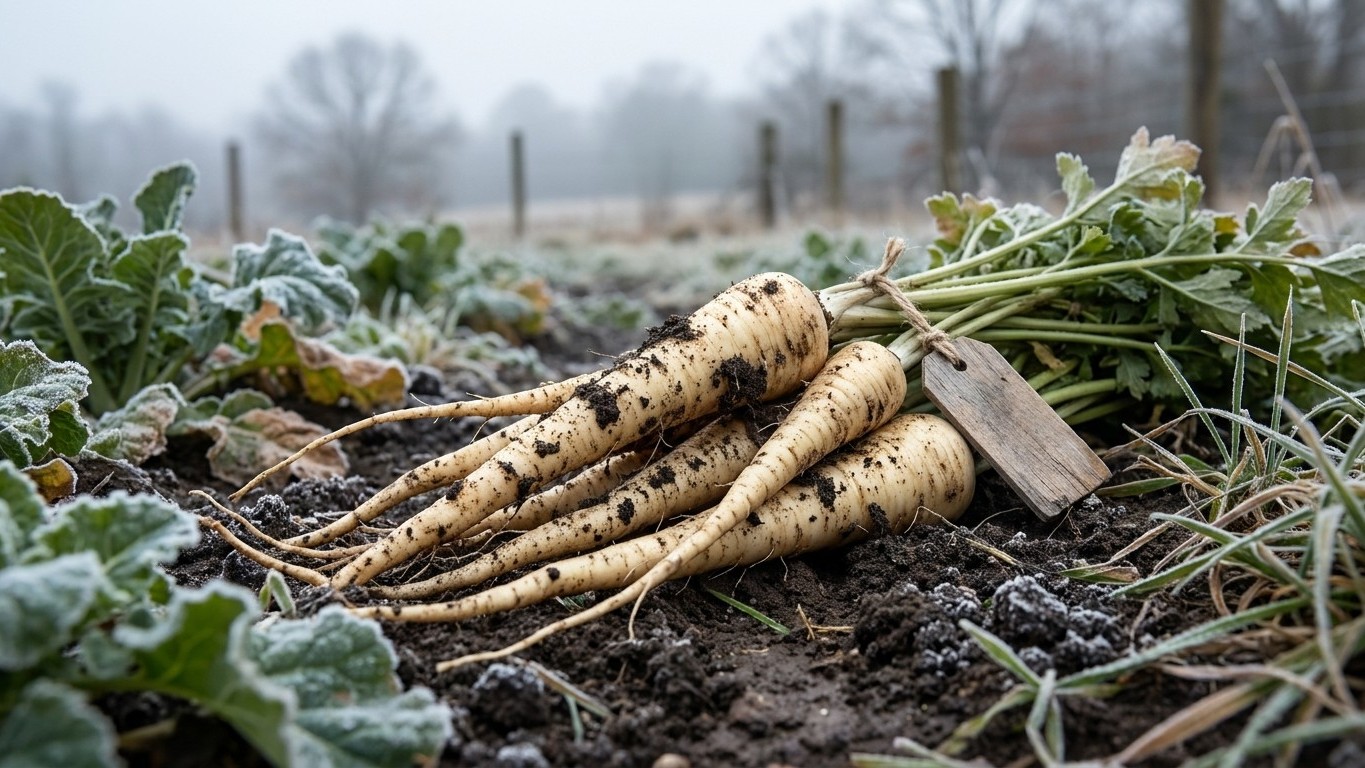

Quebec’s answer is yes: the province delivers exactly the kind of cold that parsnips need to turn their stored starch into sugar. With a coldest-month average minimum of 6.7°F at the Montreal reference station, this isn’t a place where winter merely dips below freezing once or twice. It’s a place with weeks of hard cold, which is the mechanism that makes a parsnip taste sweet instead of just starchy.
The short answer
The question that actually decides whether parsnips sweeten isn’t how mild or severe the hardiness zone label reads. It’s whether the ground and the air around the roots get several consecutive weeks of frost exposure before you dig them up. That distinction matters because a “zone 6” garden somewhere with a wet, mild December can leave parsnips underground all winter without ever triggering the starch-to-sugar conversion, while a colder zone with a real, sustained frost period does the job reliably.
Montreal-area data from Environment and Climate Change Canada’s 1981-2010 Climate Normals puts the mean daily minimum for the coldest month at 6.7°F. That’s not a record low pulled from one unusual night. It’s the average low across the coldest month, which tells you that cold in Quebec isn’t a fluke, it’s the baseline. For a root vegetable that needs sustained chill rather than a single cold snap, that kind of consistency is exactly what pushes the sweetening process to completion.
According to Utah State University Extension’s guidance on growing parsnips, the crop needs several weeks of cool, frosty weather after it reaches maturity, and that exposure is what converts the starch stored in the root into sugars. A parsnip pulled straight from warm soil in September tastes like a bland, faintly bitter carrot. The same root left in frosty ground through October and into November develops the nutty sweetness gardeners actually grow the crop for. Quebec’s cold season isn’t marginal for this. A coldest-month average minimum of 6.7°F represents weeks below freezing, not an occasional frost that thaws out by noon.
So the short answer holds up under scrutiny: yes, parsnips will sweeten here, and they’ll do it more reliably than in a lot of warmer regions where growers have to time everything perfectly to catch even a short cold stretch. The bigger question for a Quebec garden isn’t whether the cold arrives. It’s whether the growing season is long enough to get a mature root in the ground before that cold shows up, and whether the local soil sets the roots up to grow straight instead of forked. Both of those depend on timing and preparation, not on the climate’s cold credentials, which are already solid.
Does the season fit?
Parsnips need 100 to 120 days from seeding to maturity, and Utah State University Extension recommends sowing them 2 to 3 weeks before the last expected frost. Matching that timeline against Quebec’s frost dates shows a season that fits with real room to spare, not a tight squeeze.
- Start with the sowing window. The mean last spring frost at the Montreal-area reference station falls around May 6. Sowing 2 to 3 weeks ahead of that puts seed in the ground somewhere in the last third of April, even though the soil there is still cool and the ground hasn’t fully warmed.
- Account for slow germination. Parsnip seed is notoriously slow to sprout, typically taking 14 to 21 days. A grower who sows in late April may not see a single seedling until mid-May, and pulling up the row to re-sow because “nothing’s happening” is the single most common way home gardeners sabotage a parsnip bed before it’s even started.
- Count forward to maturity. From a late-April sowing, 100 days lands around early August, and 120 days lands around mid-August. That’s when the root has reached full size and is ready for the sweetening phase, not for pulling.
- Check the buffer against the first fall frost. The mean first fall frost at the same station falls around October 5. Between a mid-August maturity date and an October 5 frost sits roughly seven to eight weeks, and that stretch is exactly what allows for several frosty weeks of exposure before harvest rather than just one or two.
- Read both frost dates as averages, not guarantees. These are mean dates from Environment and Climate Change Canada’s 1981-2010 Normals for the Montreal/St-Hubert station, meaning frost arrives later than that first-fall date in about half of all years, and earlier in the rest. A grower in the Laurentides or in a colder inland district north of Montreal should expect both frost dates to run earlier than the reference station shows.
Taken together, this is a season that fits comfortably rather than tightly. There’s enough runway between the recommended sowing date and the first fall frost to cover germination, full maturity, and several additional weeks of cold exposure afterward, which is the exact sequence the crop needs to reward the wait with sweetness.
What goes wrong here
- Forked or forked-looking roots from heavy, stony ground. The St. Lawrence lowlands around Montreal carry a lot of clay-heavy soil, and a parsnip root pushing down through compacted or rocky ground will split around any obstruction instead of growing straight. Utah State University Extension recommends deep, sandy soil for this crop, and where that isn’t the native condition, double digging the bed to loosen and de-stone it 12 to 18 inches down is the fix, not switching varieties.
- Forked roots from overwatering. This is a separate cause from soil texture, and it’s easy to mix the two up. Excess water, especially uneven watering that soaks the bed after a dry stretch, encourages the root to branch rather than grow as one long taproot. The remedy is steady, moderate moisture rather than a heavy soak-and-forget cycle, particularly during the first several weeks after germination.
- A season that runs out before maturity. This isn’t the typical Quebec problem given the roughly seven to eight week buffer built into the calendar above, but it becomes a real risk if sowing gets delayed past late April, or if germination is unusually slow in a cold, wet spring. Sowing promptly within the 2-to-3-week window before the mean last frost, rather than waiting for warmer soil, keeps the full 100-to-120-day cycle inside the safe part of the year.
- A winter too mild to sweeten. This is genuinely not a Quebec risk given a coldest-month average minimum of 6.7°F, but it’s worth naming because it’s the flip side of the whole equation: a root pulled the moment it reaches size, before any real frost exposure, will be mature but flavorless. The fix here isn’t climate-related at all, it’s patience. Leave the roots in the ground through several frosts after they’ve reached maturity before harvesting, since the sweetening happens after the growing is done, not during it.
Common questions
Can I sow parsnips directly in Quebec, or do I need to start seedlings indoors?
Parsnips are sown in place. Utah State University Extension’s guidance treats direct seeding as standard practice for this crop, since parsnip taproots don’t transplant well once disturbed. Plan the sowing date around 2 to 3 weeks before the mean last frost rather than starting trays indoors.
How long should I leave parsnips in the ground after the first fall frost?
The published guidance calls for several weeks of frosty weather after maturity to convert the stored starch to sugar, but it doesn’t give an exact number of days. Rather than fixing a date, watch for a stretch of repeated cold nights following the October 5 mean frost date before pulling the crop.
Why didn’t my parsnip seeds sprout after two weeks?
That’s normal. Germination for this crop runs 14 to 21 days, which is unusually slow compared to most garden vegetables. Digging up the row and re-sowing before three weeks have passed is one of the most common reasons Quebec gardeners end up with a patchy or missing crop.
Does the type of soil in my part of Quebec change any of this?
It changes the risk of forked roots, not the sweetening outcome. Heavy or stony soil, common across parts of the St. Lawrence lowlands, needs double digging to loosen it 12 to 18 inches down. The state of the soil described here is a starting point for preparation, not a diagnosis of whether parsnips will grow at all.