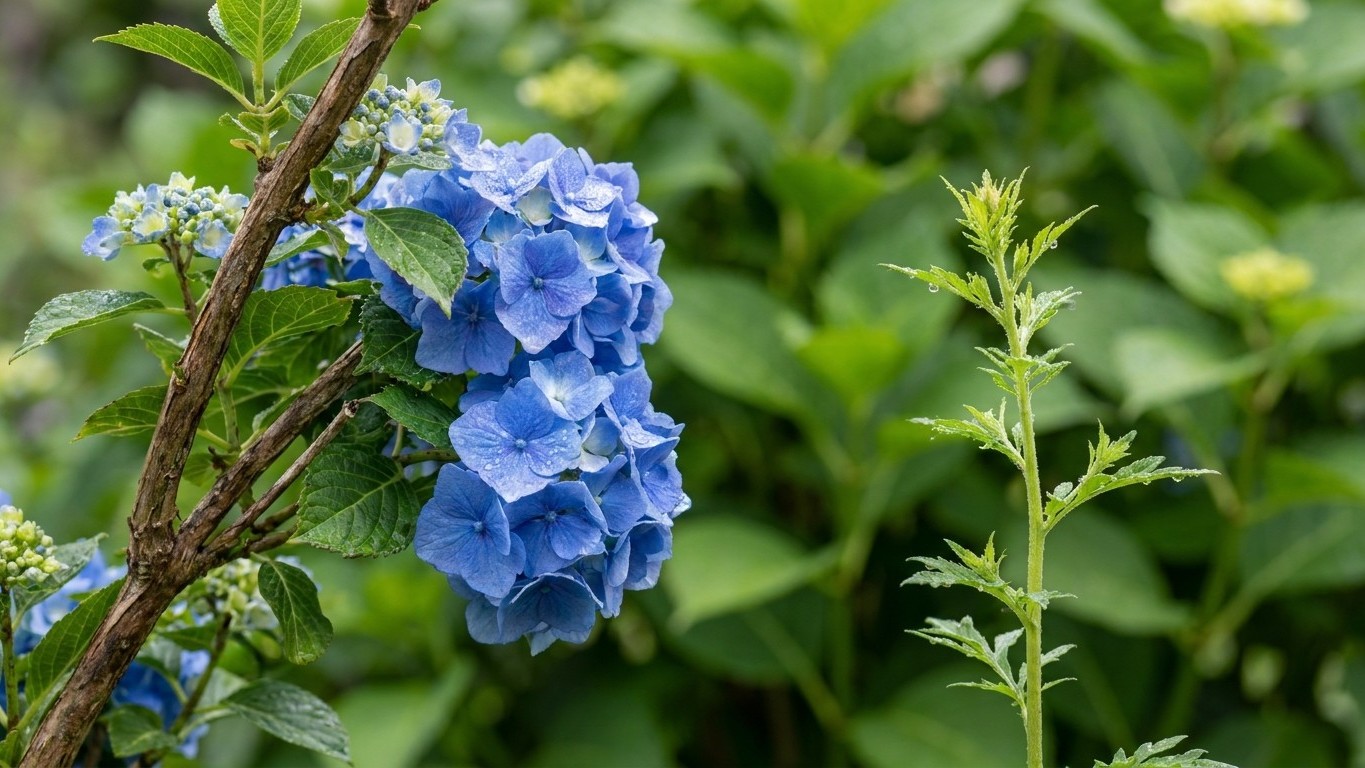

Most hydrangeas in Quebec get through winter without help. The ones that need it are bigleaf and oakleaf types, whose flower buds sit on last year’s stems. A mound of mulch at the base, a loose cage of leaves or burlap around the stems, and some patience in spring cover nearly every case. Panicle and smooth hydrangeas take most of the cold in stride. For planting and care outside winter, start with growing hydrangeas in Quebec.
What this comes down to in Quebec

At the Montréal/St-Hubert station, the mean last spring frost falls on May 6 and the mean first fall frost on October 5, so a hydrangea has to be treated as exposed from early October until at least early May. Both dates are means from Environment and Climate Change Canada’s climate normals. In one year out of two the first frost comes earlier than October 5, and in one year out of two the last frost comes later than May 6. Read each date as the middle of a window.
The station has about 150 frost-free days between those two dates. The other seven months or so belong to the cold, and that is the stretch your shrubs have to survive. Montreal sits mostly in Canadian hardiness zone 5b, with some pockets in 6a, according to Natural Resources Canada. That is a Canadian zone, built from seven climate variables, and it does not convert to a USDA zone.
Which hydrangeas need winter protection in Quebec?
It depends on where the flower buds form. A shrub that blooms on old wood carries next summer’s flowers through the winter on its stems. If those stems freeze, you lose the bloom. A shrub that blooms on new wood grows its flowers after spring, so a hard winter costs it height rather than flowers.
| Type | Flowers form on | Winter protection |
|---|---|---|
| Bigleaf (macrophylla) | Old wood, and new wood on reblooming types | Mulch plus a cage or wrap |
| Oakleaf (quercifolia) | Old wood | Mulch, wrap in exposed spots |
| Panicle (paniculata) | New wood | Mulch for young plants only |
| Smooth (arborescens) | New wood | Little or none once established |
When does winter protection go on?
Later than most people think. Apply it after the leaves have dropped and the ground has started to freeze, usually several weeks after the first fall frost. Mulch piled on warm soil gives mice and voles a cozy place to nest.
Working it out for your own garden
The method matters more than any single date, because a cold year or a move to a different part of the province shifts everything. Begin with the reference window and adjust it for your own ground. Use it as your signal to have materials in hand, not to start wrapping. Gather leaves, burlap, stakes and mulch while the weather is still mild.
How do you time winter protection for your own garden?
Work from the ground, not the calendar. Water deeply through the fall until the soil begins to freeze, because dry roots suffer more in winter than wet ones. Wait for the leaves to drop. Then mound mulch or shredded leaves around the base, and add a cage of chicken wire or stakes filled loosely with dry leaves for old-wood types. Check your own frost window in a local weather record before you decide when to start. A garden on a sheltered lot in the south of the province may be ready weeks before one on a windy hill.
Spring runs the same way in reverse. The mean last frost of May 6 means half of all years bring a frost after that date. Take covers off in two steps. Open the cage first, then remove the mulch from the crown as buds swell, and keep burlap handy for any cold night once leaves appear.
Take a bigleaf cultivar like ‘Nikko Blue’, which blooms on old wood. Its buds are already formed by fall, so a dead stem tip means a lost flower. Compare ‘Limelight’, a panicle that blooms on new wood. It can lose its stem tips entirely and still flower that summer. The first deserves a cage every year. The second needs protection only in its first winters.
How can you tell what hurt a hydrangea in spring?
Wait until the shrub should have leafed out, which is often late May. Scratch a stem with a thumbnail. Green underneath means it is alive, and brown and dry means it is dead. Healthy stems with no leaves usually just need more time. Stems chewed clean around the base point to voles or rabbits working under the snow. Dry, browned buds on stems that are otherwise alive point to winter wind or cold. Blackened new shoots after leaf-out point to a late frost.
What changes across the province
Quebec is not one climate. The Montréal/St-Hubert numbers describe the St. Lawrence lowlands, and most of the province runs colder. Moving north, the season shortens and winters last longer. A garden in the Saguenay or the Abitibi can see its last spring frost weeks after Montreal’s, and its first fall frost weeks before. Hydrangeas there often get by as cut-back perennials, with old-wood types struggling to flower at all.
Elevation does the same job over a shorter distance. Hills in the Laurentians, the Eastern Townships and the Gaspé run colder than the valleys beside them, and cold air settles into low pockets on clear nights. Distance from the St. Lawrence matters as well. The river and its estuary take the edge off the coldest nights close to the water, while inland sites swing harder in both directions.
Snow cover may be the biggest hidden variable. A deep, steady blanket insulates the base of a shrub far better than any wrap, and regions with reliable snow can get away with less protection low on the plant. Where thaws strip the snow and then temperatures crash, the same shrub is more exposed. That pattern is common in the south. City lots also run warmer than open fields, thanks to pavement and buildings.
The mistakes Quebec winters punish
The first is mulching early. A warm spell in October invites gardeners to bank leaves around the base, and rodents move in for the winter. Wait for the ground to cool and the leaves to fall.
Pruning old-wood types in fall is the second. Bigleaf and oakleaf hydrangeas set buds on last year’s stems, and cutting them removes next summer’s bloom. Prune them right after flowering, and leave panicle and smooth types until early spring.
Wrapping in plastic is the third, and a common one. Plastic traps moisture and heats up on sunny days, then drops back to freezing at night. Use burlap or a cage of dry leaves, which breathe.
Uncovering too soon comes fourth. A run of mild days in April tempts people to strip everything off, but the mean last frost does not arrive until May 6, and in half of all years it comes later. Open the cage gradually and keep covers ready.
The fifth is late planting. A shrub planted late in the fall has had little time to root, so mulch it more thickly and water it well before the ground freezes.
Checking this against your region
The dates above come from one station near Montreal, so treat them as a starting point rather than an instruction. Quebec has no county extension offices in the US sense, so check Environment and Climate Change Canada’s data for the weather station nearest you, and ask a local horticultural society about winter conditions in your area. The Ministère de l’Agriculture, des Pêcheries et de l’Alimentation du Québec mainly serves commercial agriculture, so a horticultural society is usually the better first call. Local gardeners can tell you how much your valley, hillside or river lot differs from Montreal.
Common questions
Do I need to protect hydrangeas in Quebec every winter?
Old-wood types such as bigleaf and oakleaf do, if you want flowers. Established panicle and smooth hydrangeas usually do not, though young plants benefit from mulch for their first winters.
Is Montreal’s hardiness zone the same as a USDA zone?
No. Montreal is mostly in Canadian zone 5b (some areas map as 6a), and the Canadian and USDA systems are built differently, so the zones do not convert simply. Use the Canadian zone when you read Quebec plant tags.
When should I take winter protection off?
Do it in stages as spring warms. The mean last frost at the reference station is May 6, but half of all years bring a frost after that date. Open the cage and pull back mulch gradually, and keep burlap on hand for cold nights.
My hydrangea has no leaves in May. Is it dead?
Not necessarily. Many hydrangeas leaf out late. Scratch a stem with your thumbnail, and if it is green underneath, wait. Cut only what is clearly dead, and give the plant until early June before deciding.