
Seed squash into cold Quebec clay in the first week of May and most of it just sits there and rots, no matter how good the germination rate printed on the packet. The frost-free window here runs, on average, from May 6 to October 5, which is plenty of days for any summer squash type once the soil itself has actually warmed. Wait for warm soil rather than the calendar date, and favor a fast bush type if your plot sits north or uphill of Montreal.
The short answer for Quebec
Every summer squash type clears this territory’s season with room to spare, so days-to-maturity is not really the decision. Environment and Climate Change Canada’s 1981-2010 normals for station MONTREAL/ST-HUBERT A put the average last spring frost at May 6 and the average first fall frost at October 5. Counted from one mean to the other, that is roughly 152 frost-free days in an average year. Even the slowest bush summer squash types, the ones seed catalogs list at 60 to 65 days from direct seeding to first harvest, still leave close to three months of picking after the first fruit sets. Nothing about squash maturity time is the limiting factor here the way it is for a full-season winter squash or a late tomato.
What actually separates one summer squash choice from another in Quebec is disease pressure and how the plant handles a wet start followed by a humid August. That is a decision about type, not about racing the calendar.
Matching type to the season
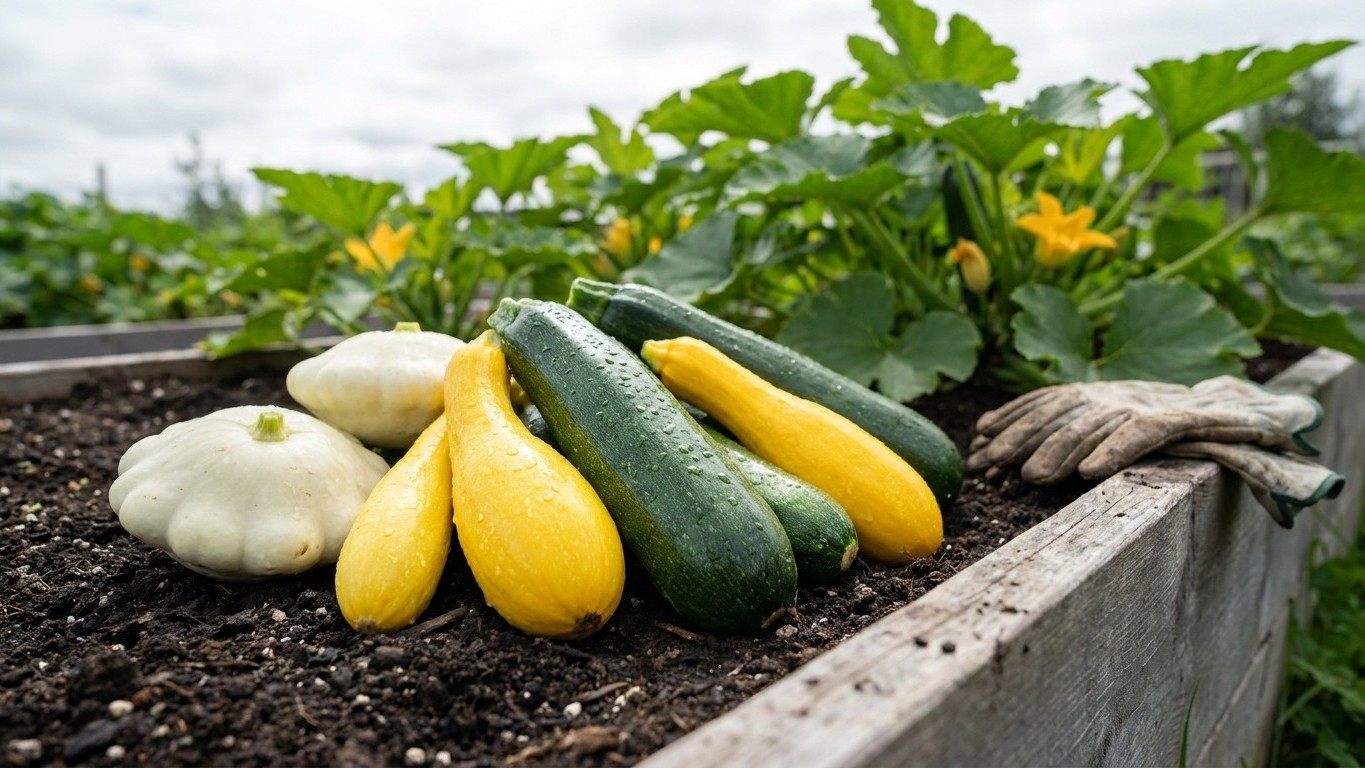
Zucchini, yellow crookneck, yellow straightneck and pattypan (also called scallop squash) are all bush-habit plants that stay compact and productive without needing a long vine to ramble, which suits a shorter northern season where garden space and warm days both come at a premium. The table below gives the maturity ranges most seed catalogs quote for each type, counted from direct seeding rather than from transplant.
| Type | Typical days to maturity | Appearance | Main risk in Quebec |
|---|---|---|---|
| Zucchini | 45-55 days | dark green, straight, cylindrical | powdery mildew by late summer |
| Yellow crookneck | 50-60 days | curved neck, bumpy yellow skin | rot in cold, wet spring soil |
| Yellow straightneck | 50-55 days | straight, smoother yellow skin | powdery mildew by late summer |
| Pattypan/scallop | 50-60 days | round, scalloped edge, pale green or yellow | slow early growth in cool soil |
Because the frost-free window itself is only a mean, half of all years run later than October 5 and half of all years the last frost lands after May 6. That margin matters more for timing the sowing date than for choosing among these types, since none of them come close to needing the full 152 days. For the exact window and how to hedge against a late spring frost, see When to Plant Summer Squash in Quebec.
Natural Resources Canada’s Plant Hardiness Site puts the reference city of Montreal at zone 5b under the Canadian system, using 1991-2020 normals. That zone number describes winter severity and matters for perennials, not for an annual crop like summer squash, but it is a fair shorthand for how short and how mild the whole growing season runs here compared with points further south.
What will not work here

This page assumes you have already read Growing Summer Squash in Quebec for the basics of hills, spacing and watering. What follows is specific to what actually goes wrong in this territory’s numbers, not general squash advice.
Seeding by the calendar instead of the soil
The single most common failure is direct-seeding squash right on May 6 because that is the average last frost from Environment and Climate Change Canada’s Montreal/St-Hubert A normals. An average is not a guarantee. In roughly half of all years the last frost falls later than that date, and squash seed sitting in soil that is still cold and wet does not just wait patiently. It rots. A seed that fails to germinate within a week or two in cold ground is gone, and there is no way to tell from the surface until you dig it up and find mush. The safer read of the same normal is to treat May 6 as a midpoint, not a target, and to check the soil itself before committing seed to it.
Humidity and a wet start
Environment and Climate Change Canada’s 1981-2010 normals for Montreal/Pierre Elliott Trudeau Intl A put summer rainfall at about 269 mm (10.6 inches) across June, July and August, with June the driest of the three months at 87 mm (3.42 inches). That is not a drought pattern. Combined with the humidity that follows a wet June, it is exactly the setup that favors powdery mildew moving through a squash planting by late summer, especially where plants are set closer together than the type wants to conserve space. Tight spacing that might get away with it in a drier climate invites mildew here once the canopy closes and air stops moving through it.
Chasing extreme heat that rarely comes
Montreal/Pierre Elliott Trudeau Intl A averages only 2.8 days a year reaching 32°C, per Environment and Climate Change Canada’s normals, and about 9.3 days a year above 30°C. That is a low count of scorching days, but it does not mean summer squash struggles for heat here. Squash is not the same as a slow-ripening paste tomato needing sustained heat units. It sets fruit readily across a normal Quebec summer’s temperatures, and treating those low extreme-heat counts as a reason to expect poor yields is the wrong read of the number. What actually limits yield in a hot dry stretch is watering, not the plant’s tolerance for heat.
What changes across Quebec
Every figure on this page comes from stations near Montreal, and Quebec is not one climate. Natural Resources Canada’s hardiness zone map puts the reference city at 5b under the Canadian system, built from seven climate variables rather than the single-variable USDA scale, and that zone number applies to Montreal specifically, not to the province as a whole. NRCan’s own comparison work makes the point directly: a single Canadian zone number can overlap several USDA zones, so it should never be read as interchangeable with hardiness figures from a US-facing garden guide.
A garden in the Laurentians, in the Gaspé, or at real altitude anywhere in the province sits in a colder zone than Montreal and should expect a shorter practical window than the frost dates given here. The safe adjustment for a colder district is to lean on the fast end of the maturity ranges in the table above and to push the sowing date later rather than earlier, since a late frost costs a colder garden more than it costs Montreal. A garden in the Montérégie or along the milder stretch of the St. Lawrence valley may run slightly ahead of these Montreal normals in spring warmth, though ECCC does not publish a single figure that covers the whole province at once.
None of this changes the type decision much, since even a compressed northern season still comfortably fits a 45 to 60 day bush squash. It changes the sowing date and the margin for error, not the crop’s viability. A reader unsure which zone their own garden falls into should check Natural Resources Canada’s Plant Hardiness Site directly rather than guess from a regional label, since the zone is assigned by location, not by province-wide averages.
Where to check this for your own county
Everything above is built from two stations near Montreal, and a state-level or province-level page like this one is a starting point, not a substitute for a local recommendation. Quebec’s Ministère de l’Agriculture, des Pêcheries et de l’Alimentation publishes provincial guidance at mapaq.gouv.qc.ca, and that is the right next stop for anyone gardening outside the immediate Montreal area.
Once there, look specifically for two things. First, any regional or MRC-level planting calendar that adjusts sowing and transplant dates for your part of the province, since a garden in the Bas-Saint-Laurent or the Abitibi region runs on a meaningfully different calendar than Montreal’s. Second, any list of squash varieties actually trialled at a regional research station or through a local demonstration garden, since a variety proven in your own county’s growing conditions beats a type recommendation made at the provincial level every time. This page reasons from Montreal-area climate normals applied across the whole province. A county-level source reasons from what actually grew there.
If your municipality or MRC runs its own horticultural extension line or a master gardener program through a local CLD or agricultural office, that contact is worth more than any provincial web page for questions specific to your soil and your microclimate. MAPAQ’s own site is the correct starting point for finding those regional contacts, since a single provincial ministry page cannot list every county-level resource directly.
Checking this against your own garden
The most reliable measure of readiness is not a date on this page. It is what the garden itself is doing, and three signs are worth checking by hand before committing squash seed to the ground.
- Soil warmth by feel: push a bare finger two inches into the planting bed in the morning. Soil that still feels cold to the touch, even if the air warmed up the afternoon before, is telling you the ground has not caught up with the calendar yet.
- The first male flowers: squash plants typically open several male flowers, on long thin stems, before the first female flower appears with a small swollen bulge at its base. Seeing only male flowers for a week or two is normal and not a sign of failure.
- True leaves, not just the seed leaves: the first two rounded leaves a squash seedling pushes up are seed leaves, not the plant’s real foliage. Wait for the next set, the ones with the jagged, true squash-leaf shape, before judging whether growth is on track.
A garden that runs warmer or colder than these Montreal-area normals will show it through these three signs well before any date on a page could confirm it. Soil that stays cold into late May, or male flowers that never give way to female ones, says more about your own plot’s microclimate than any provincial average ever will.