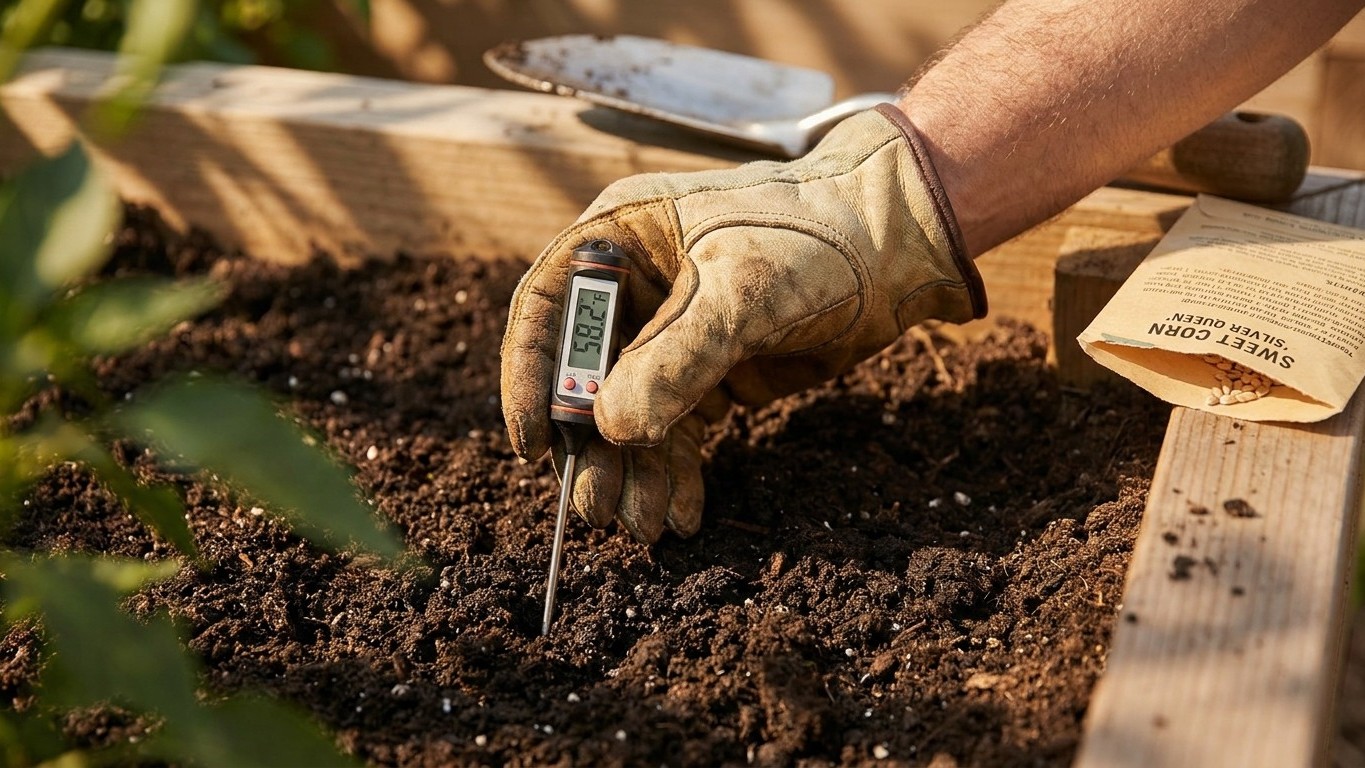

The dates that matter for sweet corn in Quebec aren’t frost dates. They’re soil temperature and the calendar days left before autumn frost returns. Soil here typically climbs above 60°F well after the last spring frost has passed, and once it does, a grower has roughly 60 to 90 days to work with before the season closes. Getting the order of these two triggers right, soil warmth first, days-to-maturity second, is what separates a good ear count from a disappointing one.
The short answer
Sweet corn seed doesn’t care what the thermometer says on a sunny afternoon. It cares what’s happening a few inches down, in the soil itself, and soil warms on its own schedule, lagging well behind air temperature. The mean last spring frost at the Montreal/St-Hubert A reference station falls around May 6, according to Environment and Climate Change Canada’s 1981-2010 climate normals. That date tells a grower when the air has typically stopped freezing. It does not tell anyone when the soil has warmed to the 60°F sweet corn needs to germinate without rotting in the ground.
There’s no published soil-temperature date for this station to hand over here, so the honest answer is that it isn’t officially tracked the way frost dates are. What can be said with confidence is the mechanism: soil is slower to respond to spring than air is, so the point where beds cross 60°F sits noticeably later than May 6, usually stretching into the back half of May in most seasons, and later still after a cold, wet spring. A grower who plants the week the frost risk clears is very likely planting into soil that isn’t ready yet.
On the other end of the season, the mean first fall frost at the same station lands around October 5. Both of these dates are averages, not guarantees. In roughly half of all years, the actual frost, spring or fall, comes later than the mean; in the other half, it comes earlier. Treat May 6 and October 5 as the midpoint of a moving window, never as a locked-in safe date.
Do the arithmetic from a realistic planting point, sometime after soil has caught up to 60°F, and the frost-free stretch that follows still leaves a workable runway for a 60-to-90-day crop in most years. One more detail worth folding in: this station averages zero days a year at 90°F or above. That’s a useful marker of how little heat surplus this climate carries. Corn planted here doesn’t get pushed along by stretches of scorching weather the way it might farther south, so a variety’s stated maturity window should be taken at face value rather than assumed to run faster.
Does a late variety fit here?
Not every sweet corn variety is built for the same length of season, and in a territory where the growing window is bounded on both ends by mean dates that can shift, the gap between a 60-day type and a 90-day type stops being a minor label difference and starts being the whole decision.
A 60-day variety
Counting from a planting date that falls after soil has genuinely warmed, a 60-day variety reaches maturity with a wide cushion before the mean first fall frost around October 5. Even in a year where soil warm-up runs later than usual, or the fall frost arrives ahead of its average date, there’s enough slack built into 60 days that this length of variety fits the territory reliably. It’s the safer bet for a grower who wants consistency year after year rather than gambling on a warm autumn.
A 90-day variety
A 90-day type is a tighter fit. Push planting into a cool, slow spring, and the extra month of maturity time eats directly into the buffer that would otherwise sit between harvest and the first fall frost. Add in the fact that this climate carries essentially no surplus heat, zero days a year averaging 90°F or higher, and there’s nothing pushing a 90-day variety to finish ahead of schedule the way it might in a hotter growing region. Combine a late soil warm-up with an early fall frost, both of which happen in roughly half of all years by definition, and a full 90-day variety can be caught before it fully matures. It isn’t that a 90-day variety is impossible here. It’s that it doesn’t reliably fit every year, and a grower choosing one should treat it as the higher-risk option rather than the default.
What goes wrong here
- Soil sown too cold. Planting on or right after the mean frost date, rather than waiting for the soil itself to warm past 60°F, is the single most common misstep. Cold, wet soil rots seed before it can germinate, or produces a thin, uneven stand. The remedy is patience: let soil temperature, not the frost date, decide the planting day, and accept that in this territory that point comes noticeably after the air has stopped freezing.
- A variety too late for the season. Choosing a 90-day type and then planting it late, after a slow, cold spring pushes the calendar back, leaves too little runway before the mean first fall frost returns in early October. The remedy is matching variety length to actual planting date each year: lean toward a 60-day type by default, and reserve longer-season corn for years when soil warms early.
- Sweetness lost to a neighbor, not the climate. This one has nothing to do with Quebec’s weather. Standard (su), sugary-enhanced (se), and supersweet (sh2) sweet corn types cross-pollinate freely, and if two types tassel at the same time nearby, the resulting kernels lose the sweetness the variety was bred for. The remedy is timing, not distance: plant only one type per season, or stagger plantings so the types never tassel together, and grow each type in blocks of three or more rows rather than a single thin row, so pollination stays reliable within that type.
Common questions
Can I use the last frost date to decide when to plant sweet corn?
Not on its own. The mean last spring frost near May 6 tells a grower when air temperatures typically stop freezing, but soil warms more slowly than air. Sweet corn needs soil above 60°F, and that point comes after the frost date, sometimes well after it in a cold spring.
What happens if I plant sweet corn before the soil is warm enough?
Seed sitting in soil below 60°F is prone to rotting before it germinates, and any seedlings that do emerge tend to be weak and uneven. Waiting for soil to actually warm, rather than planting by the calendar, avoids this.
Does a 90-day sweet corn variety have enough season in Quebec?
It’s workable in a favorable year, when soil warms early and the fall frost holds off past its mean date near October 5, but it’s a narrower margin than a 60-day variety and can be caught by an early frost in a less favorable year. A 60-day type is the more reliable choice.
How do I keep sweet corn varieties from cross-pollinating?
The issue is timing, not spacing: su, se, and sh2 types lose their sweetness if they tassel at the same time. Grow one type per season, or stagger planting dates so tasseling doesn’t overlap, and plant each type in blocks of three or more rows for good pollination.