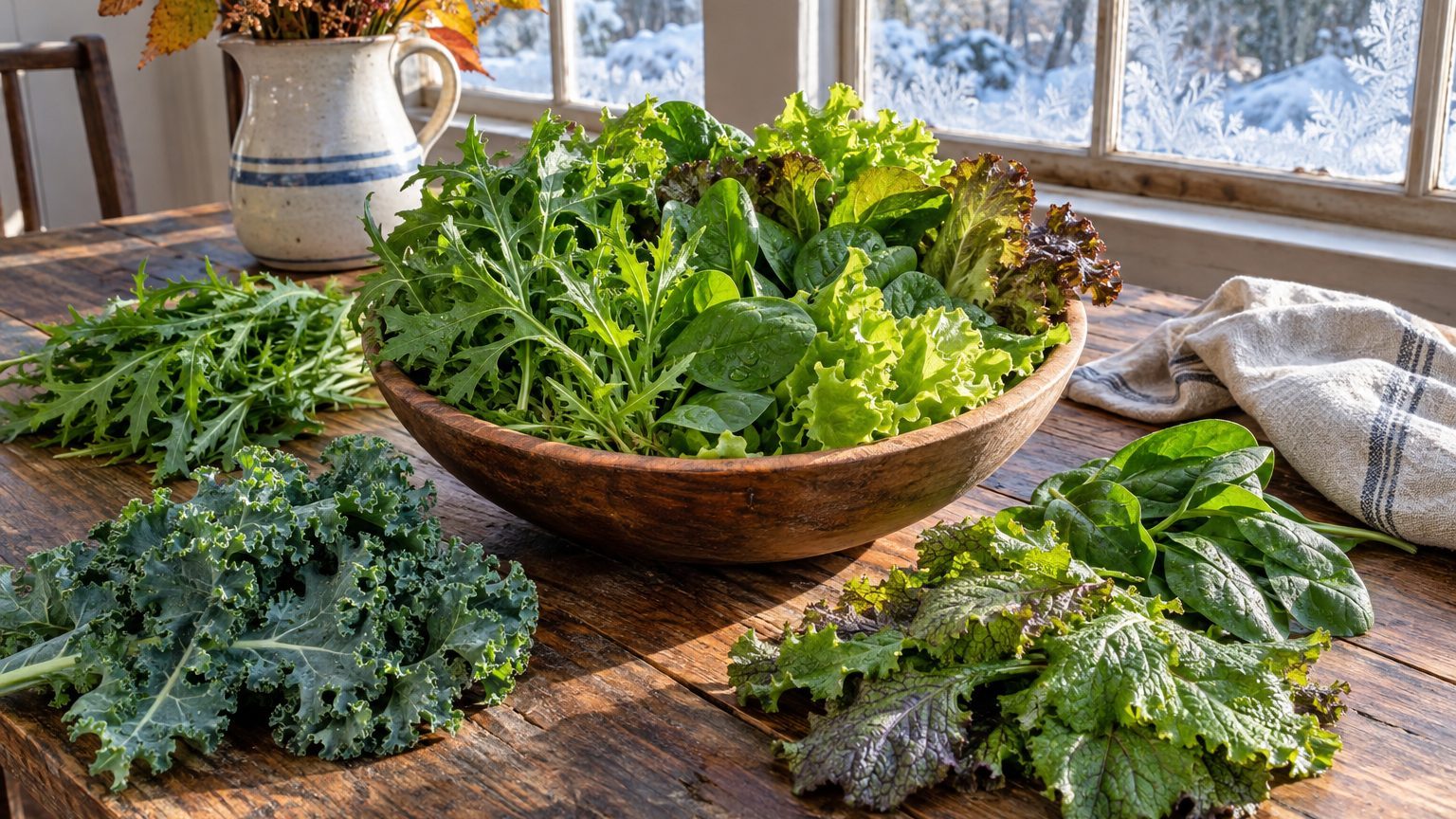

The best winter salads for Quebec are the hardiest leaf crops: mâche, spinach, claytonia and kale. Mizuna, tatsoi and winter-type lettuce make a second tier that needs a cover. Heading chicories and summer lettuce rank last. A short, cold season rewards fast, frost-tolerant greens sown in late summer and then sheltered under a cold frame or low tunnel. Here is how to choose by type.
The short answer for Quebec
Which winter salad types suit Quebec’s season?
Choose by hardiness first and flavor second. Mâche (also called corn salad or lamb’s lettuce), claytonia and spinach take cold better than anything else in the salad bowl, and they keep going under a simple cover when the ground is frozen outside. Kale sweetens after frost and works as a baby-leaf salad green. Mizuna, tatsoi and arugula grow quickly and shrug off light frost, but they need more protection once nights turn hard. Winter-type lettuces, bred to stay compact and tolerate cold, belong under a cover too.
| Type | Examples | Role in a Quebec winter garden |
|---|---|---|
| Hardiest | Mâche, claytonia, spinach, kale | The backbone of the winter harvest, grown under a cold frame or tunnel |
| Fast and cold-tolerant | Mizuna, tatsoi, arugula | Quick fall crops, picked while days are still long enough for growth |
| Protected only | Winter-type lettuce | Reliable inside a cold frame or unheated greenhouse, shaky outdoors |
| Poor fit | Heading chicories, summer lettuce | Need a long, mild fall to finish |
How much growing time do winter salads get?
The Montreal/St-Hubert reference station has about 152 frost-free days between the mean last spring frost (May 6) and the mean first fall frost (October 5). Both are mean dates, so in one year out of two the last frost falls after May 6 and in one year out of two the first frost arrives before October 5. Treat each date as the middle of a window. Canadian normals also cover 1981-2010, so a recent year may run a little differently.
Winter is the other half of the answer. The mean daily minimum of the coldest month is -14.1 °C (6.7 °F), and colder nights come in most winters. Only the toughest greens survive that, and only with a cover. For sowing windows, see When to Sow Winter Salads in Quebec.
What will not work here

Slow crops sown late fail first. Once October arrives, days are short and light is weak, and growth drops sharply. A spinach or mizuna seedling still tiny at the first hard frost will sit at that size for months and give very little to pick. A sowing meant for winter has to be well along by the time the first fall frost arrives, which can be earlier than October 5 in one year out of two.
Heading chicories such as radicchio and many escarole types need weeks of mild fall weather to form hearts. A season of about 152 frost-free days, followed by a steep drop into cold, rarely gives them that if they are sown after midsummer. Summer lettuce varieties fail for a different reason: they have no cold tolerance, and one hard freeze ends them.
Bare ground also lets people down. With a coldest-month mean minimum of -14.1 °C, unprotected beds go through repeated freezing and thawing. Greens rot where the soil stays soggy, and shallow roots heave. A snow blanket helps, but it comes and goes, and it is no substitute for a cover you control.
Covers cause trouble when they are sealed tight. On a sunny late-winter day, a closed cold frame heats up fast and cooks tender leaves. Humid air trapped inside also invites gray mold. Vent on mild days and close up again before dusk.
The spring end of the calendar has its own trap. The May 6 mean last frost says that frost still arrives after that date in about half of years, so hardy salads sown outdoors in spring are fine, but tender transplants set out on that date are not safe. The same logic applies to crops that bolt: arugula, spinach and mizuna sown in late spring run to seed when summer heat arrives, which is why the winter plan starts in late summer. Cool weather is what makes these greens good, and Quebec has plenty of it.
What changes across Quebec
The frost dates and the winter minimum above come from one station near Montreal, and the Canadian hardiness zone for that reference city is 5b. That zone belongs to Natural Resources Canada’s system, which is built on seven climate variables and does not convert to a USDA zone. NRCan itself says there are no simple conversions: Canadian zone 4a overlaps nine USDA zones, from 3a to 7a. Quebec is a huge province, so no single zone covers it, and the spread from the St. Lawrence lowlands to the northern and upland districts is wide.
Gardeners farther north or at altitude should shift everything earlier and lean harder on protection. Their fall frost comes weeks ahead of the Montreal mean, so sowings for winter harvest go in earlier in late summer. Their cold is deeper and lasts longer. The tender and the fast crops (lettuce, arugula, tatsoi) become risky even under a cover, while mâche, claytonia, spinach and kale hold up. A double layer, such as a low tunnel inside a cold frame, buys extra margin. Skip heading chicories altogether.
Closer to the river and in sheltered, low-lying southern districts, the season stretches a little. Even there, a hollow where cold air pools can be several degrees colder than a slope a few yards away, so small differences matter.
For the zone of your own town, use Natural Resources Canada’s plant hardiness map and look up your municipality. Read the zone as one number among several, and pair it with your local first-frost date. For the full set of varieties and methods, see Winter Salads for Quebec Gardens.
Where to check this for your own county
The provincial agriculture ministry, MAPAQ, is the place to start. Look for regional growing guidance, local frost dates and any advice on protected winter vegetable production. The details that matter most are the planting calendar for your area and the varieties that have been tried in your region or county, because a mâche or spinach that thrives near Montreal may behave differently in the Saguenay or the Gaspé.
A recommendation for your county or regional district beats a provincial one every time. Province-wide advice, including everything above, averages over very different climates. A local calendar reflects local frost, local soils and varieties that have survived local winters. If the ministry’s site does not carry a calendar for your area, regional gardening clubs and seed growers near you often do.
When a local source gives a sowing date, compare it with your own frost experience. If your first fall frost usually arrives earlier than the regional average, move your sowing earlier by the same margin.
Checking this against your own garden
Your own observations outrank every date above. Three are worth watching, and none needs equipment.
- Soil warmth by feel. Push your hand into the bed in the morning in late summer. Soil that still feels warm will make lettuce and spinach germinate poorly, so wait or shade the bed. Soil that feels cool and damp sprouts mâche and claytonia well. Beds that stay warm longest are your best spots for late sowings.
- The first true leaves. After the seed leaves, the first true leaves tell you a seedling is established. Count how many seedlings have them a few weeks before your usual first frost. If most have only seed leaves, they will probably stall, and next year’s sowing should go in earlier.
- Where frost shows first. On the first frosty morning, look at which corners of the yard are white and which stay clear. The white spots are the cold pockets, and tender greens do not belong there. A bed against a south wall that stays clear is your warmest and best site for a cold frame.
Write down the dates of what you see each year. After two or three seasons, those notes will tell you more than any reference station.
Common questions
What is the hardiest winter salad green for Quebec?
Mâche and claytonia are the toughest salad leaves, and spinach and kale are close behind. All four keep going under a simple cover when much else has stopped. Mâche grows slowly, so it needs an early sowing.
Can lettuce be grown through a Quebec winter?
Only winter-type varieties, and only under a cold frame or unheated greenhouse. In the open, lettuce does not survive a winter with a coldest-month mean minimum of -14.1 °C.
When is the last spring frost in Quebec?
At the Montreal/St-Hubert reference station, it falls on average on May 6, and in one year out of two it falls later. Northern and upland districts run weeks behind that station. Check your regional date before treating May 6 as safe.
Does the Canadian hardiness zone match a USDA zone?
No. Montreal is Canadian zone 5b, but the two systems use different variables and do not convert. Canadian zone 4a alone overlaps nine USDA zones, from 3a to 7a. When a Canadian seed catalog lists a zone, read it as a Canadian zone.