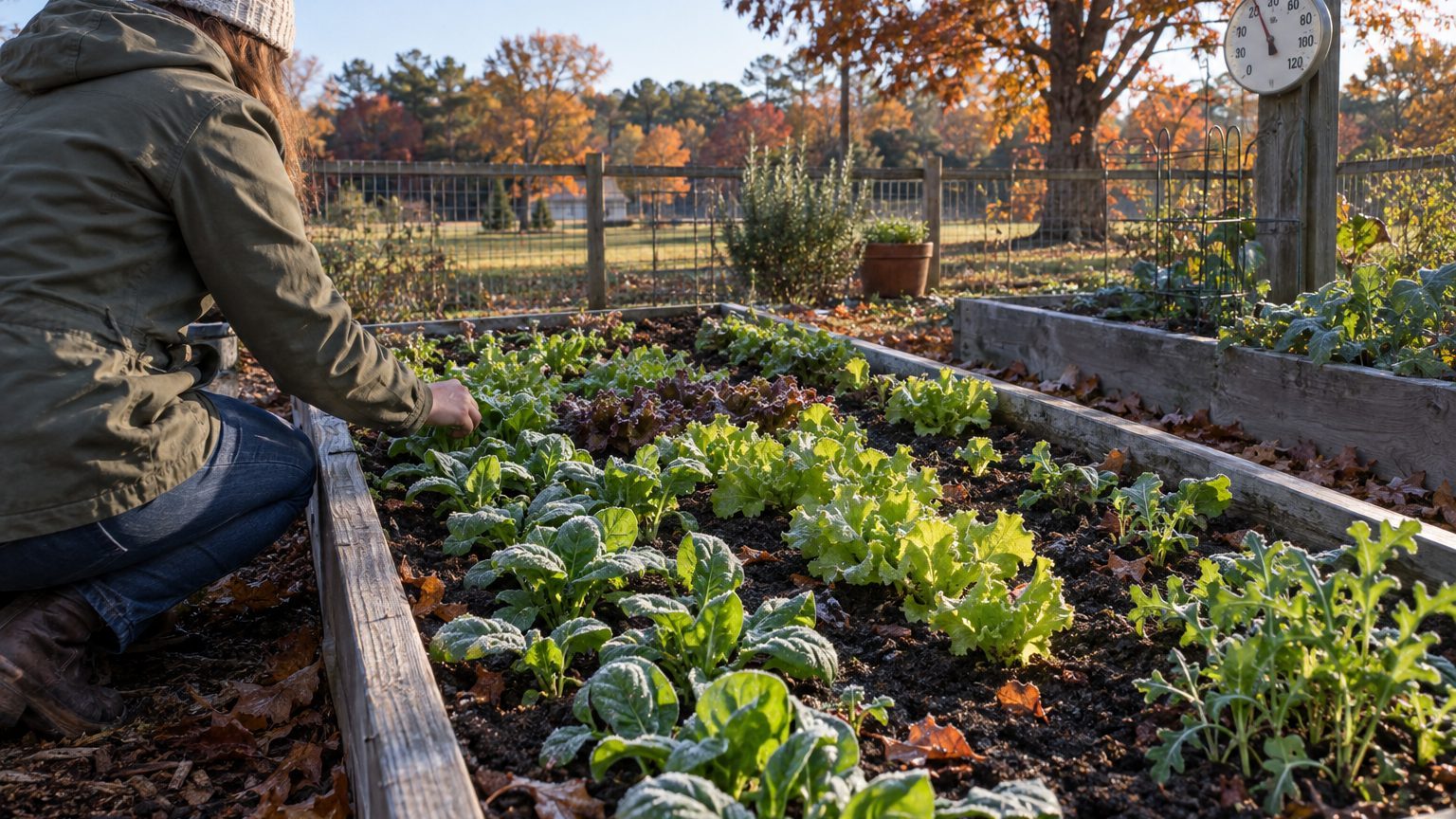

In Quebec, sow winter salads from mid-August to mid-September. Count back from a first fall frost that arrives on average October 5 at the Montreal/St-Hubert station. Hardy greens sown in that window reach harvest size before the light fades, and they sit through winter under cover, ready to pick.
The short answer for Quebec
Sow from mid-August to mid-September, with the fastest greens at the late end and the slowest at the early end. The two reference dates are May 6 for the last spring frost and October 5 for the first fall frost, both averages from Environment and Climate Change Canada’s 1981-2010 normals. Each is the midpoint of a window. In one year out of two the last spring frost falls after May 6, and in one year out of two the first fall frost arrives before October 5. Neither is a safe date. The station has about 152 frost-free days between those two dates.
Fall is the season that matters most for winter salads. After that, the plants mostly hold in place and you harvest what they put on in October. A sowing made too late gives you seedlings that sit through winter doing nothing.
When should each type of winter salad go in?
The windows below are for the Montreal area. Treat them as a starting range and adjust with the notes in the sections that follow.
| Type | Sowing window | Notes |
|---|---|---|
| Hardy lettuce | Mid-August to early September | Needs the most time to size up |
| Mâche (corn salad) | Late August to mid-September | Slow to sprout, very cold-tolerant |
| Spinach | Late August to mid-September | A late-September sowing can overwinter as small plants under cover |
| Arugula, mizuna, tatsoi | Early to mid-September | Fast growers, good for the late end of the window |
Which varieties of each type hold up best is a separate question, covered in The Best Winter Salads for Quebec. For the bigger picture of how winter growing works in the province, start at Winter Salads for Quebec Gardens.
What will not work here

Sowing in late September or October for a winter harvest fails. With the first frost arriving on average October 5, a seed sown that late has barely two true leaves when the days turn short. Cold keeps it alive, but it will not grow into anything you can pick before spring. Heading lettuces and big-leaved Asian greens are the first to fall short, because they need weeks of steady growth to reach a useful size.
Why do bare beds lose their salads?
The mean daily minimum of the coldest month is -14.1 °C (6.7 °F for readers comparing with US figures). That is an average, so individual nights run colder. Most winter salads can take a hard frost, but few come through repeated nights like that without protection. An open bed leaves tender lettuces and baby Asian greens frozen, then thawed, then rotted. Mâche and spinach tolerate more cold, yet they too do better under a cover than in the open.
Covers bring their own trouble. Snow load is real in Quebec, and a low hoop with light plastic can sag or collapse under a wet snowfall. Brush heavy snow off, or build the frame with closer hoop spacing so it holds the weight. A sealed cover on a mild, damp day is a different problem. Air gets trapped and the leaves stay wet, and that invites gray mold and mildew. Open the ends on days above freezing, even in December.
August brings the opposite failure. Soil in the sun can run warm enough that lettuce seed does not sprout well; check the soil temperature before sowing. Sow the row in the evening, water it, and shade it with a board or a sheet of burlap until the seedlings show. Mâche is even fussier about warmth and tends to sprout better once the weather cools.
Planting too thickly also hurts in a humid fall. Crowded leaves dry slowly, and a block of damp foliage under a cover is where rot starts. Thin to the spacing on the seed packet, even when the seedlings look healthy and the temptation is to leave them.
What changes across Quebec
Quebec is not one garden. The Canadian plant hardiness zone for the reference city is 5b, but that is the zone of one city, not of the whole province. The system is built on seven climate variables, and it does not convert to a USDA zone, so do not borrow a US number for it. Across Quebec the zones run from milder pockets near Montreal and along the St. Lawrence to much colder ones in the north and in the highlands, and no single answer covers all of them.
The first adjustment for a northern or upland garden is the calendar. Districts like the Laurentians, parts of the Eastern Townships, the Saguenay-Lac-Saint-Jean region, Abitibi and the Gaspé run weeks behind Montreal in spring. Fall frost tends to arrive earlier. So spring sowings move later, and fall sowings move earlier, so the August window becomes more like early to mid-August for the slowest types. How many weeks depends on your own site, which is why local observation matters (see the last section).
The second adjustment is in what you sow. A shorter fall leaves less time for slow growers, so lean on the quick types: arugula, mizuna, tatsoi, and mâche and spinach for cold hardiness. Hardy lettuce is a gamble in the far north unless it goes in the ground very early.
The third is protection. Where winters run colder than in Montreal, one layer of cover often is not enough. A second layer of row cover inside a hoop house can add extra shelter. A site sheltered from wind and facing south does more for a winter bed than a week of calendar adjustment.
To see where your own municipality falls, use Natural Resources Canada’s plant hardiness site. It lists the zone by municipality, and it is the right place to check before choosing a sowing date.
Where to check this for your own county
Quebec does not have counties in the American sense, so think in terms of your region or your MRC (regional county municipality). The provincial agriculture department, MAPAQ, is the place to start. Look for the regional office that covers your area, then ask or search for two things.
- A local planting calendar, ideally one built on frost dates from a station near you rather than Montreal’s.
- Vegetable varieties trialled in your region, with notes on cold tolerance and fall performance.
A regional recommendation beats a provincial one every time. A province-wide guide like this one has to average across places with very different seasons, and a gardener in Gaspé or Abitibi has a different growing year from one in the Montérégie. The dates above are a sound starting point, but a regional office or a local grower’s association can tell you whether your area runs two weeks behind, or three.
Local gardening clubs and farm-supply stores are also worth a visit. They often know which hardy greens people in the area have grown over winter and which ones failed. Ask what went into the ground in late August and how it did by December. That is the kind of detail no provincial average can give you.
Checking this against your own garden
Your own observations outrank every date here. Three things are worth watching, and none needs equipment.
Soil warmth by feel. In August, push your hand a couple of inches into the bed in the late afternoon. If it feels hot, lettuce and mâche seed will struggle to sprout, and the spot needs shade or a later sowing. If it feels pleasantly warm or neutral, go ahead. A bed that stays cool when the neighbor’s is hot is a good microclimate for late-summer sowing.
The first true leaves. The seed leaves come up first and look plain. The true leaves that follow have the shape of the mature plant. Note how many days that takes in your garden. If seedlings are still on seed leaves at the end of September, that sowing is too late for winter harvest at your site, and you should sow earlier next year.
The first white frost and the slowing of growth. Notice which part of the yard frosts first, and which stays clear longest. A low corner that whitens early is a cold pocket, so put your protected bed on higher ground or against a south-facing wall. Then watch the beds in early November. When new leaves stop appearing, your plants have reached their winter size, and you will know whether your sowing date gave them enough time.
Common questions
Can I still sow winter salads after October 5 in Quebec?
Not for a winter harvest. October 5 is only the average first fall frost, so about half of years bring it earlier. A late sowing of spinach or mâche under cover can overwinter as small plants and give you a spring harvest, but it will not give you leaves in December.
Do winter salads need a cover in Quebec?
Yes, in most of the province. With a mean coldest-month minimum of -14.1 °C at the reference station, an open bed loses the tender types. Spinach and mâche are the most cold-tolerant, but a hoop or cold frame improves all of them.
Can I sow winter salads in spring?
You can sow hardy greens in spring, but the date should follow the soil, not the calendar. The average last spring frost is May 6, and in one year out of two it falls later. Spinach, arugula and lettuce tolerate light frost, and you can sow them as soon as the soil is workable.
How much later does spring come in northern Quebec?
It runs weeks behind the Montreal reference station in northern and upland districts, and the gap varies by site. Check your regional office or watch your own garden to set a date. Plan fall sowing earlier than in Montreal, since frost comes sooner.