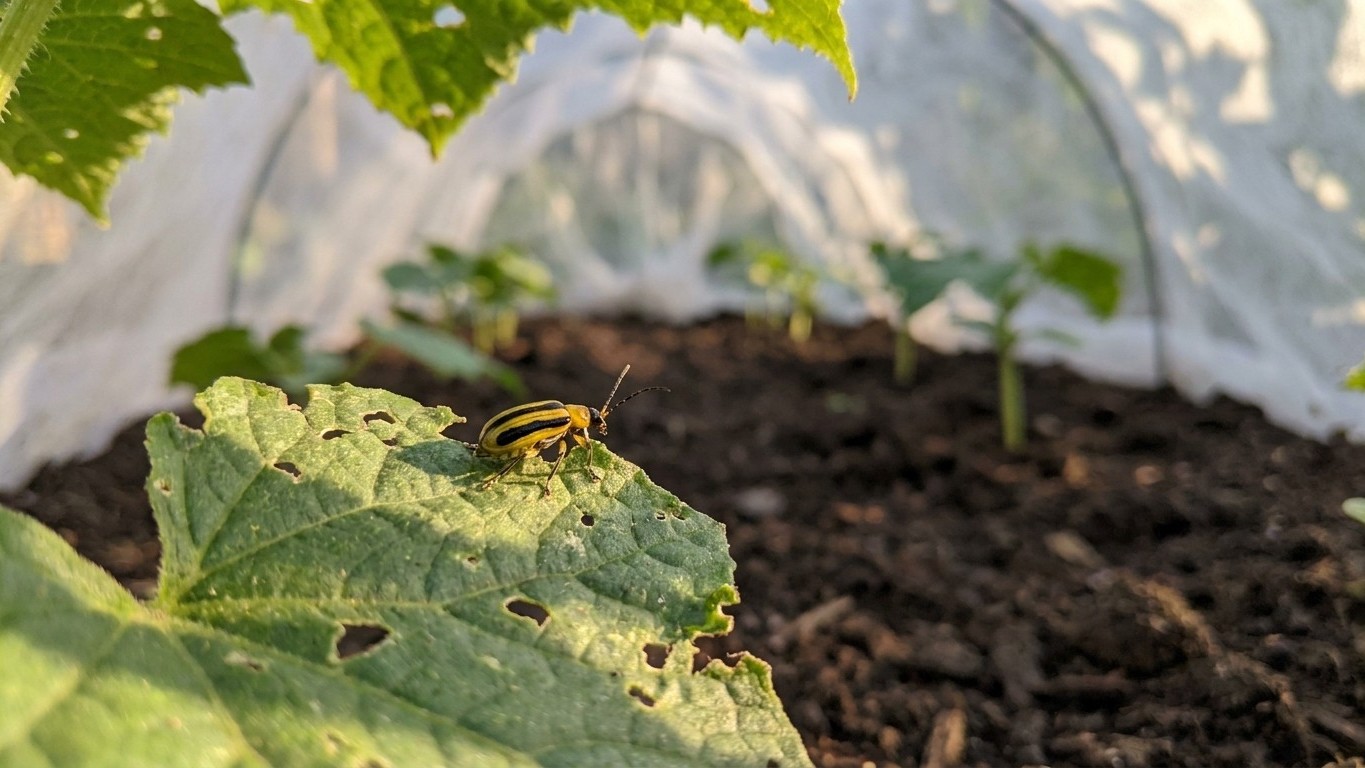

Only one insect on Rhode Island’s documented pest list actually has any business on a summer squash plant, and even that connection is thin. The state’s cooperative extension tracks a short roster of species for home landscapes, and most of them belong on trees, shrubs and flowerbeds, not in a squash patch.
Which pests attack Summer Squash in Rhode Island
The University of Rhode Island Cooperative Extension and URI Biocontrol Lab documents seven species for this territory: cicada killer wasp, crypt gall wasp on oaks, lily leaf beetle (Lilioceris lilii), rose sawfly (rose slugs), viburnum leaf beetle, white grubs including Japanese beetle, and winter moth (Operophtera brumata). That’s the full list. Nothing else on it is verified for this state on this site, so nothing else gets named here.
Run down that list with a squash plant in mind and most of it falls away fast. The cicada killer wasp digs burrows and hunts cicadas; it never touches foliage or fruit. The crypt gall wasp is an oak specialist, its larvae developing inside acorn tissue, with no reason to visit a vegetable bed. Lily leaf beetle feeds almost exclusively on true lilies and fritillaries. Rose sawfly larvae skeletonize rose leaves and nothing else. Viburnum leaf beetle is locked onto its namesake shrub. Winter moth caterpillars feed on the buds and unfolding leaves of deciduous trees and some fruiting shrubs, a springtime problem for orchards and ornamentals, not for a garden bed of cucurbits.
That leaves white grubs and the Japanese beetle. The two are the same insect at different life stages. Grubs live underground and chew on roots, mostly in turf, but they’ll also work through the root zone of a raised bed or garden border near a lawn edge. The adult beetle is a generalist feeder with a long host list, and while roses, grapes and linden are its favorites, it will land on squash foliage and chew ragged, lace-like holes between the leaf veins when populations run high nearby.
Worth being straight about what this means: Rhode Island’s documented list skews ornamental because that’s what the extension service has published pages on, not because summer squash goes untouched by insects here. Growers dealing with the classic cucurbit troublemakers, the ones that bore into vines or suck sap from the underside of leaves, won’t find them named on this territory’s documented roster. That gap is exactly why a call to the local extension office matters more than a guess based on a list built for a different kind of garden.
When each one shows up, and what it does first
Rhode Island’s frost-free stretch, based on the region’s reference weather station, runs from roughly April 7 to April 17 for the last spring frost to October 24 to November 3 for the first fall frost. Squash typically goes into the ground once that spring window has passed and soil has warmed, and pest activity tracks that same calendar rather than a fixed month.
White grubs are already in the soil before a squash seedling is transplanted. They spend the cooler months deep underground and move up toward the root zone as soil warms in spring, feeding on whatever roots they encounter, including a young transplant’s. The first sign is rarely a visible insect. It’s a seedling that wilts despite adequate soil moisture, or one that lifts easily from the ground because its root system has been chewed through.
The grubs pupate as the season’s heat builds, and adult Japanese beetles emerge over a stretch of summer weeks that overlaps with the region’s hottest stretch. Providence normally logs about 9.4 days a year at 90 degrees or higher, and that heat load is the general window when adult beetle activity peaks. The first sign of adult feeding shows up on the upper leaves: small, irregular holes that widen into a skeletonized pattern, leaving the network of veins standing while the softer tissue between them disappears. Beetles tend to feed in clusters, so damage often concentrates on a few leaves near the top of the plant before spreading.
None of the other six species on the documented list follow a squash-relevant calendar at all, since they aren’t feeding on this plant in the first place. Winter moth caterpillars are active earliest in the season, hatching as buds swell on trees and shrubs, but that timing is irrelevant to a squash bed. The practical takeaway for a Rhode Island grower is narrower than a full pest calendar: watch for root stress in a young transplant through late spring, and watch for skeletonized upper leaves once the season’s hottest stretch arrives.
Telling the damage apart from everything else
A squash plant that looks bad doesn’t always have an insect problem. Heat stress, uneven watering, powdery mildew and simple mechanical damage from wind or foot traffic can all produce symptoms that get blamed on bugs.
| What you see | Likely cause | What sets it apart |
|---|---|---|
| Lacy, skeletonized upper leaves with veins left intact | Adult Japanese beetle feeding | Beetles are often still visible on the leaf, feeding in small clusters during daylight |
| A seedling wilting despite moist soil, root system loose or chewed | White grub feeding on roots | Digging a few inches down near the root ball usually turns up C-shaped grubs |
| Yellowing between leaf veins, older leaves affected first | Nutrient deficiency | Pattern spreads evenly across the plant rather than concentrating on one section |
| White or gray powdery coating on leaf surfaces | Powdery mildew | A fungal coating that wipes off partially, unlike chewed tissue |
| Torn or shredded leaf edges, no clustered feeding pattern | Wind, hail or foot traffic | Damage lines up with one side of the plant, matching wind direction or a path |
The soil beneath a struggling plant is the single most useful place to look. Pull one wilting seedling and check the roots before treating anything, because grub damage and simple drought stress produce nearly identical wilting above ground. Squash grown on a sandy plot dries out faster than the same plant in clay, and with summer rainfall in this region running around 2.91 inches in July, the driest of the summer months, a dry stretch on light soil can mimic root feeding closely enough to fool an experienced gardener.
None of this is a substitute for a second opinion. A local extension office can confirm what’s actually chewing on a plant, and that confirmation matters more than a guess made from a photo or a leaf held up to the light.
What actually works here, and what is a waste of time
Physical barriers beat sprays on a short growing season, and timing decides whether a barrier does any good at all. Floating row cover placed over squash transplants right after they go into the ground keeps adult beetles off the foliage during the vulnerable seedling stage, but it has to come off once flowers open, since squash needs pollinators to set fruit. Leaving cover on past bloom trades one problem for a worse one.
Hand-picking adult beetles works better than most gardeners expect, especially in a small backyard bed rather than a large plot. Beetles are sluggish in the cooler part of the morning, and knocking them into a container of soapy water is a low-effort, low-cost method that doesn’t rely on any product at all. It won’t eliminate a heavy population, but it keeps damage below the level that threatens plant health.
Rotating where squash and other cucurbits go from year to year offers modest help against soil-dwelling grubs, since it disrupts the buildup of larvae in one bed, though it does little against adult beetles that fly in from elsewhere in the yard or the neighborhood. Watering deeply and consistently, rather than lightly and often, keeps root systems more resilient against grub feeding and makes a plant easier to tell apart from one that’s genuinely under insect attack.
What wastes time is treating a wilting plant for grubs without ever digging to confirm they’re there, or spraying broadly for beetles based on chewed leaves alone when powdery mildew or drought stress is the real driver. Any product decision, and which active ingredients are actually labeled for use on vegetables in Rhode Island, belongs with the state’s extension service rather than a general gardening guide. They track what’s currently approved; a website doesn’t.
Where to check this for your own county
The University of Rhode Island Cooperative Extension, working with the URI Biocontrol Lab, is the source for everything documented on this page, and their office can confirm what’s actually present in a specific yard rather than what’s been recorded for the state as a whole. Their general resource page is available at web.uri.edu/coopext, and county-level offices can take a photo submission or a sample for identification.
Rhode Island is small, but it isn’t uniform. The state’s hardiness zones span 6a to 7b under the USDA system, meaning a coastal garden and an inland one can run noticeably different, and pest pressure follows that same unevenness. A yard next to a wooded lot with old turf nearby will likely see more grub activity than one surrounded by pavement and raised beds. What’s documented at the state level tells a gardener what’s possible, not what’s actually feeding on their own plants this season.
The next useful step is specific rather than general: dig near a struggling plant’s roots before assuming grubs, photograph any beetle found feeding on a leaf, and send both to the county extension office rather than guessing from a list built for the whole state.