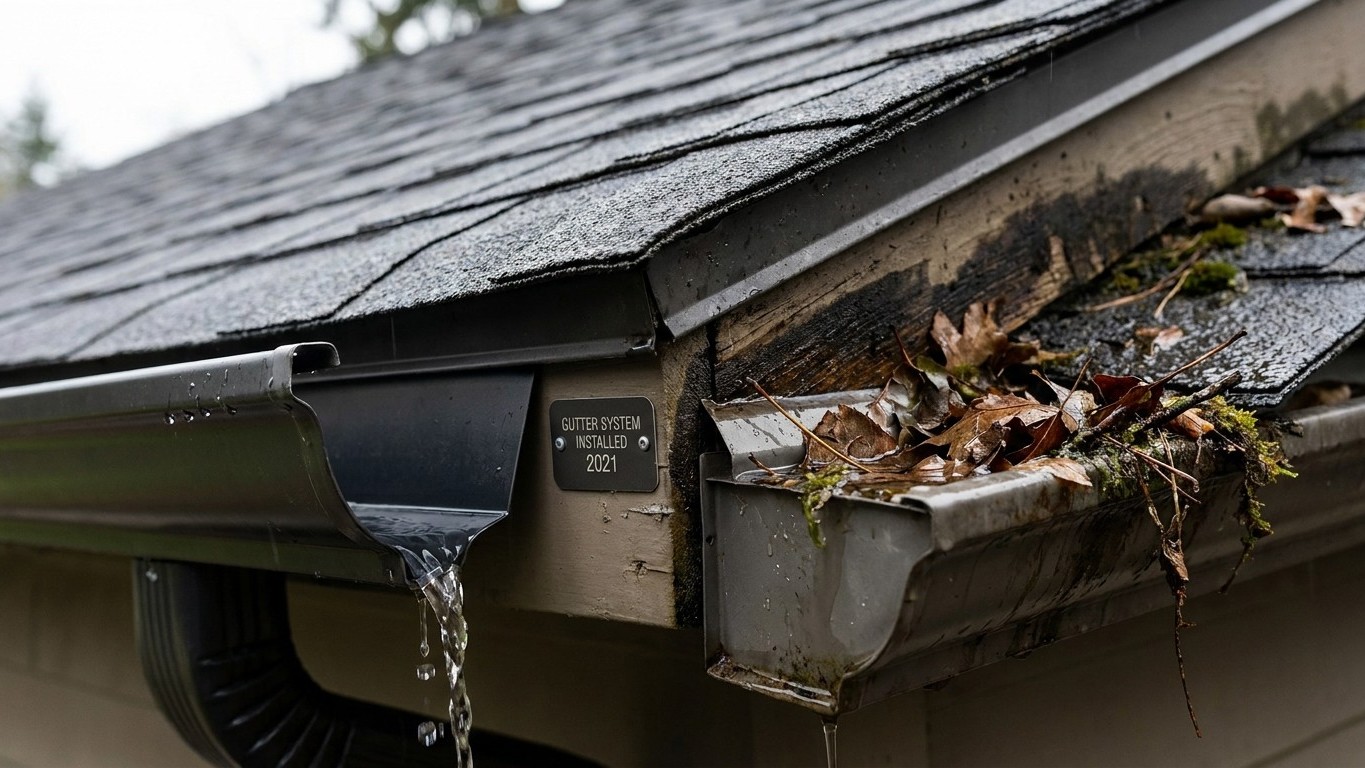

A roof does one job with two different parts. The surface sheds water off the top. The drainage, gutters and downspouts, catches that water at the edge and moves it away from the house. When either part fails, the other usually takes the blame first, because water damage shows up downstream from where the problem actually started. Watching both, on a schedule, catches most trouble before it reaches the inside of the house.
A roof is two systems, not one
Every roof problem traces back to one of two questions: did the surface let water in, or did the drainage fail to carry it away? These are separate systems, built from different materials, and they fail in different ways. A shingle can crack from age and sun exposure years before a gutter ever clogs. A gutter can pull loose from its fascia board while the shingles above it are in perfect shape. Treating “the roof” as one thing is how small, cheap fixes turn into big, expensive ones.
The handover point between the two systems is where most damage starts. Water traveling down a slope reaches the edge and is supposed to drop into a gutter. If that gutter is clogged, pulling away from the house, or pitched wrong, water backs up under the shingles instead. That backup soaks the fascia board, the roof deck, and sometimes the wall framing behind it, all in a spot the homeowner never looks at directly. A roof can be structurally sound and still cause a ceiling stain, simply because the gutter beneath it wasn’t doing its job.
This is why roof care splits into distinct pieces rather than one vague category. The gutters and downspouts handle water once it leaves the roofline. The flashing at chimneys, valleys, and vent pipes seals the places where the surface has to bend around something. The shingle field itself is the broad surface doing the actual shedding. And storm events stress all three at once, which is why insurance claims so often involve more than one kind of damage.
None of this requires a homeowner to become a roofer. It just means looking at the right thing when something seems off, instead of assuming “the roof” is one undifferentiated problem. Knowing which system to check first saves a service call, or at least tells the roofer where to look when they arrive.
What to watch, and how often
Twice a year is the baseline, once in spring after the worst of winter has passed, once in fall before leaves and freezing weather arrive. After any major storm, wind event, or hailstorm, that’s a third check regardless of the calendar. This lines up with when debris accumulates, when temperature swings stress materials most, and when insurance adjusters expect documentation if a claim gets filed later.
From the ground
Most of a useful inspection happens without a ladder. Binoculars, or a phone camera zoomed all the way in, show a surprising amount from the yard or street. Look for shingles curling at the edges, patches a different color or texture than the rest of the field, and any new sagging along the roofline. Check the gutters for visible debris spilling over, streaks of dark staining down the siding (a sign of overflow), and any section visibly pulling away from the fascia board. A downspout that isn’t draining, or one disconnected at a joint, is usually visible from directly underneath it.
From the attic
The attic tells the truth the roofline can hide. On a sunny day, turn off the attic light and look for pinpricks of daylight through the roof deck, which mean a gap somewhere in the surface above. Look at the rafters and sheathing for water stains, dark streaking, or a musty smell, all signs of a slow leak that hasn’t reached the ceiling drywall yet. Insulation that looks matted or discolored in one spot, compared to the rest of the attic, often marks the exact location of a leak overhead.
The full routine, room by room and season by season, is laid out on the roof inspection checklist, which walks through what to check from the ground, from the attic, and after specific weather events in more detail than fits here.
The failures that come up most
Four categories cover almost everything a homeowner will run into, and each has its own warning signs worth knowing before they show up.
Gutters
Clogging is the most common failure, usually from leaves, granules, and debris settling at the low point of a run or right at the downspout opening. Beyond clogs, gutters sag when the hangers holding them to the fascia loosen or rust, and they separate at the seams where sections join. Overflow during a heavy rain, even when the gutter isn’t full, often means the pitch is wrong rather than the gutter being blocked. Details on cleaning schedules, hanger types, and downspout placement live on the gutter maintenance page.
Junctions: flashing, chimney, valley
Anywhere the flat roof surface has to bend around something, a chimney, a vent pipe, a valley where two slopes meet, there’s a metal flashing doing the sealing work. Flashing fails when it rusts through, when the sealant around it dries out and cracks, or when it was never fastened correctly. These spots account for a disproportionate share of leaks relative to how little roof area they cover, because an uninterrupted shingle field almost never leaks; it’s the joints and transitions that do. More on spotting these from the ground is on the flashing and junctions page.
Surface: shingles, granules, moss
The broad field of the roof fails more slowly, through curling edges, cracking, and granule loss, all visible as a change in color or texture with a zoomed-in phone photo. Moss and algae streaking are cosmetic at first but hold moisture against the surface over time, shortening how long that section performs. Granules collecting in the gutter, rather than staying on the shingle, is worth tracking over several seasons, not a one-time alarm. Details are on the shingles and surface page.
Weather events
Hail bruises shingles in ways that aren’t always visible from the ground, wind can lift or tear sections along an edge, and heavy rain exposes every weak point in the drainage at once. These events are also where insurance gets involved, and coverage rules, deadlines, and documentation requirements vary by policy and by state, so the specific policy language governs, not general assumptions. What to document and how these claims typically unfold is covered on the storm and hail damage page.
The rule that governs all of it
Falls from roofs injure and kill people every year, and the risk isn’t limited to steep pitches or multi-story homes. A wet surface, a patch of moss, morning frost, or carrying tools with both hands while standing on a slope turns a routine check into a fall hazard. This is the one rule that overrides every checklist in this cluster: if getting the information requires climbing onto the roof itself, that’s not a homeowner task, no matter how capable or careful someone feels that day.
Nearly everything covered on these pages can be assessed without ever leaving the ground or the attic floor. Binoculars and a zoomed-in phone camera cover the surface and gutters from below. Daylight through the deck and staining on the rafters cover the interior from above. Between those two vantage points, a homeowner can catch the overwhelming majority of early warning signs, curling shingles, sagging gutters, staining, granule loss, moss, without ever needing a ladder against the house.
What’s never a householder job is anything above a single story, anything on a wet, mossy, steep, or frosted surface, and anything that requires both hands free while standing on a pitched roof. That covers shingle repair, flashing replacement, gutter reattachment on a second story, and close inspection of hail damage across a wide roof field. These are jobs for a licensed roofer with the harness, footing, and insurance to do them safely, and the cost of hiring that out is small compared to what a fall costs.
The honest version of “keeping an eye on the roof” isn’t about becoming a roofer. It’s about knowing which signs are visible from safe ground, checking for them on a schedule, and knowing which pages in this cluster to hand the problem to once something looks wrong. That division of labor, homeowner observation paired with professional assessment for anything above the eaves, is what actually keeps a roof and its gutters working the way they’re supposed to.
Common questions
How often should gutters be cleaned?
There’s no single number that fits every property, since it depends on nearby trees and roof pitch, but checking at the same twice-a-year schedule as the rest of the roof, plus after any storm with heavy debris, covers most homes. A gutter that overflows during moderate rain needs attention regardless of the calendar.
Can a homeowner check for hail damage without climbing up?
Some of it, yes. Dented gutters, dinged vent covers, and bruising on softer roof accessories are often visible with binoculars or a zoomed photo from the ground. Confirming damage across the full shingle field, though, usually requires a roofer’s inspection, which is also what most insurance claims expect as documentation.
What’s the difference between a flashing leak and a shingle leak?
A flashing leak shows up at a specific point, near a chimney, vent, or valley, rather than spread across an open area of roof. A shingle leak tends to follow a wider patch of curling, cracking, or missing granules visible over a broader section. Attic staining directly under a chimney or vent pipe usually points to flashing first.
Does moss on a roof mean it needs to be replaced?
Not on its own. Moss signals that moisture is sitting on the surface longer than it should, worth addressing, but it’s a maintenance issue rather than automatic proof of failure. A roofer can assess whether the moss has caused underlying granule loss or deck damage during a proper inspection.