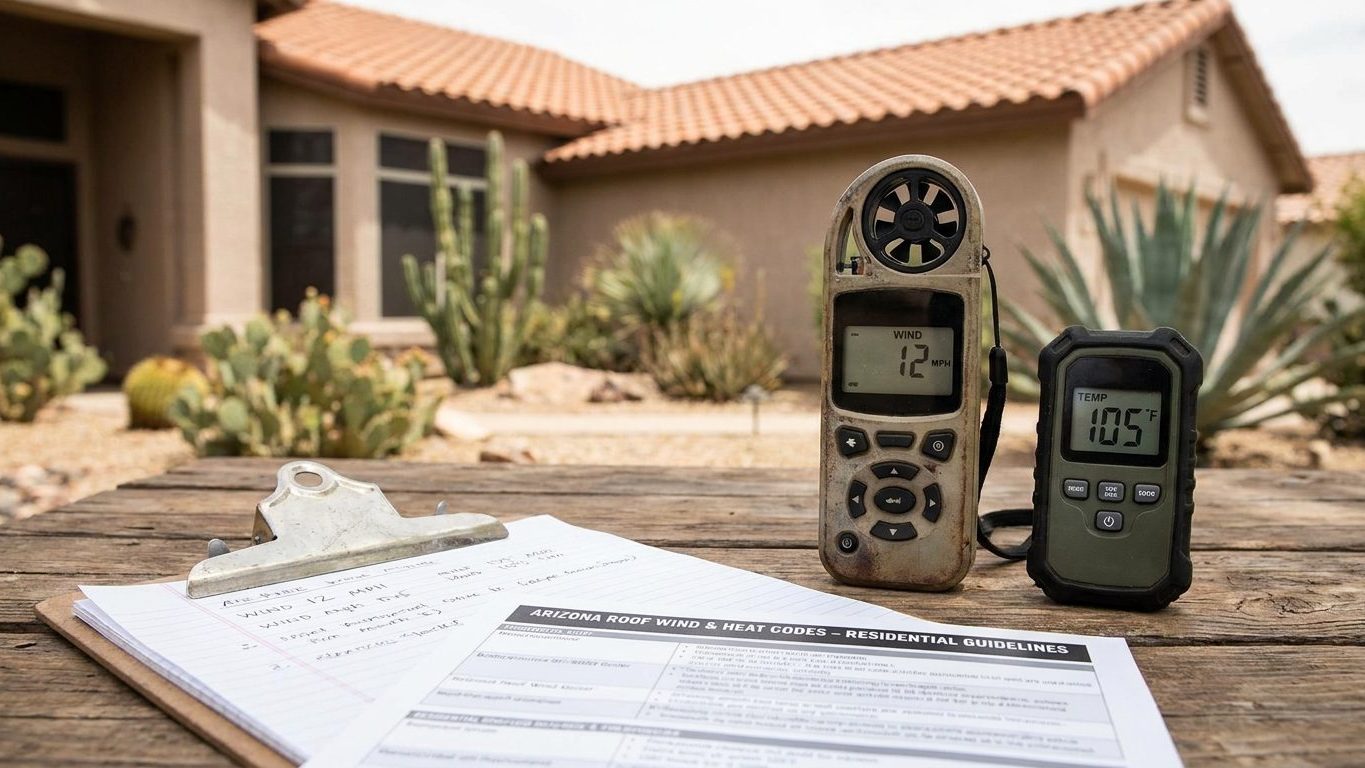

California’s building code conversation is dominated by earthquakes, so wind sounds like someone else’s problem. It isn’t: the basic design wind speed at Los Angeles is 95 mph, a 3-second gust measured at 33 feet above open, level ground, and it sets the nailing pattern, the shingle wind rating and the roof-to-wall connections on every ordinary house in that reference area. Check with your local building department which code edition governs your permit, and whether your county’s terrain pushes the design speed higher than this reference figure.
What wind speed must a roof withstand in California?

At Los Angeles, the basic design wind speed is 95 mph: a 3-second gust measured at 33 feet above open, level ground (Exposure C), for an ordinary house in Risk Category II. That is not a sustained wind, and it is not what a weather forecast reports when it announces a wind speed. It is a gust duration built into a structural formula, and the number holds whether the calculation runs on ASCE 7-16 or the newer ASCE 7-22. The map changed at other points in California between those two editions, but not at this one.
Nationally, this figure traces to ASCE 7-16, the standard referenced by the 2021 International Residential Code that most states build their wind provisions from. California’s own code, the 2025 California Residential Code, built from the 2024 IRC, carries the same 95 mph figure forward, since ASCE 7-22 maps an identical value at this point.
What the number buys
This single figure is what the whole roof assembly is engineered around in California, more than any other load the code considers here. It sets:
- The wind rating a shingle or panel product must carry
- The nailing pattern the manufacturer specifies to achieve that rating
- The fastening schedule for the roof sheathing itself
- The uplift connections, straps and clips, that tie the roof structure down to the wall framing
Edges, rakes and ridges fail first in a design wind event, because that is where suction concentrates as air separates off the roof surface. The field of the roof, where most of the deck sits flat and undisturbed, is the least exposed part of the whole assembly.
Every roofing job pulled under permit at Los Angeles is checked against this figure, but the number belongs to that reference point, not the whole state. California runs from sea-level basins to mountain ridgelines inside a single county, and the mapped wind speed shifts with terrain and elevation the same way it does everywhere else in the country. A coastal bluff or an exposed ridge can carry a higher mapped value than the basin figure given here. Your county building department has the wind speed that applies to your specific parcel, and that is the number your truss drawings and shingle rating need to match, not the Los Angeles reference figure on its own.
Does California require impact-rated roofing or shutters?
Not at the reference wind speed above. The requirement for impact-rated glazing or approved shutters over windows, doors and skylights switches on where the mapped basic wind speed reaches roughly 140 mph, the threshold that defines a wind-borne debris region under the model wind code. Los Angeles maps at 95 mph under both ASCE 7-16 and ASCE 7-22, well under that line, so nothing in the wind figure itself puts an ordinary house here inside a wind-borne debris region. That is a real difference from the Gulf coast, where the same threshold routinely applies. See Louisiana’s roof wind speed and heat rules for how that plays out where it does.
Why the requirement targets openings
Where the flag does apply, the logic is worth understanding even if it doesn’t touch a Los Angeles permit. The rule targets openings, windows, doors, skylights, because a window that fails in high wind lets pressure build up inside the house. That internal pressure pushes up on the roof deck from below at the same time suction pulls from above outside. A roof and its windows are one structural problem in a wind-borne debris region, not two separate ones.
What still applies at 95 mph
None of that removes the wind load from a California roof. What the 2025 California Residential Code, Title 24 Part 2.5, built from the 2024 International Residential Code and enforced as a statewide minimum by the California Building Standards Commission, still requires at 95 mph is a sealed roof deck detail, fastening schedules matched to the shingle or panel’s tested wind rating, and roof-to-wall connections, ties, straps, clips, sized to carry uplift load down through the wall framing to the foundation. Ring-shank or coil roofing nails and a secondary water-resistive barrier under the primary roofing are the kind of detail a local building department checks regardless of whether the parcel sits inside a wind-borne debris region.
Municipalities in California may adopt requirements stricter than this statewide floor, and the 2025 edition takes effect January 1, 2026. Any local amendment beyond that floor must be justified by climatic, geological or topographical conditions and filed with the state Commission, so a stricter wind provision in one jurisdiction reflects an actual site condition rather than a stylistic preference.
Does snow ever matter for a roof in California?
Barely, at the reference point. The design ground snow load at Los Angeles is 0 psf under ASCE 7-16, the edition behind the wind figures above, so snow carries no weight at all in the calculation that sizes rafters, sheathing and connections there. Wind governs roof design in this reference area, not snow, and that holds for most of the state’s low-elevation cities.
ASCE 7-22 maps a small value at the same point, about 4 psf, but that number is calculated on a different basis, a strength-level figure meant to pair with a 1.0 load factor rather than the nominal figure used with 1.6, and it remains far too small to control a roof design either way. It is not evidence of new snow risk, just a different way of expressing a load that was already negligible.
Ground snow load is also not the weight a roof surface actually carries. The code converts a mapped value with exposure, thermal and slope factors before it reaches a rafter, typically cutting it well below the ground figure for an ordinary sloped, heated house. Where a rare snowfall does hit a California roof not built to shed it, the trouble is usually drainage rather than weight: a flat or low-slope roof, a blocked scupper or gutter, and the ice that follows, backing water up under the shingles.
How much does heat shorten a roof in California?

The heat load by the numbers
At the reference station in Los Angeles, NOAA’s 1991-2020 climate normals put the average at 2.4 days a year reaching 90°F or higher, a count NOAA’s National Centers for Environmental Information track for exactly this kind of question. That is a modest number as summer heat loads go, but it understates what a roof surface itself experiences. A dark asphalt shingle sitting in direct sun runs far hotter than the air temperature reported at a weather station, whatever the count of 90-degree days at ground level.
The state also spans seven IECC climate zones across its 58 counties: 25 counties fall in zone 3B, 14 in zone 3C, 8 in zone 4B, 6 in zone 5B, 2 in zone 6B, 2 in zone 4C, and 1 in zone 2B, per the 2021 International Energy Conservation Code. That spread matters more for attic insulation choices than for the shingle itself, but it is why a single insulation number can’t be given for the whole state. Check the county table or the ENERGY STAR map for the zone that applies to a specific address.
What actually wears out a shingle
Ultraviolet light and heat drive the volatile oils out of an asphalt shingle’s mat over time. The mat stiffens as those oils leave, granules let go of the surface they no longer bind to, and the shingle loses the flexibility that let it lie flat through daily temperature swings. None of that is a wind failure, and none of it is a single dramatic event. It is a slow loss of the material properties the shingle started with.
Attic ventilation is part of this picture, not a separate comfort issue. A hot, poorly ventilated attic raises the temperature of the roof deck from underneath at the same time the sun raises it from above, and the underlayment beneath the shingles has its own temperature rating that a hot deck can push past. Roof color and reflectance change how much heat the surface absorbs in the first place, and how hot the deck runs is a bigger factor in a place like Los Angeles than it would be in a climate with fewer sunny, dry days. Arizona’s reference city logs far more days above 90°F than Los Angeles does, a gap covered on Arizona’s roof wind speed and heat rules, and that difference changes how hard a shingle mat works over a season even before wind enters the calculation.
What roofing material suits California best?
Where wind is the governing load, as it is at the Los Angeles reference figure of 95 mph, fastening and the roof deck matter more than the covering material itself. A premium shingle nailed to a lower standard performs to the lower standard, not to the number printed on the wrapper. That is worth saying before naming any category of roofing material at all.
Comparing the categories under these loads
| Material | Wind consideration | Heat consideration | Weight / fastening note |
|---|---|---|---|
| Architectural asphalt shingles | Wind rating is set by the specific product and the nailing pattern matched to it | Granule and oil loss accelerate under sustained UV and heat | Light. Nail count and placement are what fail first in a gust |
| Standing-seam metal | Concealed clip fastening resists uplift without exposed nail heads to work loose | Reflective finishes lower surface temperature compared with dark shingles | Light to moderate. Clip spacing, not the panel itself, sets wind performance |
| Concrete or clay tile | Individual tiles and their fasteners are the failure point in high gusts, not the tile material | Long service life under direct sun and heat | Heavy. The roof structure must be designed to carry the added weight |
Each category answers a different part of the problem. Architectural shingles carry a published wind rating tied to a specific nailing pattern, and that rating means nothing if the pattern isn’t followed on the actual roof. Standing-seam metal moves the fastening question to concealed clips spaced along the panel, which avoids the exposed nail heads that loosen over repeated wind cycles on other systems. Concrete and clay tile hold up well against sun and heat over a long service life, but the tiles are heavy and the fasteners holding individual units down are the part that gives way first in a high gust, not the tile material itself. A reflective surface, whichever category it comes in, changes how hot the roof deck runs under the sun. It does not change what the deck and its fasteners need to resist under the wind figure that governs the design at Los Angeles or anywhere else in the reference area.