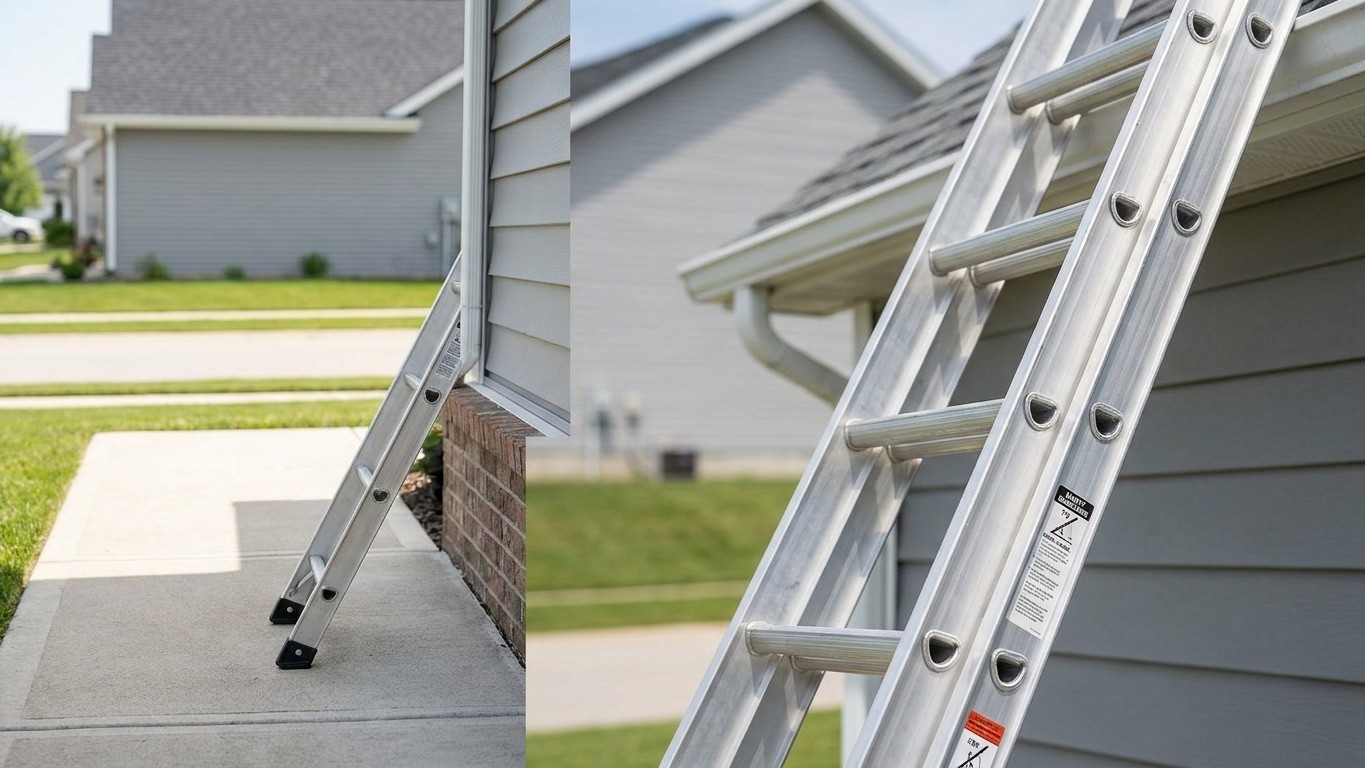

Most gutter injuries have nothing to do with the gutter. They happen on the way up or down, on a ladder that shifted, slipped, or was never quite stable to begin with. The safest way to handle gutters is to do most of the work from the ground, save the ladder for short, controlled climbs on a single-story section, and hand off anything higher or steeper to someone trained for it.
What is actually happening
Picture a ladder leaned against a house at the recommended angle. The base sits out roughly a quarter of the working height from the wall. That angle isn’t arbitrary. It’s the point where the ladder’s weight is distributed between pushing down and pushing back, so it neither kicks out from under you nor tips backward. Move the base in a foot to reach past a downspout, or set it on a slope instead of flat ground, and that balance is gone before you’ve climbed a single rung.
The reach problem
Gutter work makes people do the one thing every ladder safety notice warns against: lean sideways to reach a clogged corner instead of climbing down and moving the ladder over. That sideways lean shifts your body weight outside the ladder’s rails. On a stable, flat surface that’s risky. On grass with any slope to it, or on pavers slick from morning dew, it’s often the difference between a normal afternoon and a trip to urgent care. The gutter itself doesn’t care how far you reach. Your footing does.
Footing nobody checks
The other part of the mechanism is what’s under the ladder’s feet. Soft soil compresses unevenly under a ladder’s weight, especially after rain, so a base that looked solid when you set it can sink an inch on one side by the time you’re at the top rung. Concrete and pavers are more stable, but they get slick fast, and a ladder foot on wet pavers behaves almost like it’s on ice. None of this is about the gutter being hard to clean. It’s about the fact that gutter cleaning is one of the few home tasks that reliably puts an untrained person on a ladder, at height, reaching sideways, for several minutes at a stretch. That combination is where the injuries come from, not the debris itself.
What you can see without climbing
A surprising amount of gutter and roof trouble is visible without ever leaving solid ground. The routine below covers most of what a homeowner needs to know before deciding whether a ladder, or a call to a professional, is even necessary.
From the ground
- Walk the perimeter of the house and look up at the gutter line with binoculars or a phone camera zoomed all the way in. You’re looking for sagging sections, visible plant growth, standing water lines, or debris spilling over the edge.
- Check the downspouts at ground level. Rusty streaks, moss trails, or a fan of dirt washed out at the base usually mean water is overflowing somewhere above rather than draining properly.
- Look at the fascia board, the trim just behind the gutter, for peeling paint, dark staining, or a slight outward bow. That’s usually the first visible sign of water sitting where it shouldn’t.
- After a heavy rain, watch where the water actually falls. Sheeting off in one spot instead of channeling into a downspout is a clear, low-effort clue that something’s blocked or misaligned.
From the attic
- Bring a flashlight or headlamp into the attic on a dry day and turn off any other lights. Daylight visible through the roof deck, even as pinpricks, means there’s a gap that needs attention.
- Scan the rafters and the underside of the roof deck for dark staining, streaking, or a slightly different sheen than the surrounding wood. That’s often the residue of water that has already dried.
- Press gently on Insulation near the eaves if it’s safe to reach. Damp, compacted, or discolored insulation is one of the more reliable signs of a leak that’s been going on for a while, even if the ceiling below still looks fine.
This combination, ground observation plus an attic check, catches the overwhelming majority of problems that would otherwise only be found by climbing onto the roof itself. It’s worth doing twice a year regardless of whether anything looks obviously wrong.
What it costs to leave it
Clogged gutters don’t fail dramatically. They fail slowly, in places nobody’s looking, which is exactly why the ground and attic checks above matter. Water that can’t drain where it’s supposed to finds somewhere else to go, and that somewhere is almost always a place that’s expensive to fix and easy to miss.
Where the water actually goes
| Where water backs up | What typically absorbs it | Early visible sign |
|---|---|---|
| Behind the gutter, at the fascia | Fascia board and roof edge sheathing | Paint bubbling or peeling, dark trim staining |
| Over the gutter lip, along the foundation | Soil and foundation wall | Damp patches on basement walls, efflorescence (white mineral residue) |
| Through a blocked valley or seam | Roof deck and attic insulation | Ceiling staining, musty attic smell |
| Pooling near entry points and walkways | Landscaping, mulch beds, hardscape base | Standing water, moss growth, shifting pavers |
The part that stays hidden
The frustrating thing about water damage is that it’s patient. Wood can absorb moisture and dry out repeatedly for a good while before it visibly rots, and insulation can stay damp under a roof deck without anyone noticing from inside the house. By the time a ceiling stain actually shows up in a living room, the water has usually been finding its way in for some time already. That’s why the attic check matters more than most people assume: it catches the problem while it’s still just staining, before it becomes a soft spot in the drywall or a sagging section of roof deck. None of this requires a specific timeline to take seriously. Damp wood, damp insulation, and standing water near a foundation are problems on their own terms, regardless of how long they’ve been building.
What is not a householder job
There’s a point where a sensible homeowner project turns into a genuine risk, and gutters cross that line quickly. Clearing debris from a single-story gutter, from a stable ladder on flat ground, in dry conditions, is reasonable for most people. Almost everything past that description isn’t.
Where the line actually sits
Anything above a single story changes the physics of a fall enough that it’s simply not worth the risk for a task that a professional can do safely in less time than it takes to set up a ladder correctly. The same goes for any surface that’s wet, mossy, steep, or frosted, since all four remove the footing that ladder and roof work depend on. And any job that requires both hands free while standing on a sloped surface, clearing a valley, resetting a flashing, or reaching into a valley clog, isn’t something to attempt without proper fall protection and training, regardless of how confident the ladder felt getting up there.
What to do instead
The honest move, when a gutter problem clearly involves the roof itself rather than just the gutter channel, is to step back and get eyes on it a different way. A proper roof inspection can identify exactly what’s happening at height without anyone in the household needing to climb anything. And if the fix does turn out to be roof-related rather than a simple debris clear, hiring a roofer who does this work daily, with the right harness, footwear, and experience reading a roof surface, is the difference between a routine repair and a preventable injury. It costs a phone call. The alternative can cost a lot more.
Common questions
How often should gutters actually be checked?
Twice a year is a reasonable baseline for most homes, once in spring and once in fall, with an extra look after any unusually heavy storm. The ground and attic checks described above can be done at any time and don’t depend on weather.
Is it ever safe to clean gutters alone?
A single-story gutter, cleared from a stable ladder on dry, flat ground, with someone else aware you’re doing it, is about as low-risk as this task gets. Add height, slope, moisture, or solo working conditions, and the risk profile changes fast.
What does insurance cover if a clogged gutter causes damage?
That depends entirely on the specific policy and the state it was written in. Documentation, photos, dates, and a clear description of what happened, matters regardless of the outcome, so it’s worth keeping a record as soon as damage is noticed rather than waiting until a claim is filed.
Do gutter guards remove the need to check gutters at all?
No. Guards reduce debris buildup but don’t eliminate it, and they can hide a developing clog rather than prevent one. The ground and attic checks still apply, guards or not.