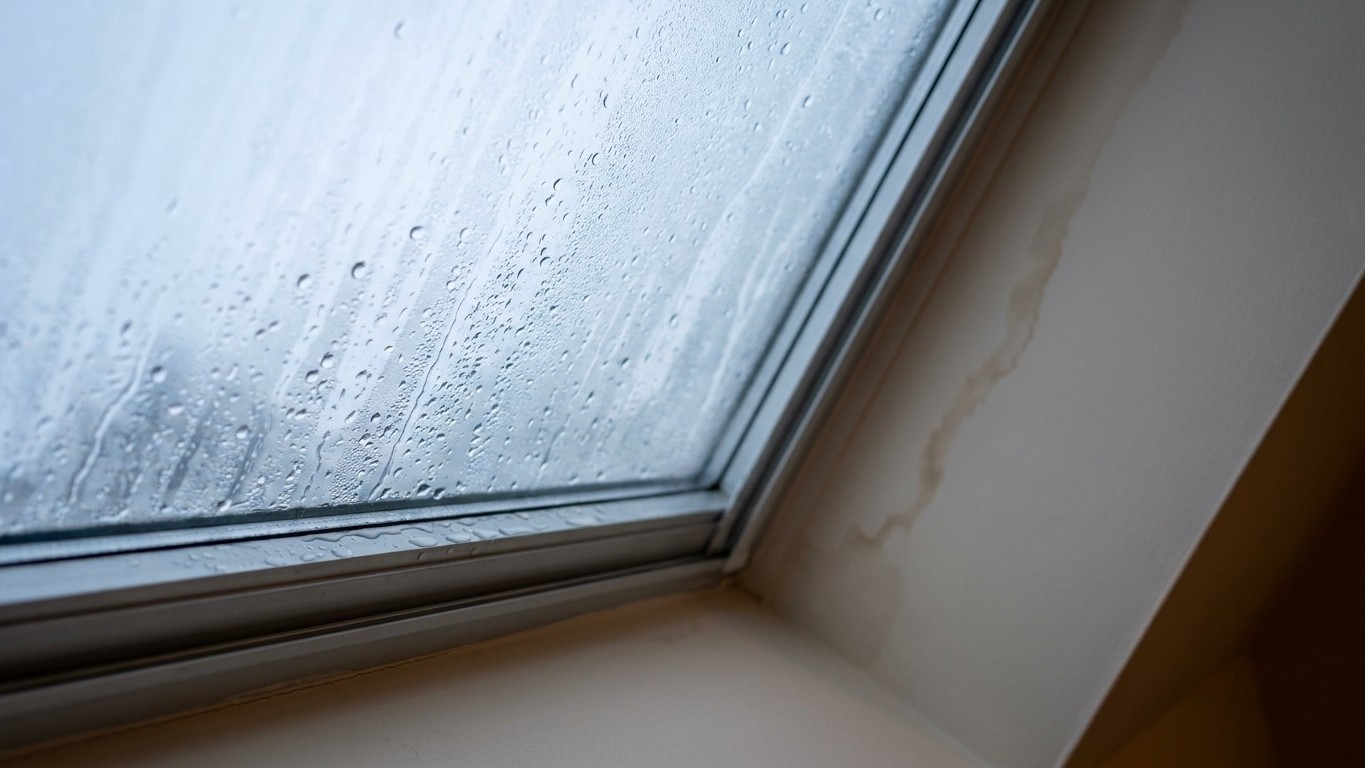

That stain spreading across your ceiling under the skylight might have nothing to do with rain. Roughly half the calls roofers get about skylight leaks turn out to be condensation instead, a completely different problem with a completely different fix. The clue is in the pattern: when the moisture shows up, where it collects, and whether a storm was involved at all.
What is actually happening
A skylight leak and skylight condensation start from opposite directions. A leak is water getting in from outside, through a gap in flashing, a cracked bead of sealant, or a path opened up by ice damming on the roof above. Condensation is moisture that was already inside your house, turning back into liquid when warm, humid air meets a cold surface, in this case the glass or frame of the skylight itself.
That difference shows up in timing. A leak tracks with weather. It appears during or shortly after rain, sometimes with a lag if water is traveling along a rafter before it drips somewhere lower. Condensation doesn’t care about rain at all. It shows up on cold, still mornings, often worse in winter, and it can appear on a completely dry, sunny day if the temperature swing between inside and outside is sharp enough.
Location matters just as much. Leaks tend to leave a trail: a stain that starts at the frame and runs along drywall or down a wall, following gravity and whatever path the water found. Condensation stays local. It beads on the inside of the glass or pools right at the base of the frame, without the streaking pattern you’d expect from water that traveled any distance.
Where the moisture is worst is another tell. Skylights above bathrooms, kitchens, and laundry rooms condense more because those rooms produce more humidity. A skylight over a bedroom or hallway that’s still fogging up points more toward a ventilation or insulation issue around the frame than toward a hole in the roofing above it.
| Sign | Leak | Condensation |
|---|---|---|
| Timing | During or right after rain | Cold mornings, regardless of rain |
| Location of moisture | Trail along frame, wall, or ceiling | Beads on glass, pools at frame base |
| Rooms most affected | Any room under the skylight | Bathrooms, kitchens, laundry rooms |
| Pattern | Follows gravity, spreads over time | Stays localized, disappears as room warms |
What you can see without climbing
Most of what you need to know is visible without ever setting foot on the roof. The routine works best in this order, checking the outside first, then the inside.
- Stand at a safe distance from the house, on the ground, and use binoculars or a phone camera zoomed in to scan the metal flashing around the skylight’s edges for gaps, rust streaks, or lifted seams.
- From the same safe spot, look for cracked or missing sealant along the frame, and check for moss, granules, or debris piled against the upper edge of the skylight, which traps water against the frame instead of letting it run off.
- Go into the attic with a flashlight during daylight hours and look directly up at the skylight shaft or the roof deck around it for any pinpoint of daylight coming through where it shouldn’t.
- Sweep the light across the rafters and framing near the skylight, looking for dark staining, streaking, or a chalky white residue, all signs that water has been traveling through at some point.
- Press gently on the insulation near the skylight shaft, or just look for insulation that appears compressed, discolored, or sagging, since damp insulation loses its loft and holds water instead of shedding it.
This ground-and-attic combination is genuinely enough to form a solid opinion about what’s going on. A dry attic with no staining, paired with condensation-pattern moisture only on cold mornings, points strongly toward a humidity problem, not a roof problem. Daylight through the deck or dark staining on rafters points the other way, toward an actual breach that needs repair.
What it costs to leave it
Ignoring either problem doesn’t make it go away, it just moves the damage somewhere less visible. With an actual leak, water that gets past the flashing travels along the path of least resistance, usually down a rafter or along the underside of the roof deck before it ever reaches drywall you can see from inside the room. By the time a stain shows up on the ceiling, the wood behind it has typically been wet for a while already.
What gets wet first is the framing lumber and the insulation packed around the skylight shaft. Wood that stays damp starts to soften, and insulation that gets saturated stops doing its job, which means the room below runs less efficiently even before any visible damage appears. Left long enough, softened framing becomes an entry point for rot, and rot doesn’t stay contained to the spot where the water first landed.
Condensation causes a different, slower kind of damage. Instead of a single wet spot, you get repeated small doses of moisture on the same surfaces, morning after morning, especially through colder months. That steady dampness is exactly what mold needs to get established on drywall, on the wood frame, or on insulation paper facing. Mold growth around a skylight is often the first sign homeowners notice, sometimes before they even connect it to condensation rather than a leak.
Hail and wind events add another layer, because damage from a storm can open a path for water without an obvious hole ever forming. If a storm has hit your area and you suspect it affected the skylight, your insurance policy is what governs any claim, including what documentation is required and what timeline applies. Photos from the ground, dated and clear, plus notes on when symptoms started, are the kind of documentation that helps regardless of what your specific policy requires. Coverage rules and deadlines vary by policy and by state, so the policy itself, not general advice, is the reference point.
None of this needs to turn into a guessing game about how many years you have before it gets bad. The point isn’t a countdown, it’s that early observation, the kind covered in the section above, catches both problems while the fix is still a small one.
What is not a householder job
Everything described so far stays at ground level or in the attic, and that’s intentional. Once the question becomes “what do we do about it,” the job changes character, and so does the risk.
Any skylight above a single-story roof puts you at a height where a fall carries real consequences, and that alone is reason enough to bring in someone equipped for it. A wet, mossy, steep, or frosted roof surface removes footing that would otherwise be manageable, turning a straightforward repair into a hazard regardless of the roof’s height. And any task that requires both hands occupied while you’re standing on a slope, holding a tool, applying sealant, replacing flashing, is a task where you have no free hand left to catch yourself.
These aren’t arbitrary lines. They’re the conditions under which most roof falls happen, and they apply just as much to an experienced do-it-yourselfer as to someone doing it for the first time. A homeowner’s job stops at observation and documentation. Diagnosis of what exactly failed, and the physical repair itself, belongs to someone trained for roof work.
If you’ve gone through the ground-and-attic checklist and you’re still not sure, a proper roof inspection settles it with tools and access a homeowner doesn’t have. And if the diagnosis points to an actual repair, the next step is finding someone qualified to do it rather than attempting it yourself. Both of those next steps are covered in more depth on our pages about what a professional roof inspection covers and how to hire a roofer.
Common questions
Can a skylight leak and condensation happen at the same time?
Yes. A frame with failing seals can let in outside moisture while also providing a cold surface where indoor humidity condenses. If you’re seeing both a rain-linked stain and a dry-morning fog pattern, treat them as two separate issues rather than assuming one explains everything.
Does opening a window near the skylight help with condensation?
It can, since it lowers indoor humidity, but it’s a temporary fix rather than a solution. Persistent condensation usually means the humidity source (a bathroom fan not venting outside, a kitchen without adequate ventilation) needs addressing at the source.
Is a small amount of condensation on a skylight normal?
Light condensation on very cold mornings that clears once the room warms up is common and not automatically a problem. What matters is whether it’s increasing over time, spreading to new areas, or leaving standing water rather than evaporating.
Should I call my insurance company before or after an inspection?
Check your specific policy for what it requires, since documentation rules and reporting windows differ by insurer and state. Having dated photos and notes from your own ground-and-attic check ready before you call generally makes the conversation more useful, regardless of what the policy specifies.