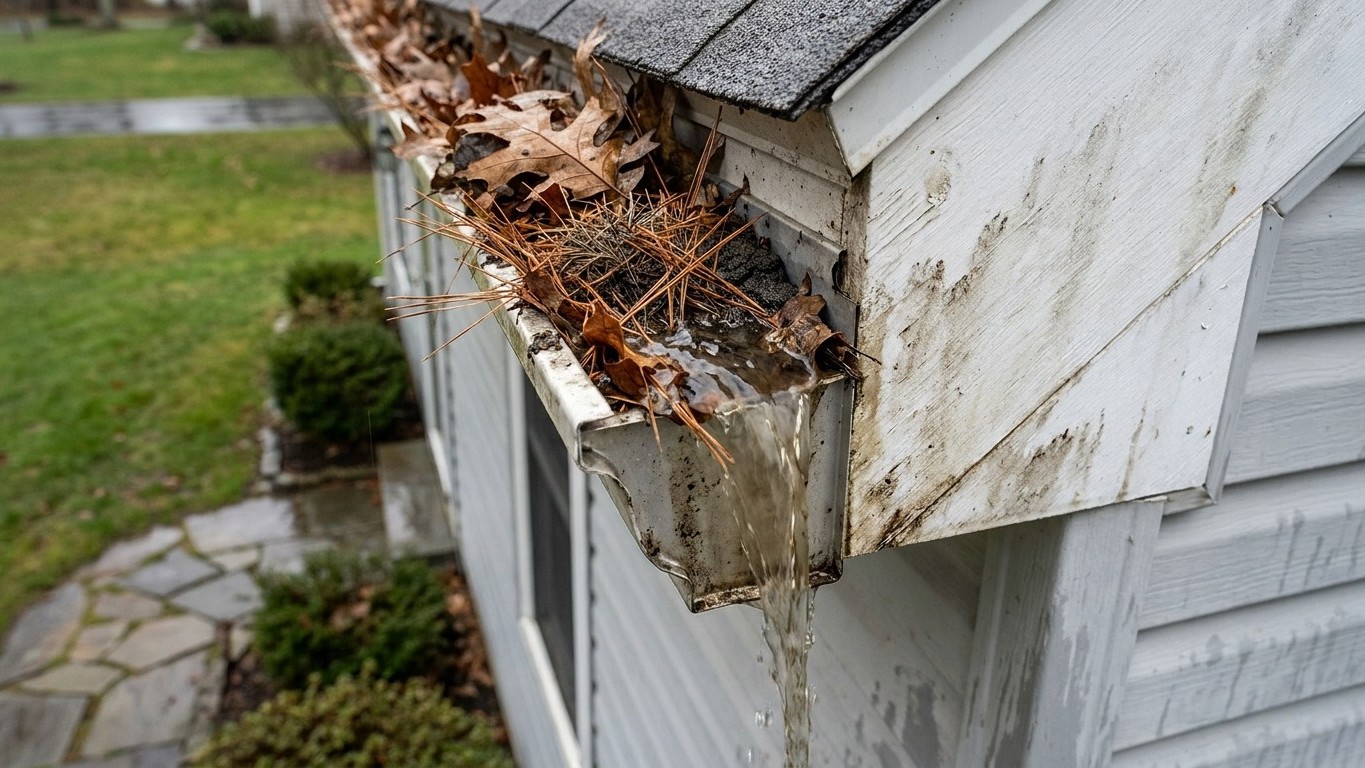

Water always finds a way down. When a gutter is packed with leaves, shingle grit, or a season’s worth of debris, that water doesn’t stop, it just changes direction. Instead of running through the downspout and away from the house, it spills over the front edge onto siding and foundation, or backs up under the roofing material behind it. The gutter itself is rarely what suffers. The damage shows up in the wood, the drywall, and the ground around the house, often weeks after the clog first formed.
What is actually happening
A gutter is just a channel with one job: collect water off a sloped roof and move it to a downspout before it touches the building. When leaves, pine needles, or granules from aging shingles pile up, they form a dam. Water still arrives at the same rate off the roof, it just has nowhere to go once it reaches that blockage.
From there, water takes one of two paths. The first is simple overflow: it pours over the front lip of the gutter in a sheet, landing right at the foundation line. Do that every time it rains, over enough seasons, and the soil next to the house stays saturated instead of draining away. That’s the mechanism behind wet basements and cracked foundations that seem to appear out of nowhere.
The second path is less obvious and more damaging: backflow. When the dam sits high enough, water pools behind it and starts climbing back up the roof slope instead of moving forward. On a roof edge, that means water pushing up and under the bottom row of shingles, tiles, or metal panels, past the point where they’re designed to shed water. Roofing materials are built to handle water flowing downhill over them, not water sitting still or moving uphill underneath them. Once moisture gets past that first layer, it’s touching the roof deck, which is just wood sheathing, not a waterproof barrier.
This is why a clogged gutter can cause interior stains on a ceiling that has nothing visibly wrong with the roof itself. The leak isn’t coming through a hole in the shingles. It’s coming through the edge, at the exact spot where the gutter failed to do its one job. The fix people usually picture, patching a ceiling stain, treats the symptom. The clog upstream is the actual cause, and until that channel runs freely again, the same water will keep finding the same path.
What you can see without climbing
A ladder isn’t the first tool for this job. Most of what matters can be checked from solid ground or from inside the attic, and that’s enough to know whether a gutter problem is starting to become a structural one.
- Look from the ground with binoculars or a zoomed phone camera. Scan the gutter line for sagging sections, plant growth, or a dark, wet stripe on the fascia board just below the gutter, that stripe is a sign water has been overflowing there repeatedly.
- Check the downspouts during or right after rain. Water should be exiting steadily. A trickle, or no flow at all while the gutter above looks full, points to a blockage somewhere in the system.
- Walk the perimeter of the house after a storm. Look for erosion channels in mulch or soil directly under gutter sections, splash-back staining on siding, or water pooling near the foundation.
- Go into the attic with a flashlight, in daylight. Turn off the attic light and look at the roof deck from underneath. Any pinpoint of daylight coming through means there’s a gap somewhere in the roofing layer above.
- Scan the rafters and the underside of the roof deck for staining. Water trails look like dark, elongated streaks running down the wood, often following the line of a rafter or truss.
- Press gently on Insulation near the eaves, using a gloved hand or a tool, not bare skin. Damp, compressed, or discolored insulation near the outer edges of the attic usually means water has been getting in along the roofline, exactly where gutter backflow would land.
None of this requires going up onto the roof. A pair of binoculars, a working flashlight, and ten minutes in the attic on a dry day will tell you more than a quick visual pass from a ladder ever could, and without the risk that comes with it.
What it costs to leave it
Nothing about a clogged gutter announces itself loudly. That’s part of what makes it a problem worth taking seriously: the consequences build quietly, in places nobody checks regularly.
Fascia boards, the trim running along the roof edge that the gutter is mounted to, are usually wood. Wood that stays damp behind a gutter that constantly overflows starts to soften. It doesn’t collapse outright; it goes spongy, then starts pulling away from the fasteners holding the gutter in place. A gutter that sags or pulls loose from the house is almost always a fascia problem first, a gutter problem second.
Behind that fascia, at the edge of the roof deck, sits the wood sheathing that everything else is nailed or screwed into. Sheathing that stays wet doesn’t rot instantly, but repeated soaking softens the wood fibers, and a soft deck can’t hold fasteners the way solid wood does. That’s when roofing material starts to loosen along the edge even though nothing hit it and no storm tore it off.
Inside the house, moisture that gets past the roof edge travels along the path of least resistance, usually down a rafter or truss until it hits insulation or drywall. Insulation that gets wet loses most of its ability to slow heat transfer, so a room with soaked attic insulation above it often just feels harder to keep at a comfortable temperature, long before anyone notices a stain on the ceiling.
Outside, the foundation takes a slower but steadier hit. Water dumped repeatedly at the same spot along the foundation line saturates the soil, and saturated soil expands and contracts differently than dry soil around it. That uneven movement is a common contributor to hairline cracks in foundation walls, and to basements that stay damp no matter how many times a dehumidifier runs.
None of this happens on a fixed schedule. A house in a region with heavy fall leaf drop and frequent rain will see these effects show up faster than a house in a dry climate with few overhanging trees. What’s consistent is the order: overflow first, fascia and deck softening next, then insulation and interior staining, then foundation and basement moisture. Catching it at the first stage is always the cheaper, simpler fix.
What is not a householder job
Clearing a gutter sounds like a weekend chore, and on a single-story house with a dry, low-slope roof and good weather, it often is. But a lot of gutter problems live in conditions that turn a simple task into a genuine fall risk, and it’s worth being honest about where that line sits.
Anything above a single story is a different job than anything at ground-floor eave height. The height itself changes the consequences of a slip, and most residential ladders aren’t rated or positioned for safe, stable work at that reach. A wet, mossy, or algae-covered roof surface adds a slickness that isn’t always visible from a photo or from the ground, and steep pitches remove the flat footing that makes any roof work manageable in the first place. Frost or morning dew does the same thing to a low-slope roof that moss does to a steep one: it turns a walkable surface into one with almost no grip.
Any task that requires both hands free while standing on a sloped surface, scooping debris, repositioning a ladder, handling a hose, belongs in the category of jobs that need proper fall protection and experience, not a homeowner balancing on a rung. It isn’t a matter of confidence or fitness. It’s a matter of the surface, the height, and what happens in the one second something goes wrong.
The better move, when ground-and-attic observation turns up signs of overflow, staining, or a sagging gutter line, is to get a proper inspection rather than attempt the fix personally. A roof inspection from someone equipped to safely access the roof line will confirm what’s actually happening at the edge, whether it’s debris, a pitch problem, or damage to the fascia and deck underneath. If the inspection turns up work that needs doing, from clearing to repair to replacement of damaged sections, that’s the point to bring in someone qualified, and knowing how to hire a roofer matters just as much as knowing there’s a problem in the first place. Documentation matters too, particularly if the damage followed a storm: photos from the ground, dated notes on when staining or overflow was first noticed, and a written inspection report all help if an insurance claim ends up being part of the fix. What a policy covers and by when varies by insurer and by state, so the policy itself, not general assumptions, is what governs that process.
Common questions
Can a clogged gutter cause a roof leak even if the shingles look fine?
Yes. Water backing up behind a clogged gutter can push under the bottom edge of otherwise undamaged roofing material, since that material is built to shed water flowing downhill, not water pooling or pushing upward at the edge.
How can I tell if attic staining is from a gutter problem or something else?
Staining that follows a rafter line near the outer edges of the attic, close to where the roof meets the gutter, points toward an eave-area issue like gutter backflow. Staining in the middle of the roof deck is more likely a separate issue and worth flagging clearly to whoever performs the inspection.
Is it safe to clear a single-story gutter myself in good weather?
A dry, low-slope, single-story situation is the lower end of the risk scale, but “safe” still depends on stable ladder footing, dry conditions, and having someone else present. Anything wet, steep, mossy, or above one story shifts into professional territory.
Does a clogged gutter affect the foundation even in a house without a basement?
Yes. Saturated soil around a foundation can cause movement and cracking whether or not there’s a basement underneath. A slab foundation sitting in repeatedly soaked soil is just as exposed to that uneven ground movement as a basement wall would be.