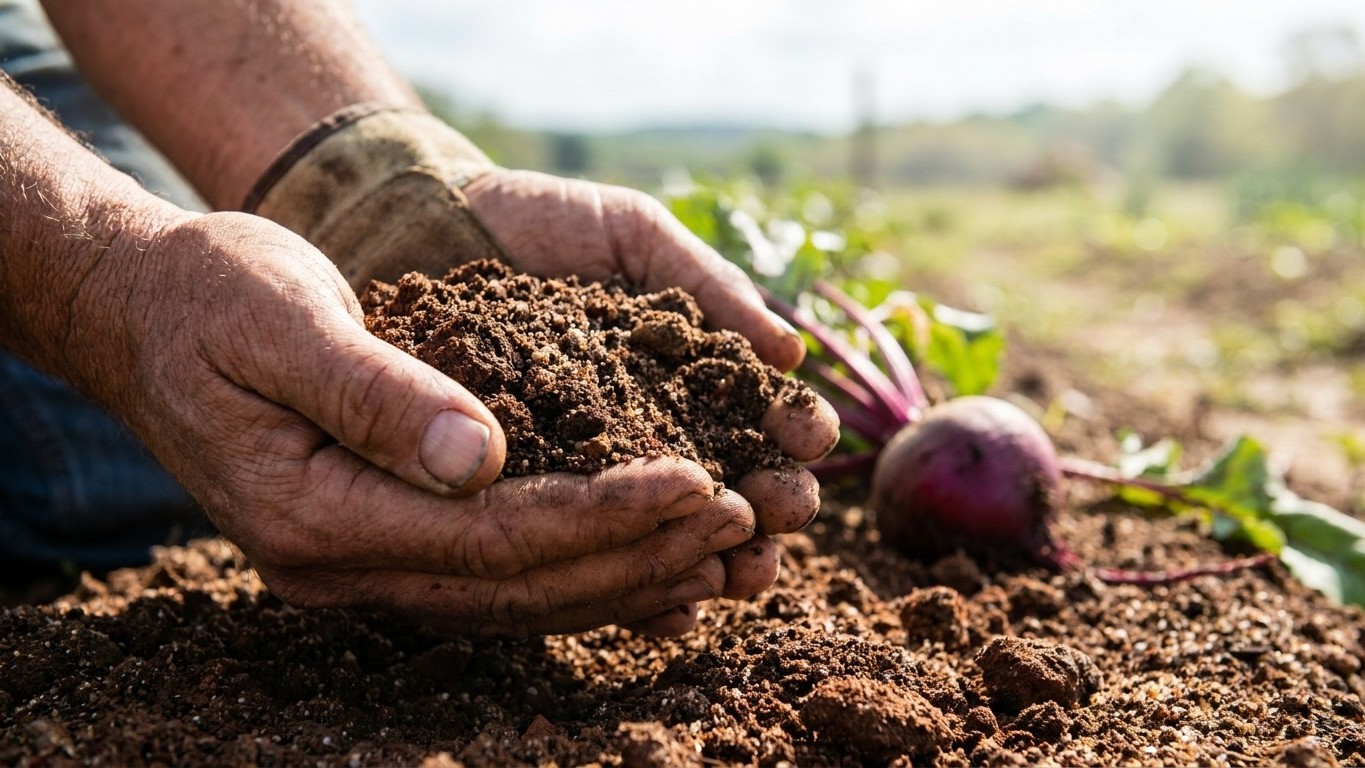

Saskatchewan’s dominant farmland soil is a Chernozem: dark, deep, well drained, running about 43 percent sand, 22 percent clay and 35 percent silt at the surface, with a median pH near 6.8 and roughly 4 percent organic matter. That combination is close to what a beet root wants, loose enough to size up straight, fertile enough to skip heavy feeding. The catch sits in spring timing and in summer heat spikes, not in the dirt itself.
The short answer
A soil built 43 percent sand, 22 percent clay and 35 percent silt is, by texture, a loam leaning toward silt loam, not the deep sandy ground Utah State University Extension points to as ideal for beets, but not far off it either. The clay fraction is modest enough that a well-drained Chernozem still lets a taproot push down without forking hard on a compacted layer, and the near-neutral pH of 6.8 sits inside the range beets tolerate without extra lime or sulfur. Organic matter around 4 percent is respectable for a root crop that doesn’t want heavy fresh manure but does want steady tilth, and Utah State’s guidance of no more than 1 inch of composted material per 100 square feet fits neatly on top of ground that already carries that much natural humus.
Drainage class matters more than the texture numbers suggest. A Chernozem’s structure holds moisture in the root zone through short dry spells without staying waterlogged after a downpour, which is the balance a beet seedling needs during germination. Where the map shows Solonetzic soil instead of Chernozem, expect a harder, more alkaline subsoil that can perch water and choke root development; that’s a different profile with a different set of problems, and it covers a real share of the province’s cultivated area.
Heat is the piece this soil profile can’t fix on its own. Utah State’s research ties woodiness in the root to temperatures above 85 F arriving while the plant is also short on water. Saskatchewan does produce stretches of summer heat that clear that 85 F mark, but a specific count of how many days a year a reference city spends above 90 F isn’t published in the sources behind this page, so no number is offered here. What can be said plainly: a Chernozem’s decent water-holding capacity buys a beet grower some insurance against a hot week, provided irrigation or rainfall keeps pace, because the soil isn’t the limiting factor once the sand-clay-silt balance is this workable.
None of this describes any one garden. Saskatchewan’s agricultural belt alone is mapped across roughly 3,675 sampled soil components, and the Chernozem profile above is the median of that survey, not a promise about the ground behind a particular house. A low spot that collects spring runoff, a yard built on scraped or filled soil, or a plot near a slough can sit on Solonetzic or poorly drained ground entirely unlike the provincial median. A soil test remains the only way to know which sandy-clay-silt mix, and which pH, is actually under a given row of beets.
The six weeks that decide it here
Beets go into the ground as seed, not as transplants, and the standard advice is to sow 2 to 3 weeks ahead of the last spring frost. In Saskatchewan, the Saskatoon SRC station’s climate normals put that mean last-frost date at May 18, which pins the sowing window to late April or the first days of May and puts the seedling’s first six weeks squarely inside the province’s early-season weather. That May 18 figure is an average from a thirty-year record, which means in one year out of two the real last frost lands after it, sometimes well after it. Treat it as the middle of a window, not a date to plan around with any confidence.
Prairie spring on the Saskatchewan grain belt tends to run cool and can turn abruptly dry or swing wet within the same few weeks, and that variability lands directly on the beet’s germination and early rooting stage. A cool, slow start is not itself the danger; a dry stretch during those first six weeks is, because Utah State’s research links early water stress to premature flowering, meaning the plant bolts to seed instead of building a root worth harvesting. On a Chernozem’s loam-leaning texture, moisture drains fast enough that a week without rain or supplemental water during germination can already tip a stand toward bolting, particularly on the sandier end of that 43 percent sand fraction.
This is why the six weeks after sowing carry more weight in Saskatchewan than almost any other stretch of the season. Sow too early into ground barely past the mean frost date and a late freeze can still take out young seedlings; sow with an eye only on frost and ignore soil moisture, and a dry snap during those same weeks sets up bolting regardless of how the frost date played out. The two risks don’t cancel each other out, they stack, and both trace back to the same early window rather than to the heat spikes that show up later in July and August.
What goes wrong here
- Bolting after a dry start. A Chernozem drains well enough that a rainless week or two right after sowing, inside that first six-week window, can push beet plants to flower instead of forming a root. Utah State University Extension identifies early water stress as the trigger. The remedy is consistent moisture from the day seed goes in, not just after seedlings emerge, a soaker line or regular hand-watering through those first six weeks matters more than any fertilizer decision.
- Woody roots from a summer heat spike combined with thirst. Once temperatures pass 85 F, a beet under water stress starts laying down tough, fibrous tissue instead of tender flesh. This is a separate failure from bolting, it shows up later in the season, at sizing-up time, not at germination. The fix is watering through hot stretches specifically, rather than assuming the moisture regime that worked in May will still be adequate once real heat arrives.
- Perched water and stunted roots on Solonetzic ground. Where a plot sits on Solonetzic rather than Chernozem soil, a hard, more alkaline subsurface layer can trap water above it after rain, drowning roots or forcing them to fork around the obstruction. A soil test that checks structure at depth, not just surface pH, is the only way to catch this before a whole row comes up misshapen.
- Over-amending an already fertile soil. With organic matter already near 4 percent, piling on more than the 1-inch-per-100-square-feet compost limit Utah State recommends can push growth toward leafy tops at the expense of root development. Testing existing organic matter before adding more avoids that trade-off.
- Surface crusting after a hard rain. The silt fraction in this soil, at 35 percent, can cap over into a crust that small beet seedlings struggle to push through. Light raking or a thin mulch layer right after sowing keeps the surface loose enough for emergence without needing to rework the whole bed.
Common questions
Is Saskatchewan’s soil naturally good for growing beets?
Its dominant Chernozem profile, well drained with a near-neutral pH and a loam-leaning texture, sits close to what beets need. The main limits are timing around the last frost and heat combined with dryness later in the season, not the soil chemistry itself.
How many days after sowing should a Saskatchewan gardener expect to harvest beets?
Utah State University Extension’s guidance counts 60 to 80 days from seeding, not from a transplant date, since beets are direct-sown. Given a sowing date tied to the May 18 mean last frost, that puts most harvests somewhere across the summer, depending on the variety and the season’s weather.
Does the province’s soil pH need adjusting for beets?
The median surface pH across mapped Saskatchewan farmland sits near 6.8, which is within the range beets tolerate without amendment. That figure is a provincial median, though, so a soil test on the actual plot is the only way to confirm a specific garden’s pH before deciding whether to adjust anything.
What’s the single biggest early-season risk for beets in Saskatchewan?
Water stress in the first six weeks after sowing, which coincides with the province’s variable early spring. That stress triggers premature bolting according to Utah State University Extension, a distinct problem from the woodiness that later summer heat can cause if watering lapses again once temperatures climb past 85 F.