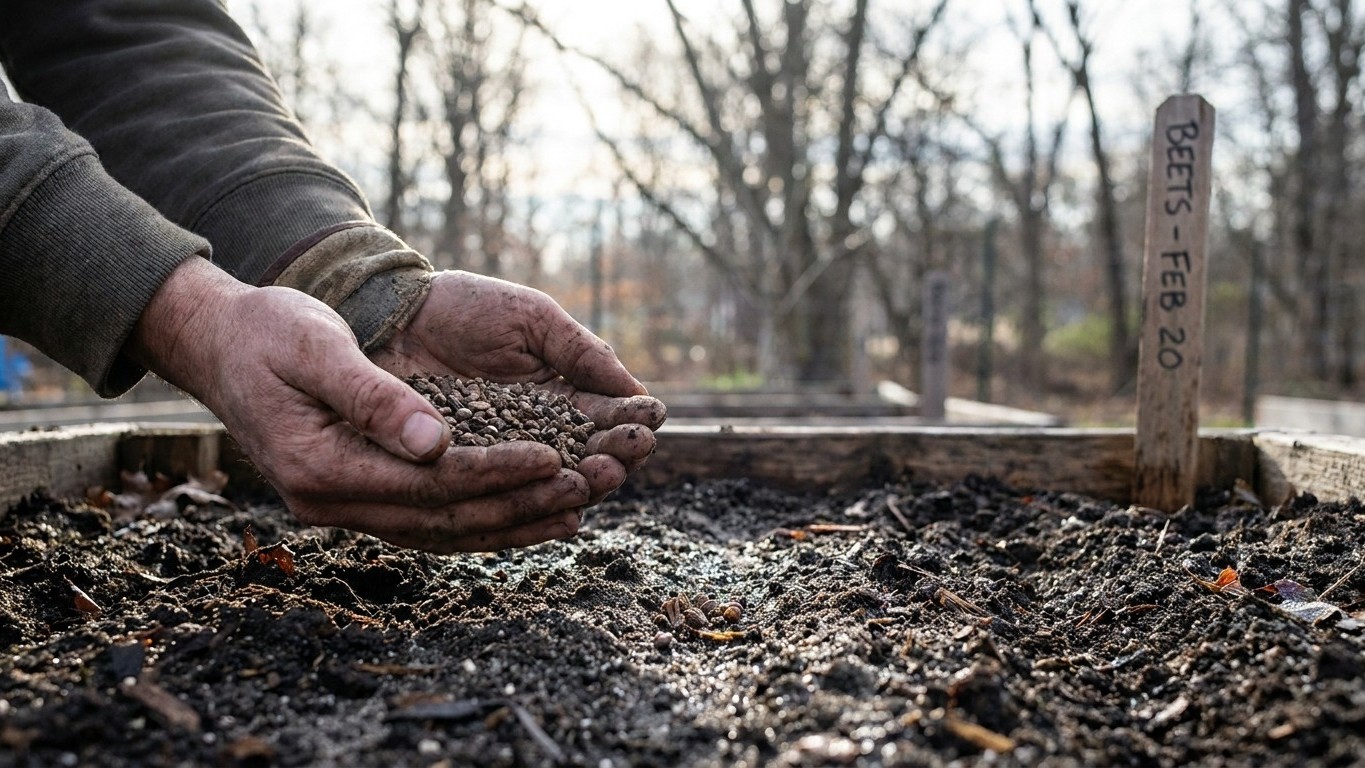

Sow beet seed directly into the ground two to three weeks before Saskatchewan’s average last spring frost of May 18, which puts most of the province’s seeding window in late April through the first days of May. Beets don’t transplant well, so seed goes straight into cool soil rather than into trays. From that date, expect roots ready in 60 to 80 days depending on variety, with the crop’s fate decided less by the calendar than by what the first six weeks of spring moisture and soil texture do to a germinating beet.
The short answer
Start with what’s actually under the seed. Across the mapped agricultural surface of Saskatchewan, the most common soil order is Chernozem, the deep, dark grassland soil the prairies are known for, rich in organic matter and naturally fertile. It covers about 68 percent of the mapped surface, with Solonetzic soils coming in second. The median surface reading runs close to neutral at pH 6.8, the texture sits at 43 percent sand, 22 percent clay and 35 percent silt, organic matter averages about 4.0 percent, and drainage is classed as well drained.
That combination lines up reasonably well with what a beet wants. Utah State University Extension describes the ideal beet bed as deep, sandy, well-drained soil that’s rich in organic matter, amended with no more than 1 inch of composted organic matter per 100 square feet. A 43-percent-sand, well-drained loam with 4 percent organic matter already sits close to that target, which means most Saskatchewan garden beds built on typical Chernozem don’t need heavy amendment to grow a decent beet. Where the soil runs closer to the Solonetzic side of the province, expect tighter drainage and a more alkaline pH, and expect to test before planting rather than assume.
The heat side of the equation is where this page has to be honest about its limits. Utah State’s research is specific that heat above 85 F combined with water stress is what turns a beet root woody, but no day-count of how often Saskatoon or any other Saskatchewan reference point crosses 90 F is published on this page, so no such figure appears here. What can be said is that the well-drained, sandy-leaning texture of the province’s dominant soil drains fast, which means the soil dries at the surface quickly once a warm stretch arrives, and that’s the condition that sets up water stress in the first place.
None of this replaces a soil test. Saskatchewan spans hundreds of mapped soil series, and the median figures above describe a province-wide tendency, not any one garden. A backyard bed in a river valley, a plot built on scraped or trucked-in fill, or ground closer to the Solonetzic pockets can behave nothing like the numbers above. Treat the Chernozem profile as the starting assumption to test against, not the answer.
The six weeks that decide it here
Sowing two to three weeks ahead of the May 18 average last frost means the first six weeks of a Saskatchewan beet crop run from roughly late April into the middle of June. That’s the stretch that decides whether the crop bolts before it roots. Utah State’s Extension is direct on the mechanism: water stress during those first six weeks is what pushes beets into premature flowering, a completely different failure from the woody-root problem that shows up later in a hot, dry summer.
The Saskatchewan spring that seedlings emerge into is a swinging one. Dry stretches under clear prairie skies alternate with sudden, heavy rain, and the warm-up from a cool April into a mild June can move fast once it starts. That swing matters more than it would in a climate with steadier spring rainfall, because a well-drained, sandy-leaning Chernozem surface dries out quickly between rain events. A bed that looked adequately moist after a weekend rain can have a bone-dry crust by the following week if a dry, windy stretch moves through, and that’s exactly the kind of gap in moisture that triggers bolting in a young beet.
The other detail worth carrying into this window: the May 18 frost date is a mean, not a guarantee. In roughly half of all years the last frost falls later than that date, and in the other half it falls earlier. A grower who sows strictly by the calendar without watching the week’s actual forecast risks either a frost hit on tender seedlings or, more commonly in this discussion, a false sense of security about when the “safe” moisture window begins. The practical takeaway is that the six weeks after sowing need active moisture management, not a single planting-day decision, and that management matters more on a fast-draining, sandy-leaning bed than it would on heavier clay ground elsewhere.
Where the risk actually sits
Because the province’s dominant soil already drains well, the bolting risk here sits less in waterlogging and more in the gaps between rain. A grower on true Chernozem loam should plan to check soil moisture by hand every few days through late April and May rather than relying on the calendar or on rainfall alone.
What goes wrong here
- Seedlings bolt before they root. A dry stretch in the first six weeks after sowing, common on a fast-draining sandy-loam surface, stresses the seedling and pushes it toward premature flowering instead of root growth. Water on a consistent schedule through late April and May rather than waiting for the soil to look visibly dry.
- Roots turn woody once summer heat arrives. This is a separate failure from bolting: it happens later in the season, when heat above 85 F combines with water stress on a maturing root. Keep water consistent once warm weather sets in, and don’t let the bed dry out between waterings during any hot spell.
- Spring soil gets worked while still wet. Chernozem holds enough organic matter and moisture that tilling it too early in a wet April can compact the structure that made it well drained in the first place. Wait until a handful of soil crumbles rather than clumps before turning the bed.
- Solonetzic pockets behave differently than the province-wide median. Where a bed sits on or near Solonetzic soil, the second most common order in Saskatchewan, drainage and pH can run well outside the Chernozem figures used above. A soil test before planting catches this before the crop shows the problem.
- Over-amending an already fertile bed. With organic matter averaging around 4.0 percent already, adding more than the recommended 1 inch of composted organic matter per 100 square feet per Utah State’s guidance can overshoot what a beet needs and skew growth toward leaf rather than root.
Common questions
How many days does a Saskatchewan beet crop need from seeding to harvest?
Beets are direct-seeded, never transplanted, and Utah State University Extension puts the range from seeding to harvest at 60 to 80 days depending on variety. That range starts from the day seed goes into the ground, not from any later transplant date, which matters for counting backward from a target harvest week.
Should I sow beets by the calendar or by soil condition?
Both, weighed together. The May 18 average last frost gives a starting point for counting back two to three weeks, but it’s a mean date, meaning roughly half of all years see frost arrive later. Check the week’s actual forecast and the soil’s workability, rather than treating the calendar date alone as a green light.
Does Saskatchewan’s soil need extra organic matter for beets?
Often not much. The province’s dominant Chernozem soil already averages about 4.0 percent organic matter, close to what Utah State University Extension recommends amending toward, with a cap of 1 inch of composted organic matter per 100 square feet. A soil test is still the only way to know what a specific bed actually needs.
What’s the difference between bolting and woody roots in beets?
They’re two separate failures with two separate causes. Bolting is premature flowering triggered by water stress in the first six weeks after sowing. Woody roots come later, when heat above 85 F combines with water stress on a root that’s already sizing up. Treating both as one “keep it watered” problem misses that they happen at different points in the season for different reasons.