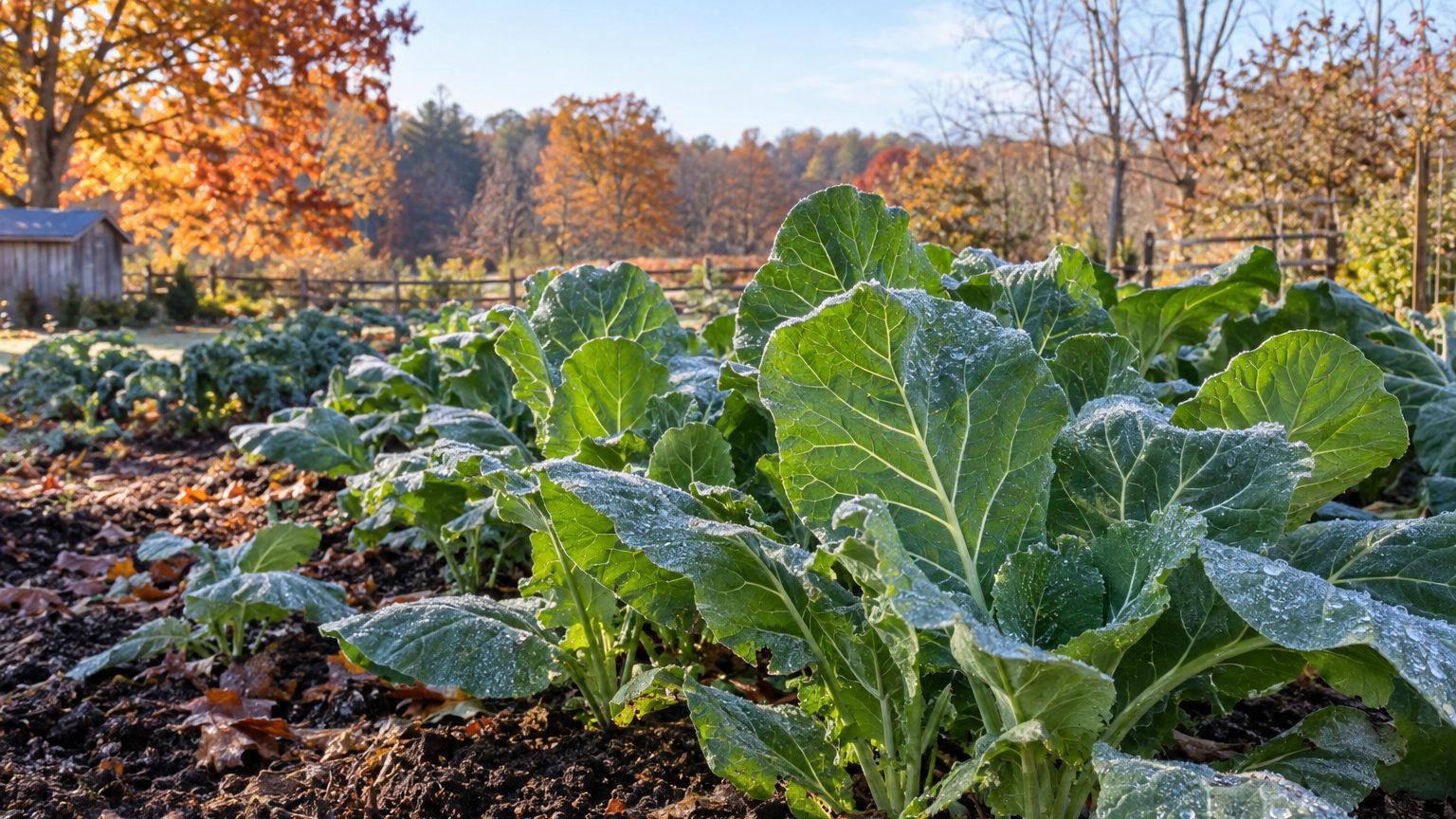

Set collard transplants outside around Saskatoon’s average last spring frost, May 18, and expect the season to end near the average first fall frost, September 18. Both are midpoints from a single weather station, not safe dates. Start seed indoors several weeks ahead and harden the seedlings off. Treat the two dates as the edges of a window. For the crop itself, see Growing Collards in Saskatchewan.
The short answer for Saskatchewan
Sow collard seed indoors several weeks before the average last spring frost, then move the seedlings outside on or shortly after May 18, once the forecast stops showing hard freezes. Direct seeding works, but it spends weeks of a short season on germination, so transplants are the safer bet on the Prairies.
Environment and Climate Change Canada’s Canadian Climate Normals for 1981-2010, at the Saskatoon SRC station, give an average last spring frost of May 18 and an average first fall frost of September 18. These are mean dates. In one year out of two, the last spring frost lands later than May 18. In one year out of two, the first fall frost arrives before September 18. Nobody should read May 18 as the day the danger ends. It is the midpoint of a spread that runs earlier and later.
Count from one mean date to the other and you get 123 days. That is the frost-free stretch in an average year, and a bad year eats into it at both ends. Collards tolerate light frost far better than tomatoes or beans, so a cautious gardener can set hardened-off plants out a little before May 18 with a cover on hand. Only the frost-tender crops truly need to wait for the date to pass.
A workable sequence looks like this:
- Seed indoors several weeks before May 18, in bright light so the stems stay stocky.
- Harden the seedlings off over about a week, moving them outdoors for longer each day.
- Transplant around May 18, with row cover or overturned buckets ready for a late cold snap.
- Harvest leaves through summer, and keep picking until hard freezes end the season.
Two limits on these numbers. The Canadian normals cover 1981-2010, while the US figures elsewhere on this site cover 1991-2020, so the two sets are not on the same footing. And this page holds no Saskatchewan extension sowing calendar for collards, so the window above comes from the frost dates alone. Northern and upland districts run weeks behind Saskatoon.
What will not work here
Planting the slowest collards fails first. With 123 days between the two average frost dates, and only half the years cooperating on each end, a variety bred for a long southern season may still be small when autumn arrives. Choosing fast-maturing types matters more here than in most of the country, and The Best Collards and Greens for Saskatchewan covers which ones to favor.
Direct seeding on May 18 and calling it done also fails. The date is a coin flip. In roughly half of years, a frost falls after it, and a seedling with two true leaves is not a hardened plant. Gardeners who sow the day the calendar says so often lose the first planting and reseed in June, which costs them the head start they were trying to get.
Overwintering is the third failure, and the winter numbers explain it. The mean daily minimum of the coldest month at the Saskatoon reference station is -20.7 °C (-5.3 °F). That is an average of the daily lows, not the record cold, so individual nights run well below it. Collards that sit through a Saskatchewan winter in the ground should be treated as finished at the first hard freeze, not as a crop that will resprout in April the way it might in the American South.
Late sowing for a fall crop fails too, and it catches people who read southern advice. A midsummer planting only pays if it has time to size up before frost, and September 18 is an average, so half of years bring the frost sooner. A crop sown in late summer will be caught by the cold while still small in a large share of years. Fall harvest here comes mostly from spring-planted collards that keep producing, not from a second sowing.
Weekly watering is the last habit to drop. The source facts give no summer rainfall figure, so this page does not claim one. But prairie summers can be hot and dry, and a shallow weekly soak leaves a leafy crop stressed between waterings. Mulch and steadier, deeper watering do more good than extra fertilizer.
What changes across Saskatchewan
Saskatchewan is not one garden, and the hardiness numbers say so. The figure this page holds is Canadian hardiness zone 3a, from Natural Resources Canada’s plant hardiness site (1991-2020 normals), and it belongs to the reference city, not to the province. The province spans several zones from south to north, so there is no single answer for the whole of it. This page carries only the one zone, and it will not guess at the others.
Canadian hardiness zones are also not USDA zones. The Canadian system is built on seven climate variables, the USDA system on one, and NRCan itself states that there are no simple conversions between them. Its own example: Canadian zone 4a overlaps nine USDA zones, from 3a to 7a. So a Canadian zone number should not be lined up against US charts, and 3a here does not mean the same thing as a USDA 3a.
For a gardener north of Saskatoon or on higher ground, the practical shift is toward the late end of every window. The frost dates above come from the Saskatoon station, and northern or upland districts run weeks behind it. That pushes the transplant date later, shortens the harvest at the far end, and makes fast-maturing varieties and row cover more valuable. Someone in a warmer southern pocket may get an earlier start, but should still treat May 18 as a midpoint.
To find your own zone, do not rely on this page. Look up your municipality on the Canada’s Plant Hardiness Site map. Write down the zone it shows for your town, then add a week or two to the transplant date if you are well north or uphill of Saskatoon.
Where to check this for your own county
The Government of Saskatchewan’s agriculture page is the starting point for local advice: saskatchewan.ca agribusiness, farmers and ranchers. That is the address on record, verified to load on August 22, 2026. This page has not confirmed that a collard calendar sits on it, so treat it as a place to start looking and to find the right contact.
Two things are worth hunting for. The first is a local planting calendar with frost dates for a station near you, not for Saskatoon. The second is a list of leafy brassica varieties trialled in your area, since a variety that finished well in one district can stall in another. If you cannot find either, phone or email the office and ask what growers near you plant and when.
Saskatchewan is organized by rural municipalities rather than American-style counties, so a local answer may be framed by municipality or region. The principle is the same either way. A local recommendation beats a provincial one, because it rests on frost records and trials from your own conditions. This page is the provincial one, built from a single station, and it is a starting frame, not the last word for your yard.
When you find a local frost figure, check what it measures. A mean date means half of years fall later, and a percentage-based date (such as a 10 percent chance of frost after a given day) is a much safer sowing marker. Ask which of the two your source is giving before you plant on it.
Checking this against your own garden
Your own observations outrank every date above. Three are worth watching, and none needs equipment.
Soil warmth by feel comes first. Dig a few inches down and squeeze a handful. If it feels cold and stays clammy in your hand, seedlings will sit and sulk. Compare beds: a raised bed or south-facing strip usually warms sooner than low, shaded ground, and that gap tells you where the first transplants can go.
The first true leaves on your seedlings come second. After the two seed leaves, the first true leaves signal that a plant is ready for hardening off. If they appear slowly on your windowsill, the light is weak or the room too cool, and you should shift the start date rather than force it.
Frost in your yard is third. Low spots collect cold air, and a lawn or bed that whitens while a neighbor’s stays clear tells you your microclimate runs colder than the station data. Write down the date of the last frost you see in your own yard, then compare it with May 18 next year. Three or four seasons of notes will be worth more than any average.
Common questions
Can I sow collard seed directly in the garden in Saskatchewan?
You can, but it uses up a large share of a short season. Starting seed indoors and transplanting around the May 18 average last frost, with cover ready, is the safer route.
Is May 18 a safe date to plant?
No. It is the average last spring frost at Saskatoon SRC, so in one year out of two the last frost comes later. Use it as the middle of a window.
Will collards survive a Saskatchewan winter?
Do not count on it. The mean daily minimum of the coldest month is -20.7 °C at the Saskatoon reference station, and individual nights run colder. Plan on collards as a single-season crop here.
Do these dates apply in northern Saskatchewan?
Not directly. They come from one Saskatoon station, and northern or upland districts run weeks behind it. Check your own municipality’s zone on the Natural Resources Canada map and ask local growers or the province for nearer frost figures.