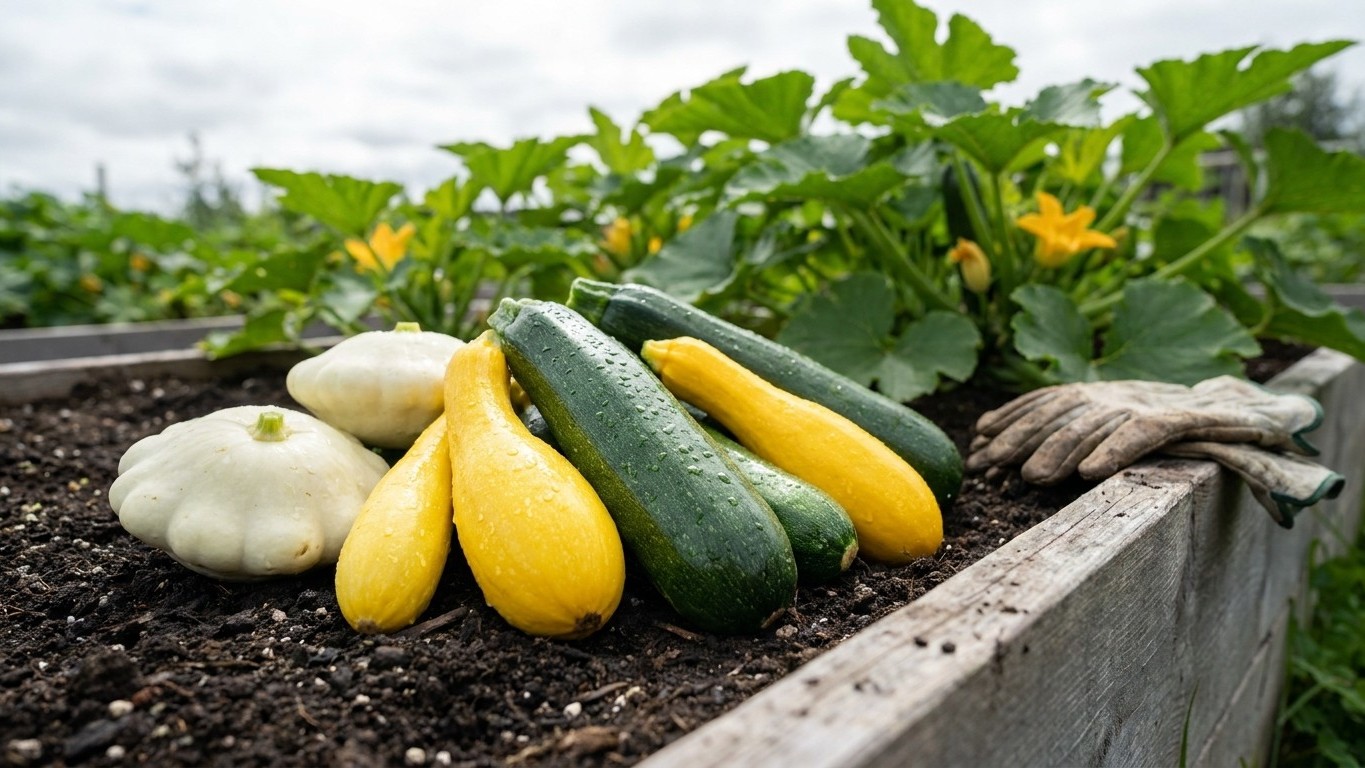

Fast-maturing bush types win here: zucchini, yellow crookneck or straightneck, and scallop (patty pan) squash bred to finish in 40 to 55 days. Saskatchewan’s frost-free window is short and unreliable on both ends, and summers never reach the heat that some squash varieties need to set fruit well. That combination rules out slower, heat-hungry types before you even open a seed catalog.
The short answer for Saskatchewan
Saskatoon’s climate normals give a mean last spring frost of May 18 and a mean first fall frost of September 18, a frost-free window of 123 days on average. That sounds workable for summer squash, which typically needs 40 to 65 days from seed to first harvest. But a mean date is not a safe date: in one year out of two, the last spring frost falls later than May 18, and in one year out of two, the first fall frost arrives earlier than September 18. Stack those two probabilities and the real, usable window in a rough year can run well under 100 days.
That’s the number that should drive variety choice. Among summer squash types, the decision comes down to how fast a cultivar reaches harvest and how reliably it germinates in cool soil. Bush zucchini and bush yellow summer squash (crookneck and straightneck) are bred for exactly this: quick germination, a short run to first flower, and harvest windows clustered in the 40-to-55-day range. Scallop and patty pan types run similarly fast. These are the types that fit inside a window that might shrink on either end without warning.
Cousa (Lebanese-style) squash and other longer-season summer squash types are a harder sell here. Saskatoon’s climate normals also show zero days a year averaging 90°F or higher, meaning there is no reserve of extra heat later in the season to push a slower-finishing plant across the line. A squash that needs 60-plus days and a run of warm nights to size up its fruit is fighting both a short season and a cool one at the same time.
: for this territory, the winning move is picking the fastest-maturing cultivar within whichever summer squash type you already like to eat, not picking a type based on flavor preference alone and hoping the season cooperates.
What will not work here
Long-season varieties
Any summer squash variety listed at 60 days or more to maturity is gambling with a season that averages 123 frost-free days but can run shorter in half of all years. Plant a 65-day variety on the mean last-frost date and you’re already assuming the frost cooperates and the fall frost holds off past its own mean date, September 18. Both of those assumptions fail about half the time. A slow variety has no margin left if either one goes wrong.
Varieties that need real heat to set fruit
Some summer squash cultivars, particularly ones bred for hot-summer regions, need a run of warm nights to set and size fruit reliably. Saskatoon’s normals show an average of 0.0 days a year at or above 90°F. There’s no heat surplus here to compensate for a variety that sulks without it. Plants may flower but set fewer fruit, or size up slowly enough that the short season runs out before there’s much to harvest.
A rainfall assumption borrowed from elsewhere
Summer rainfall across June, July and August averages about 6.6 inches, and August, the month when fruit is sizing fastest, is also the driest at 1.68 inches. That’s not drought territory, but it’s not enough to skip watering either. A garden plan that assumes rainfall alone will carry squash through August, the way it might in a wetter region, will produce smaller, tougher fruit and earlier plant decline. This figure never reads alone, either: sandy soil lets that 1.68 inches drain through in a day, while clay holds it for a week, so the same rainfall total means very different watering schedules depending on what’s underfoot.
None of these are universal squash-growing problems. They’re specific to a province where the season is short and uncertain at both ends, the summer heat load is close to nil, and August rainfall is thin. A variety pushed past its comfortable range on all three points at once is the one that disappoints.
What changes across Saskatchewan
The hardiness zone figure available for this territory, 3a on the Canadian system, comes from a single reference point: Saskatoon. It is not a province-wide number. Natural Resources Canada builds its hardiness zones from seven climate variables, not one, and openly states there’s no simple way to convert between the Canadian and USDA systems, or to assume one city’s zone describes a whole province. Saskatchewan stretches from agricultural land in the south to boreal forest in the north, and a zone map built on minimum winter temperature, frost-free period and several other variables is going to shift meaningfully over that distance.
What that means practically: a garden well north of Saskatoon, or at higher elevation in the Cypress Hills area, should assume a shorter and later-arriving frost-free window than the Saskatoon normals describe, and lean even harder toward the fastest-maturing summer squash varieties available. A garden in the milder, longer-season pockets of the south may have more room to experiment with a slightly slower variety.
The honest answer is that there is no single hardiness zone for Saskatchewan, and no single frost-date pair either. Natural Resources Canada publishes an interactive zone map built for exactly this problem, letting a reader look up the zone for their own municipality rather than borrowing Saskatoon’s. Check it before locking in a sowing date or a variety choice: Canada’s Plant Hardiness Site.
Where to check this for your own county
Saskatchewan doesn’t use counties in the way many U.S. states do, but the principle is the same: a provincial figure is a starting point, not a final answer, and your local growing conditions can differ from Saskatoon’s in ways that matter for a crop with a tight window like summer squash. The province’s agriculture ministry is the place to check what applies to your specific area rather than the Saskatoon reference station.
Start with Saskatchewan’s agriculture and agribusiness resources: saskatchewan.ca : Agribusiness, Farmers and Ranchers. Two things are worth hunting for there specifically. First, any regional planting guidance or frost-date data for your part of the province, since the Saskatoon normals used here can run weeks off from conditions in the north or in higher-elevation districts. Second, any variety trial results or extension recommendations for summer squash grown under Saskatchewan conditions, since provincial or regional trials test cultivars against local disease pressure and season length in a way a general article can’t.
A local recommendation beats a provincial one every time, for the same reason a provincial one beats a generic gardening guide written for a different climate entirely. Your local ag office, extension contact, or a nearby Master Gardener program works from what actually happens on ground closer to yours. Treat the numbers here as the starting estimate to bring with you when you ask, not as the final word.
Checking this against your own garden
Every date and average in this article is a regional mean. Your own garden will tell you more than any of them, and it does it through three signs worth learning to read without any special equipment.
First, soil warmth by feel. Summer squash seed wants soil that’s genuinely warm, not just frost-free air. Push a finger a couple of inches into the soil in the morning; if it still feels cold and damp rather than mild, the ground hasn’t caught up to the calendar yet, whatever the mean frost date says. Second, watch for the first flush of male flowers, the ones on longer, thinner stems that open before any fruit-bearing female flowers appear. Their timing tells you how the season is actually running in your specific spot, sheltered yard or exposed field, compared to the regional normal. Third, note when the first true leaves appear after the seedling’s initial rounded leaves. A slow gap between germination and true leaves usually points to soil that’s still cooler than the plant wants, a useful early warning before you’ve committed a whole season’s worth of hope to one sowing date.
None of these replace the planning value of frost normals or provincial variety trials. But they’re the tiebreaker when your yard runs warmer or cooler than the Saskatoon reference station, and that gap is often the difference between a summer squash harvest that starts on time and one that runs out of season before it gets going.