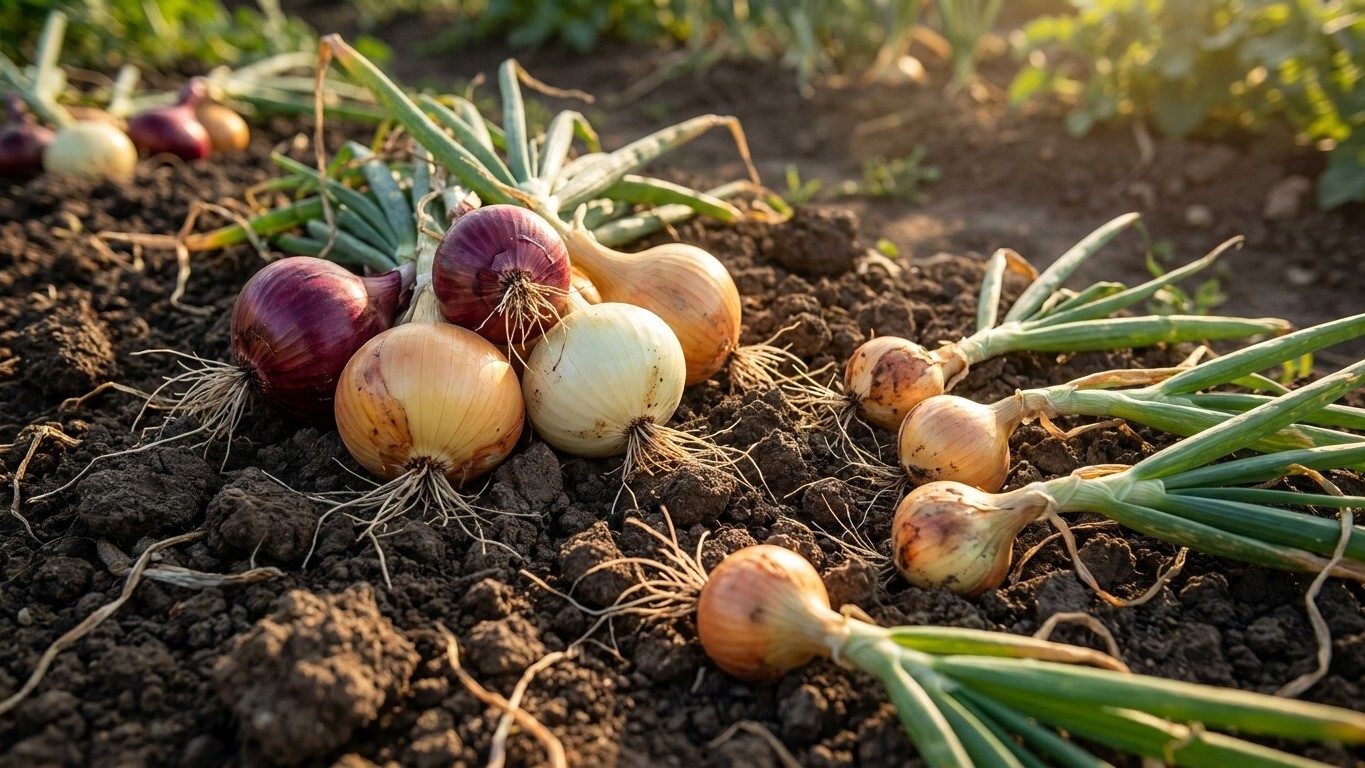

Lift onions once the tops have flopped over and started to yellow, then cure them in a dry, airy, rain-proof spot until the necks are tight and the skins papery. Only after curing do they go into storage, somewhere cool and dry that stays above freezing. Pungent, long-day varieties can carry a household deep into winter. Sweet ones won’t, so eat those first. Where you store them decides how long the crop lasts, and that is where most northern gardeners lose bulbs.
Keeping them, and for how long
Clemson Cooperative Extension’s Home & Garden Information Center puts the target plainly: “Ideal conditions are between 45 °F and 55 °F, and 50 to 60 percent humidity.” Onions want dry air. Carrots, beets and other roots want the opposite, which is why one cellar corner rarely keeps both well.
Those numbers describe the best case. How long onions last is a ceiling reached only when every step goes right: a proper cure, sound bulbs, steady temperature, dry air. A well-cured pungent onion can last into March. A bulb with a thick green neck, a bruise or a maggot tunnel will fail well before that (the What Eats Onion in Alaska, and When guide shows which damage to sort out at harvest).
Why do some onions keep and others rot?
The bite of an onion comes from volatile sulfur compounds, and those same compounds help protect the bulb in storage. University of Missouri Extension states the rule in its onion guide (G6355): “As a rule, ‘sweet’ onions do not store as well as the more pungent types.” A sweet variety carries fewer of those compounds. It tastes better raw, but it will not make it through the winter, so don’t plan on it.
Day length lines up with this. Bulbing is triggered by the length of the day, not by warmth. Clemson Extension notes that short-day onions start bulbing at about 12 hours of daylight. They bulb early and stay small in the north, and they run sweeter. Long-day types wait for 14 to 16 hours, then make large bulbs that keep longer.
In Anchorage, at 61.17 degrees north, the longest day brings 18 h 56 of daylight. That is plenty for long-day onions to bulb. A gardener much farther north or south should check their own latitude, because day length shifts quickly with it. The The Best Onion Varieties for Alaska page sorts the choices by how well they keep.
How do you cure onions before storing them?
Curing comes first, always. Pull the bulbs on a dry day once most of the tops have fallen over. Brush off the soil, but don’t wash them. Leave the tops on and spread the onions in a single layer on screens, slatted racks or newspaper. The spot needs moving air, shade and a roof, because rain on drying bulbs invites rot. A covered porch works, and so does a garage with a fan running. Short Alaska autumns often bring damp weather, so be ready to move the racks indoors.
Curing is finished when the neck is tight and no longer squeezes soft, and the outer skins rustle like paper. Bulbs with necks that stay thick and juicy won’t keep, so put them in the kitchen first. Trim the tops to an inch or so and clip the roots. Then the onions are ready for the cold, dry place they’ll spend the winter in.
Where in the house that actually is
A domestic fridge runs colder than the 45 °F floor, and it is humid inside. Onions kept there for months get soft and pick up moisture. Keep it for cut onions only.
A heated living space has the opposite problem. Anything above 55 °F wakes the bulbs up, and they sprout early. A kitchen cabinet next to the stove is the worst spot in the house.
A garage or shed swings with the weather. In Alaska that can mean mild afternoons in September and hard freezes by November. A frozen onion looks fine until it thaws, then collapses into mush. Even a garage that stays above freezing most of the winter can drop below it during one cold snap.
The room that comes closest is usually an unheated interior space that stays cool without freezing: a closet on the north side of the house, a spare room with the heat turned down, an enclosed porch that doesn’t freeze, or a basement corner far from the furnace. A basement works only if it is dry. A damp cellar suits roots and ruins onions.
Before the crop moves in, put a min-max thermometer in the chosen spot for a week and read both ends of the range, especially after the coldest night. Skipping this check is how a whole winter’s crop ends up frozen or sprouted by January. A cheap hygrometer will show whether humidity sits near 50 to 60 percent. If it climbs higher, add airflow or move the bulbs.
Store onions in mesh bags, slatted crates or shallow boxes so air moves around each bulb. Keep them away from potatoes, which like it damper. Check the stash every few weeks and use any soft or sprouting bulb at once, since one rotting onion can spoil its neighbors.
Common questions
Can I leave onions in the ground until the first hard frost?
Leaving them is risky. Once the tops have fallen and yellowed, the bulbs are done growing, and sitting in cold, wet soil only invites rot and sprouting. Lift them on a dry day and cure them, even if frost is still weeks away. If a hard freeze threatens while the tops are still green, pull the bulbs and finish curing indoors. Eat those first, since a bulb with a thick neck won’t keep.
Can I store sweet onions through the winter?
Not reliably. Sweet onions have fewer of the sulfur compounds that protect pungent types, so they soften and rot sooner. Cure them well, store them cool and dry, and plan to use them in the first weeks. If you want onions that last into late winter, grow a pungent long-day variety alongside the sweet ones.
What do I do with onions that won’t keep?
Use them first, or process them. Chopped raw onions freeze well in bags for cooking, though they lose their crunch. Slicing and drying them in a dehydrator also works. Bulbs with thick necks, bruises or damage are the ones to cook or freeze soon after harvest.
Why are my stored onions sprouting or going soft?
Sprouting usually means the room is too warm, or the bulbs were stored before curing was done. Soft spots, especially near the neck, point to moisture: an incomplete cure, humidity above the 50 to 60 percent range, or poor airflow. Move the onions to a cooler, drier spot, use any with soft spots right away, and check a thermometer reading before you blame the variety. Your county extension office can help if the problem keeps coming back.
For the rest of the season’s work, the Onions in Alaska guide covers planting and care from transplant to harvest.