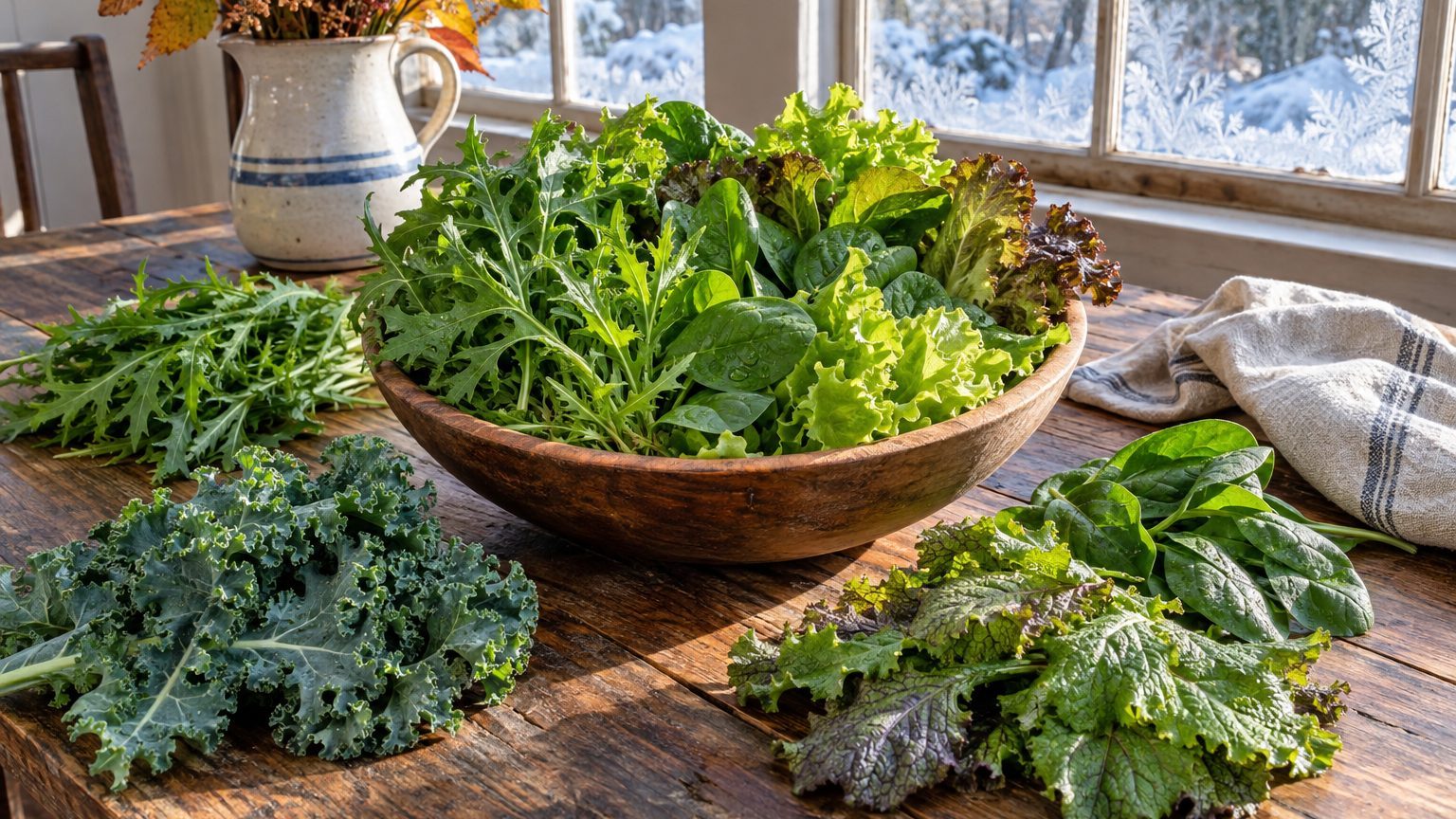

The best winter salads for Saskatchewan are the hardiest leaf crops: spinach, mâche, claytonia and kale, plus a tough lettuce or two if you can give them cover. Sow them in late summer and grow them under protection. With a coldest-month average low of -20.7 °C (-5.3 °F), a January harvest from bare ground is a long shot, but a cold frame or low tunnel changes the odds.
The short answer for Saskatchewan
Decide by type. Spinach and mâche go in the coldest beds, claytonia and kale back them up, and head lettuce only goes under cover. Slow, fussy crops such as radicchio and Belgian endive are poor bets on the Prairies.
The calendar explains why. The Saskatoon reference station has about 123 frost-free days between the mean last spring frost (May 18) and the mean first fall frost (September 18). Both are averages from Environment and Climate Change Canada’s 1981-2010 normals, so in one year out of two the last spring frost falls later than May 18 and the first fall frost arrives earlier than September 18. Treat each date as the middle of a window.
Daylight is the other limit. At Saskatoon’s latitude, the shortest day gives only a short stretch of daylight. Salad plants nearly stop growing through midwinter, even when they stay alive. A winter salad bed here works like a pantry: you grow the plants to near full size before the light fades, then harvest what holds. The practical sowing window sits in late summer, and When to Sow Winter Salads in Saskatchewan lays out the timing in detail.
Which winter salad greens are hardiest?
Here is how the main types compare for a Saskatchewan bed:
| Type | Cold tolerance | Role in a Saskatchewan bed |
|---|---|---|
| Spinach (Giant Winter is a commonly sold hardy type) | Very hardy | The backbone. Sown in late summer, it holds in a frame and resumes growth in early spring. |
| Mâche, or corn salad (Vit is a common variety) | Very hardy | Small rosettes that tolerate hard freezes. Slow to size up, so it goes in first. |
| Claytonia, or miner’s lettuce | Very hardy | Tender, mild leaves that keep through cold spells under cover. |
| Kale (Red Russian, Winterbor) | Very hardy | Sweetens after frost. Baby leaves work as salad greens. |
| Mizuna, tatsoi, arugula | Moderate to hardy | Fast to size up, so they suit the first fall weeks and a frame. |
| Winter lettuce (Winter Density is one example) | Moderate | Cover only. Expect damage in hard cold without a second layer. |
For a wider look at the whole category, start with Winter Salads for Saskatchewan Gardens.
Do winter salads need a cold frame in Saskatchewan?
For anything past November, yes. A cold frame or a tunnel with row cover inside it gives the plants a few degrees of shelter and keeps wind off the leaves. Snow banked around the frame adds more insulation. Vent on mild afternoons, because a closed frame in March sun can cook seedlings that survived January.
What will not work here

Slow crops fail first. Radicchio, Belgian endive and celery-type salads need a long run from sowing to harvest, and a season with a mean first frost of September 18 does not give it to them. Even if you sow in late summer, half of years will bring that first frost sooner than the mean date. Plants that are still small when the light fades never catch up.
Spring sowing fails for a different reason. Spinach, arugula and bok choy sown in April or May meet the long days of June and bolt, which means they send up flower stalks and turn bitter. Late summer sowing avoids this because days are shortening rather than lengthening. Late-summer seedbeds have their own trouble: warm soil and thin rainfall dry out the top inch fast, and lettuce seed often refuses to germinate in hot soil. Shade the row and water lightly every day until the seedlings are up.
Cold itself ends the unprotected tender types. A coldest-month average low of -20.7 °C is the typical figure, and individual nights run colder. Head lettuce and mizuna left in open ground do not make it, and a single layer of thin row cover is not enough on its own. Even the hardiest plants, such as spinach and mâche, are far safer with a frame or tunnel over them than without.
Dry winter wind does damage too. Leaves that survive the temperature can still desiccate when exposed on an open, windswept bed, which describes much of the Prairies. A windbreak on the north and west side, such as a fence, a shed wall or a row of straw bales, helps more than most gardeners expect.
Finally, watering once a week will not carry a late-summer sowing. Seedlings need steady moisture while they establish, and then they can ease off. A bed that starts dry and stays patchy gives you gaps in the row right when the cold arrives, with no time left to resow.
What changes across Saskatchewan
Saskatchewan is not one garden. Natural Resources Canada’s plant hardiness map puts the reference city, Saskatoon, in zone 3a of the Canadian system. That is the Canadian zone, built from seven climate variables, and it does not convert to a USDA zone. NRCan itself says there are no simple conversions between the two systems. Zone 3a describes the reference city and not the whole province, so there is no single answer for Saskatchewan. The province runs from the southern prairie to the northern forest, and the zones change with it.
The frost dates move with the zone too. They come from the Saskatoon station, and northern or upland districts run weeks behind it. A gardener in the north has a spring frost that arrives later and a fall frost that arrives earlier, so the whole sowing window shrinks from both ends. If you are there, sow the slow crops, mâche and spinach, as early in the late-summer window as you can, drop anything that needs a long season to size up, and plan on a second layer of cover from the first hard freeze.
In the south, the window opens a little wider, but the cold hasn’t gone anywhere. Winters on the open southern plains can be as harsh as those farther north, and wind exposure often makes up for what the calendar gives back. A frame with a windbreak still beats a bare bed there.
Hills, valleys and lake shores add small differences inside any one district. Cold air drains downhill and collects in low spots, so a bed at the bottom of a slope frosts sooner than one halfway up. To see where your own municipality falls, check the Natural Resources Canada plant hardiness map and look up your area directly.
Where to check this for your own county
Saskatchewan does not have a county extension office on the American model, but the provincial agriculture ministry runs the closest equivalent. Start with the Government of Saskatchewan agriculture pages and look for two things. The first is a local planting calendar, with frost dates for the station nearest your garden. The second is a list of varieties tried in your area, which tells you what has actually come through a Prairie winter rather than what a seed catalogue promises.
Ask for the nearest weather station to your garden rather than the provincial average. A town forty miles from Saskatoon can have a different last spring frost, and the answer matters more for a late-summer sowing than for a spring one. If the ministry or a regional agrologist has a gardening contact, they can usually say which of the hardy crops above have been reliable for local growers.
A recommendation for your own county or rural municipality beats a provincial one, every time. Province-wide advice, including everything in this article, is an average over very different ground. Use it to choose a type and a rough sowing window, then adjust to what the local sources say.
Checking this against your own garden
Your own observations outrank every date above. Three are worth watching.
- Soil warmth by feel. In August, push your hand into the seedbed. If the soil feels hot to the touch, lettuce and spinach seed will struggle to sprout, so shade the row and wait for a cooler spell. If it feels cool and damp, you can sow.
- The first true leaves. Seedlings show a pair of seed leaves, then the first true leaves that look like the mature plant. Aim for true leaves before the first hard frost. If seedlings are still at the seed-leaf stage in early October, they are behind, and they will need a frame to have any chance.
- Where frost and snow show up first. Walk the yard on the first frosty morning. The spots where frost lies heaviest are your cold pockets, and the spots where snow melts first in spring are your warm ones. Put the frame on the warm side and keep tender crops away from the frost pocket.
Keep a note of the dates you see each year. After two or three seasons, those notes will tell you more than the Saskatoon averages ever can.
Common questions
What is the hardest winter salad green for Saskatchewan?
Mâche and spinach are the hardiest salad greens you can grow here, with claytonia and kale close behind. All four tolerate hard freezes, especially under a cold frame or low tunnel. Mâche is slowest to size up, so sow it first.
Can you harvest salad greens all winter in Saskatchewan?
Not in the open. Growth nearly stops in midwinter because daylight at Saskatoon’s latitude falls to under seven hours at the solstice. Plants grown to near full size by late fall can hold under cover and be picked through the cold months, with fresh growth returning in late winter.
Is Saskatchewan’s hardiness zone 3a the same as USDA zone 3a?
No. Canada’s system uses seven climate variables, and the USDA system uses one. Natural Resources Canada says the two do not convert simply. Always read the Canadian zone against Canadian plant ratings.
When should I sow winter salads in Saskatchewan?
Late summer, working back from the mean first fall frost of September 18 at the Saskatoon station. That is an average, so half of years bring frost earlier. When to Sow Winter Salads in Saskatchewan has the full sowing window.