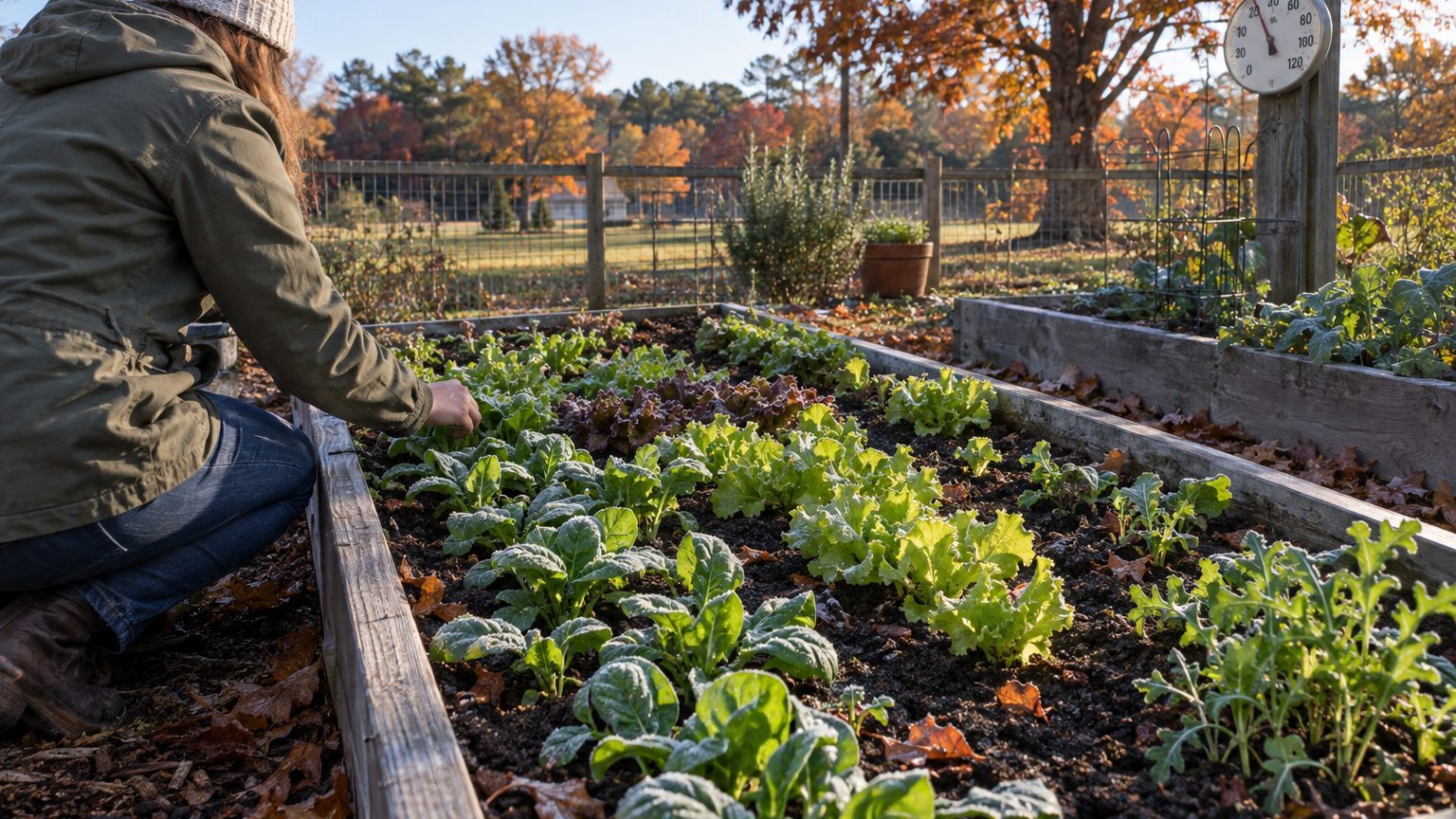

Sow Saskatchewan winter salads in late summer, counting backward from September 18, the average first fall frost at the Saskatoon station. Spring is the wrong season for this crop, and sowing on the frost date itself is too late. The dates here come from Environment and Climate Change Canada normals, and they are midpoints, not guarantees. In roughly half of all years, frost will break them.
The short answer for Saskatchewan
The window for sowing winter salads closes weeks before September 18, the average first fall frost at the Saskatoon SRC station. How many weeks depends on the crop’s days to maturity, which the seed packet states. Everything else on this page hangs from that one subtraction.
Both frost dates in the table are means. A mean is a midpoint, a coin flip. In about half of years the last spring frost comes after May 18, and in about half of years the first fall frost arrives before September 18. Neither date is a safe date.
| Date | What it is | What it is a probability of |
|---|---|---|
| May 18 | Average last spring frost | A midpoint: frost falls after it in about one year out of two |
| September 18 | Average first fall frost | A midpoint: frost arrives before it in about one year out of two |
Both come from the Saskatoon SRC station, using Canadian normals for 1981-2010. Between the two mean dates sit about 123 frost-free days. That is the whole season, and a fall salad crop has to be sown inside its last stretch.
Here is the arithmetic, using a made-up packet that says 40 days to maturity (an illustration, not a variety recommendation). Counting back from September 18 lands on August 9. But growth slows as days shorten, so that crop needs a cushion on top of the 40 days, which pushes the real sowing date earlier still. A packet with a longer number moves the date earlier again.
Cover changes the harvest, not the sowing. A cold frame or low tunnel lets you keep picking after frost, but the plants still have to reach size while the light is strong. This page has no Saskatchewan-trialled sowing dates by crop, so the packet’s number plus a generous cushion is the honest method. For the wider picture of what to grow, see Winter Salads for Saskatchewan Gardens.
What will not work here

Winter harvest from a bare outdoor bed will not work. The mean daily minimum of the coldest month at the reference station is -20.7 °C (-5.3 °F, for comparison with US readers). That is an average of the nightly lows, not a record, so many nights run colder. Salad greens in open ground do not carry through that. They have to be eaten before it arrives or protected from it.
Sowing on the frost date fails too. A seed that goes in on September 18 is a seedling facing a coin-flip frost with almost no growing days left. Because the date is a midpoint, a calendar built on it fails in about half of years. Build in weeks of margin, not days.
Slow crops lose. Any winter salad with a long days-to-maturity figure needs an early start, and after the first half of August the arithmetic stops working for it. The faster types still work later, which is why the choice of variety matters here more than in a long-season state. The Best Winter Salads for Saskatchewan goes into which types suit a season this short.
Borrowed calendars are another trap. Advice written for the Pacific Northwest or the mid-Atlantic says to sow in September, because their first frosts fall much later. Follow that here and the crop sits in cold soil, going nowhere. The mismatch also runs through the data. Canadian normals here cover 1981-2010, while the US figures elsewhere on this site cover 1991-2020, so even the baselines differ.
Mid-summer sowing has its own problem. August seed needs steady moisture to germinate, and lettuce seed in particular tends to stall in hot soil. A bed that dries out between waterings quietly wastes the sowing window. Shade cloth, or sowing in the evening and watering the row daily until seedlings emerge, helps. And in spring, long prairie days push lettuce and spinach toward bolting, so spring is not a second chance at the same crop.
What changes across Saskatchewan
One garden does not stand for a whole province. The figures above come from a single station at Saskatoon, and the Canadian hardiness zone for that reference city is 3a. This is the Canadian system, not a USDA zone, and it does not convert to one. Natural Resources Canada builds its zones from seven climate variables, where USDA uses one, and publishes that there are no simple conversions between them. Its own example: Canadian zone 4a overlaps nine USDA zones, from 3a to 7a.
The page does not have a zone figure for every part of the province, so it cannot give you the spread. What it can say is that there is no single answer for Saskatchewan. The Saskatoon frost dates describe Saskatoon. Northern and upland districts run weeks behind them, and the weeks only go one way, toward a shorter season.
If you garden in the north or on higher ground, treat September 18 as optimistic. Count back from an earlier date, and favor the fastest types over the slowest. Expect your last spring frost to come later than May 18 and your first fall frost earlier than September 18, so each end of the season is squeezed. How much earlier is a question for your own records and your local office, not for this page.
To find the zone for your own municipality, use the Natural Resources Canada plant hardiness map rather than guessing from a neighbor’s garden. Its zones use 1991-2020 normals, which is a different period from the frost dates above. Use the zone to judge what survives winters, and the frost dates to time your sowing. Do not swap one for the other.
Where to check this for your own county
A provincial page like this one is the starting point. For your own sowing dates, go to the Government of Saskatchewan’s agriculture pages, the province’s closest equivalent of a US state extension service. Saskatchewan has rural municipalities rather than counties, but the idea is the same: the closer the advice is to your ground, the better it is.
Two things are worth looking for there. The first is a local planting calendar, ideally one that gives dates for your part of the province rather than one for the province as a whole. The second is any list of varieties that were actually trialled near you. A variety that did well in one district’s trials is worth more than ten that merely look good in a catalog.
A county recommendation beats a state one, and this page is the state one. It rests on one station’s frost dates, a single hardiness zone for a reference city, and general reasoning about a short season. It does not have a Saskatchewan winter-salad calendar. The only extension calendar among the sources used here is a tall fescue lawn calendar from Clemson, in South Carolina. That is no use for lettuce in Saskatoon, and I will not stretch it to fit.
If the local office and this page disagree on a date, trust the local office. Where they agree, you can be reasonably confident.
Checking this against your own garden
Your own observations outrank every date above. Three are worth watching, and none needs more than a hand and a notebook.
- Soil warmth by feel. Push your fingers a couple of inches into the bed in the morning. A bed that feels warm while a neighbor’s feels cold tells you that you have a sheltered, sunny spot. Sow there first, and in the fall expect it to hold its warmth longer.
- The first male flowers. If you grow squash or cucumbers, the first male blooms mark when your garden’s season is really moving. Write down the date each year. If it runs a week or two late, your fall window will likely be tight as well.
- The first true leaves. The first pair of leaves after the seed leaves tells you how your bed is growing a crop. If seedlings reach that stage slowly, the packet’s days-to-maturity are optimistic for your spot, and you should sow earlier next time.
Add one more habit: write down the date of the first frost that actually blackens something in your garden. After a few years, that number is worth more than the Saskatoon midpoint.
Common questions
Can I Sow Winter Salads in spring in Saskatchewan?
You can sow salad greens in spring, but they are a different crop from winter salads. The average last spring frost is May 18, which means frost comes later in about half of years. Long summer days then push many greens toward bolting.
Is September 18 too late to sow?
For most crops, yes. It is the average first fall frost, so a seed sown that day has almost no growing time left. The sowing window closes weeks earlier, depending on the crop’s days to maturity.
Does hardiness zone 3a decide my sowing date?
No. The Canadian zone, 3a for the reference city, describes whether plants survive winter, using seven climate variables. Sowing dates come from frost dates and your own garden’s behavior.
Can I use a US sowing calendar?
Not safely. Most US calendars assume a later first frost, and the baselines differ: the Canadian normals here cover 1981-2010, while the US figures on this site cover 1991-2020.