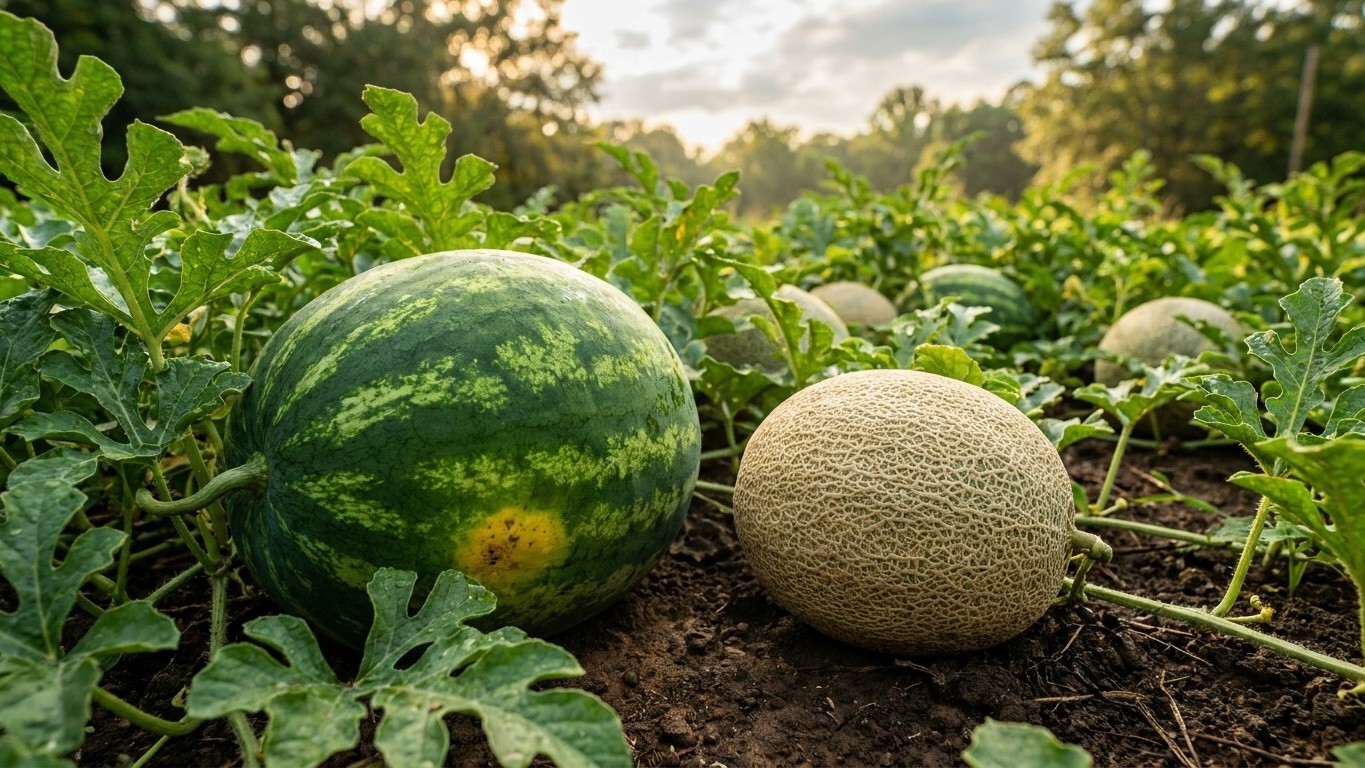

Short-season, heat-tolerant melons win in South Carolina, and long-season honeydew types are the riskiest bet outside the coastal Lowcountry. The state’s frost-free window runs long enough to grow almost anything, but the real filter is summer heat and humidity, not the calendar.
The short answer for South Carolina
Watermelon and cantaloupe (muskmelon) are the safest categories statewide. Both tolerate the heat load South Carolina throws at a garden: the reference station near Charleston logs an average 55.1 days a year at or above 90°F, and that number is the one that actually decides which melon survives a South Carolina July, not the average temperature or the frost dates alone. Vining crops that need a long stretch of steady warmth without a cold snap thrive here, because the frost-free season, from a last spring frost typically falling between February 28 and March 17 to a first fall frost between November 20 and December 5, stretches to roughly eight months at that reference point.
Honeydew and other late-maturing melon types are a harder call. They need every one of those warm months and don’t forgive a late, wet spring or an early cold snap, so they belong closer to the coast, where the frost window itself runs milder than at the airport station used for these normals. Specialty and Asian melon types that expect drier air and a strong day-to-night temperature swing also struggle here, because South Carolina’s summer nights stay warm and its air stays humid, a combination that favors foliar disease over fruit quality.
The practical decision, by type:
- Icebox and standard slicing watermelon: best statewide fit, tolerant of the heat load and forgiving of the humidity if given room to spread.
- Cantaloupe/muskmelon: a close second, reliable almost Everywhere in the state if netting and disease pressure are managed.
- Honeydew and other long-season melons: workable near the coast, riskier inland and upstate where the season closes earlier.
- European or Asian specialty melons bred for dry heat: the weakest fit statewide, undermined by humidity more than by temperature.
None of this comes from a single ideal variety. It comes from matching a melon’s maturity length and disease tolerance to what this state’s summer actually delivers: a long frost-free window, but one loaded with heat and humid rain rather than dry, even warmth.
What will not work here
A melon that needs dry heat to finish well is fighting South Carolina’s climate before it even sets fruit. Summer rainfall across June, July and August averages about 19.8 inches, with June alone delivering 6.21 inches, July 6.6 and August 6.97. That rain rarely falls evenly. It tends to arrive as a thunderstorm that dumps an inch in an afternoon, then leaves the garden dry for a week, which is exactly the pattern that punishes melons bred for a steady, moderate irrigation schedule and rewards varieties with strong resistance to leaf disease.
Spacing habits that work in a drier state fail here. Powdery mildew and downy mildew spread fastest where humid air sits still between plants, so a melon planted at tight, dry-climate spacing in South Carolina’s Lowcountry or Midlands is inviting a disease outbreak by mid-July, right as the days above 90°F start stacking up. This isn’t a minor yield hit. Untreated foliar disease in a hot, humid July can defoliate a vine before the fruit finishes sizing, which is the single most common melon failure reported across the state’s home gardens.
Watering on a fixed weekly schedule doesn’t match this rainfall pattern either. A gardener assuming “it rained an inch this week, that’s enough” is ignoring that a single storm on clay soil behaves nothing like the same inch on sand: clay holds surface moisture for days while sand lets it through within hours, so two gardens ten miles apart under the same storm can need completely different watering decisions the following week. A melon that demands consistent, metered moisture, rather than tolerating feast-or-famine rainfall, is the wrong pick for a state where June is actually the driest summer month at 6.21 inches and August, near harvest for many varieties, is the wettest at 6.97.
Finally, any melon type that needs a full 100-plus frost-free days and a mild finish will run into trouble the moment it’s planted late or in the state’s tighter inland pockets, where the frost window closes several weeks earlier at both ends than it does at the coastal reference station. Betting on a slow-maturing variety without accounting for that gap is the most common way a South Carolina gardener runs out of season before the melon runs out of growing time.
What changes across South Carolina
South Carolina spans USDA Hardiness Zones 7a to 9a, a range built on one measurement only, the average annual extreme minimum winter temperature, according to the USDA Plant Hardiness Zone Map. That’s a two-zone spread across a single state, which means there is no single frost-safe planting date and no single “best variety” answer that applies from the mountains to the coast. A zone spread that wide typically separates a coastal garden that barely sees a hard freeze from an upstate or higher-elevation garden that sees several.
The frost-date range given for this state, a last spring frost between February 28 and March 17 and a first fall frost between November 20 and December 5, comes from a single reference station near Charleston. Peninsular Charleston itself runs milder than that airport station, while the Upstate runs its frost window several weeks tighter at both ends, according to the same NOAA Climate Normals data. That gap changes the math for melon choice directly: a coastal gardener has room to gamble on a longer-season honeydew or a late-planted cantaloupe succession, while an Upstate gardener working with a shorter window should default to faster-maturing icebox watermelon and short-season cantaloupe types and treat any later planting as a race against an earlier fall frost.
Elevation compounds the zone spread in ways a statewide page can’t resolve. Higher ground in the Upstate cools faster on both ends of the season than the Midlands or the coastal plain, even within the same nominal hardiness zone, because elevation and cold-air drainage shift local frost timing independent of latitude. A gardener working near the mountains should assume their actual frost window sits at the tighter edge of the statewide range, not the middle of it, and plan melon maturity length accordingly.
None of this tells an individual reader which zone their own garden falls into. That answer sits on the USDA’s own zone map, checked by ZIP code, not on a statewide range.
Where to check this for your own county
This page describes South Carolina as a whole. A county sits inside one part of that 7a to 9a range, one part of that frost-date spread, and one particular soil type, not the average of all of them, and a county-level recommendation from Clemson Cooperative Extension will always beat a statewide generalization built for a single reference station.
Clemson Cooperative Extension is the land-grant extension service for South Carolina, and its site is the starting point for anything county-specific. Two things are worth pulling from there before planting melons in any particular county. First, the local vegetable planting calendar for that county’s extension office, which adjusts the statewide frost-date range down to the dates that actually apply to that soil and elevation. Second, any variety trial results or recommended-cultivar lists published for home vegetable gardens in that region, since Clemson’s horticulture specialists test melon performance against the specific disease pressure and rainfall pattern of different parts of the state, not just the coastal reference station cited here.
A county office can also confirm something this page can’t: how the local soil, sandy near the coast, heavier clay through parts of the Midlands and Piedmont, is likely to interact with that summer rainfall total, which changes how often a given melon variety needs supplemental watering between storms. That’s a detail no statewide climate normal can capture, because it depends on the specific soil survey for that county, not a regional average.
Treat this article as the broad frame, useful for deciding between a watermelon and a honeydew before a single seed goes in the ground, and treat the county extension office as the source that adjusts that frame to one specific piece of ground.
Checking this against your own garden
Every date and average on this page is a regional probability, not a promise about one particular yard, and a gardener’s own observations of that yard outrank all of it once the season actually starts.
Soil warmth, felt by hand a few inches down in the planting bed, is the first check. Melon seed germinates poorly in cold soil regardless of what the calendar says, so a bed that still feels cool and damp in late March, even after the statewide frost-date range has passed, is signaling a slower local warm-up, worth waiting out before committing seed.
The first flush of male flowers on a young melon vine is the second signal. Male flowers typically open before the female flowers that actually set fruit, and their timing tells a gardener how far along the plant’s own internal clock is running compared to the season, useful for deciding whether a variety chosen for its maturity length is actually on pace to finish before the fall frost window closes in that particular yard.
The first true leaves, the ones that emerge after the initial seed leaves and start looking like a recognizable melon leaf, mark the point where a seedling has moved from surviving off stored seed energy to actually growing on its own. A slow, stunted appearance of true leaves after a cool, wet spring is a local signal to hold off on additional plantings rather than assuming the statewide frost-free window is already reliably open.
Reading these three signs in a specific garden, rather than trusting the regional dates alone, is what turns a statewide range into an actual planting decision for one particular yard.