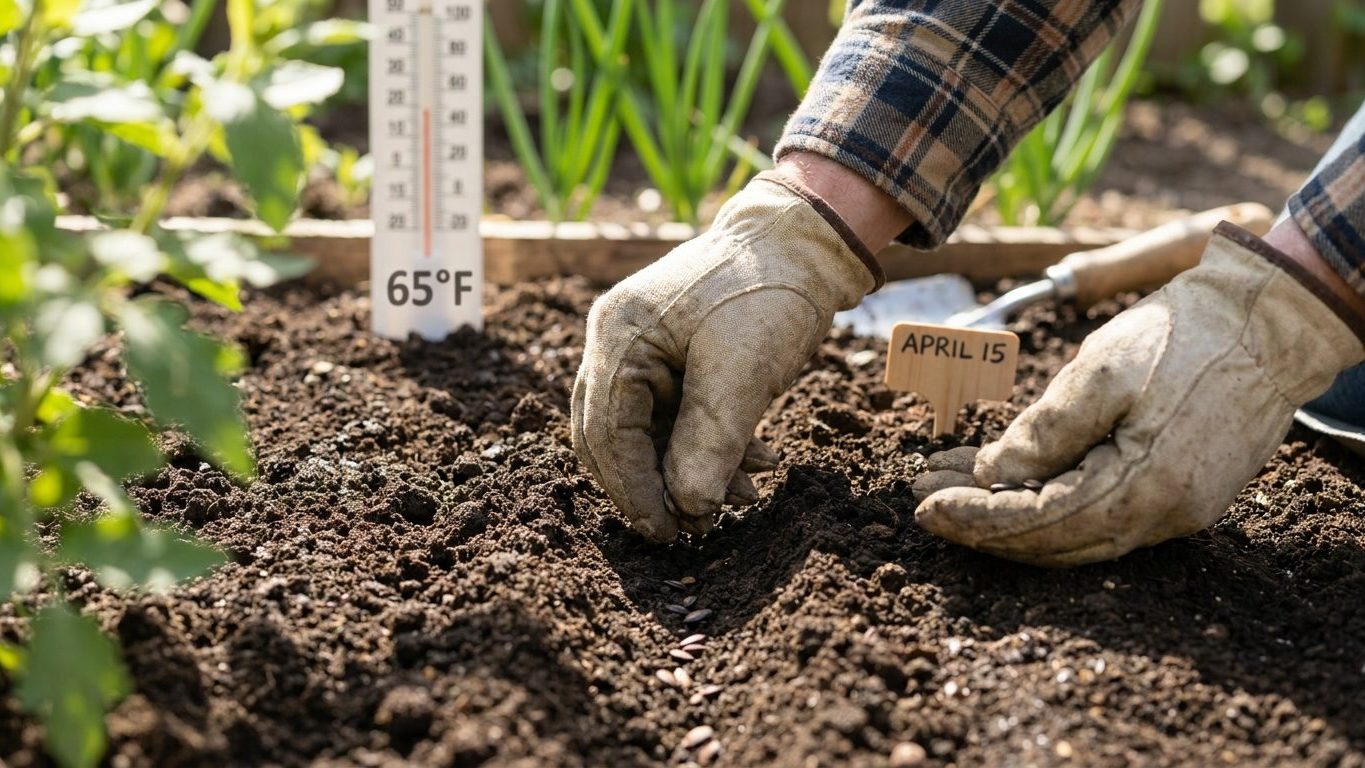

Across most of South Carolina, melons go into the ground from mid-April through mid-May, once soil has shaken off the last frost risk of late winter. The state’s frost-free stretch runs long enough, into late November or even early December, that the real limiting factor isn’t season length. It’s getting the timing right on the front end and managing heat and humidity through the middle.
The short answer for South Carolina
Plant melons, whether direct-seeded or set out as transplants, from mid-April through mid-May across most of South Carolina. That window sits safely after the state’s last spring frost date, which NOAA’s 1991-2020 Climate Normals place between February 28 and March 17 at the Charleston-area reference station (USW00013880). On the other end, the first fall frost typically arrives between November 20 and December 5 at that same station, which leaves roughly eight months of frost-free growing time. That’s far more than melons need to mature, so the fall date rarely forces a decision the way it does for northern gardeners.
Those frost dates aren’t a hard switch that flips from freezing to safe. NOAA defines them as the 30-70% probability band for a 32F freeze, meaning even at the late end of the window, there’s still roughly a 30% chance of frost showing up. Melon seedlings have zero tolerance for that. A grower who plants right at February 28 is gambling on the early edge of a probability spread, not a guarantee. That’s why the practical window pushes past the upper bound of the frost date, into April, before seed or transplants go in.
This page doesn’t have county-level or variety-specific timing data for South Carolina; that detail lives with local extension offices, covered further down. What the state-level numbers do tell you is the shape of the season: a wide berth after the spring frost risk clears, and no real pressure from the fall side. Growers aiming for an early harvest sometimes push into late March in the warmest pockets of the state, but that’s a risk decision made against the 30-70% band, not a schedule guaranteed by the normals.
The bigger question for South Carolina isn’t whether there’s time to grow melons. It’s whether the heat and rain pattern that follows planting will let the crop actually finish, which is where the next section matters more than the calendar does.
What will not work here
Sowing melon seed into soil that’s merely frost-free, but still cold from a slow South Carolina spring, is the first common failure. The frost dates measure air temperature at 32F, not soil temperature, and melon seed sitting in cool, damp soil tends to rot before it germinates rather than wait patiently for warmth. A grower who plants the moment the last-frost window closes, rather than a few weeks after, is often solving the wrong problem.
The second failure comes from the state’s heat load. The Charleston-area reference station averages 55.1 days a year at or above 90F, a heavy tally that drives evaporation hard through the exact months melon vines are sizing fruit. A weekly watering routine, the kind that works fine in a milder climate, tends to leave South Carolina melons short on moisture during the stretch that matters most, right as fruit is filling out under sustained heat.
Rainfall that doesn’t behave the way the total suggests
South Carolina isn’t short on summer rain. June, July, and August bring about 19.8 inches combined, with June the driest at 6.21 inches and August the wettest at 6.97. On paper that looks like plenty. But that rain doesn’t arrive evenly. It tends to come as thunderstorm bursts that run off a hot, dry surface rather than soaking down to root depth, especially on the sandier soils common across the Coastal Plain. A grower who skips irrigation because “we’ve had rain this month” is trusting a monthly total that doesn’t describe how the water actually reached the ground.
The fourth failure is spacing borrowed from a drier state’s garden guide. South Carolina’s combination of summer heat and regular rain events builds humid, still air around a melon patch fast, and that’s exactly the condition that lets powdery mildew and downy mildew take hold. Vines packed in tight, the way a grower might space them in a low-humidity climate, lose airflow and hold moisture on the leaf surface longer after every rain or dew. That’s not a minor cosmetic issue here; it’s often the difference between a vine that fruits through August and one that collapses in July.
What changes across South Carolina
South Carolina isn’t one growing zone, and treating it like one is where a lot of statewide advice goes wrong. The USDA Plant Hardiness Zone Map, built from average annual extreme minimum temperatures under the 1991-2020 normals, places the state across a 7a-9a range. That’s a two-zone spread, and it doesn’t just move the frost dates around at the margins; it shifts the whole planting calendar by real weeks.
The coastal reference station used for the frost dates in this article already skews milder than the state average, since Charleston-area readings run warmer than the interior. NOAA’s caution on this data is direct: peninsular Charleston itself runs even milder still, while Upstate South Carolina, in the western hills near the North Carolina border, runs its frost dates several weeks tighter on both ends. A last-frost date that lands in early March along the coast can easily push into late March or beyond in the Upstate, and the first fall frost arrives correspondingly earlier there too.
That spread matters more for melons than for a lot of other crops, because melons are among the least frost-tolerant plants in a home garden and among the slowest to forgive a cold snap. A planting date that’s comfortably safe in the Lowcountry can land squarely in frost risk territory in the foothills, even though both places are technically “South Carolina.”
This page can describe the range, but it can’t tell an individual reader which zone their own yard falls into, since zone boundaries shift with elevation, distance from the coast, and even local terrain like valleys that pool cold air. The USDA’s online hardiness zone map lets a reader enter a ZIP code and get a specific zone reading for their own address, which is the right tool for narrowing a statewide 7a-9a range down to something usable.
Where to check this for your own county
A state-level planting window, the kind on this page, is a starting point, not a finish line. Clemson Cooperative Extension is South Carolina’s land-grant extension service, and it’s organized by county office, which means the agents there work with local trial data and local growers rather than a single statewide average. That’s a meaningfully different resource than a national climate normal, because it accounts for microclimate patterns a statewide dataset simply averages away.
The place to start is Clemson Extension. From there, look specifically for county-level vegetable planting guides and any variety trial results for melons grown in that region. Clemson’s Home and Garden Information Center publishes crop-specific guidance the same way it handles other categories, with separate material by crop rather than one blanket document, so the goal is finding the vegetable gardening section for the reader’s own county rather than a generic statewide page.
What a county office adds that a state figure can’t is local trial history: which melon varieties have actually performed well in that county’s soil and disease pressure, and what planting window local growers have found reliable in practice, not just in probability bands. A county recommendation, built from years of local observation, outranks a state-level answer like this one every time they disagree. This page describes what the statewide numbers say. A county agent describes what has actually grown well down the road.
Reaching out directly is also worth the five minutes it takes. Most county extension offices take phone calls and walk-in questions from home gardeners, and a quick question about local melon timing often gets a more specific answer than anything published online.
Checking this against your own garden
Every date on this page is built from a 30-year average at one reference station. A reader’s own yard, with its own soil, slope, and sun exposure, is the more reliable instrument, and it doesn’t require anything more than a bit of attention.
Soil warmth by feel is the first check. Cold, clammy soil that clings and feels damp against bare skin is still telling a melon seed to wait, regardless of what the calendar says. Soil that feels dry-warm and crumbles loosely is a better signal that the ground itself, not just the air, has caught up to the season. Since melon seed tends to rot rather than simply sit dormant in cold wet ground, this single check prevents the most common early-season failure.
The first flush of male flowers is the second signal worth watching. Melon vines typically produce a run of male blooms before the female flowers, the ones with a small swelling at the base that will become fruit, show up. A garden running warm for its microclimate tends to push that first flush earlier than a neighbor’s plot a mile away in a lower, shadier spot; a garden lagging behind is a sign the vine is still catching up to the season’s heat.
The emergence of the first true leaves, the leaves that appear after the initial rounded seed leaves, rounds out the picture. Quick, vigorous true-leaf growth suggests the local soil and sun combination is running warm and the vine is thriving; slow, stalled growth is worth reading as a sign that a particular spot, maybe a low corner that holds cold air, runs cooler than the rest of the yard and might need a later planting date next season.