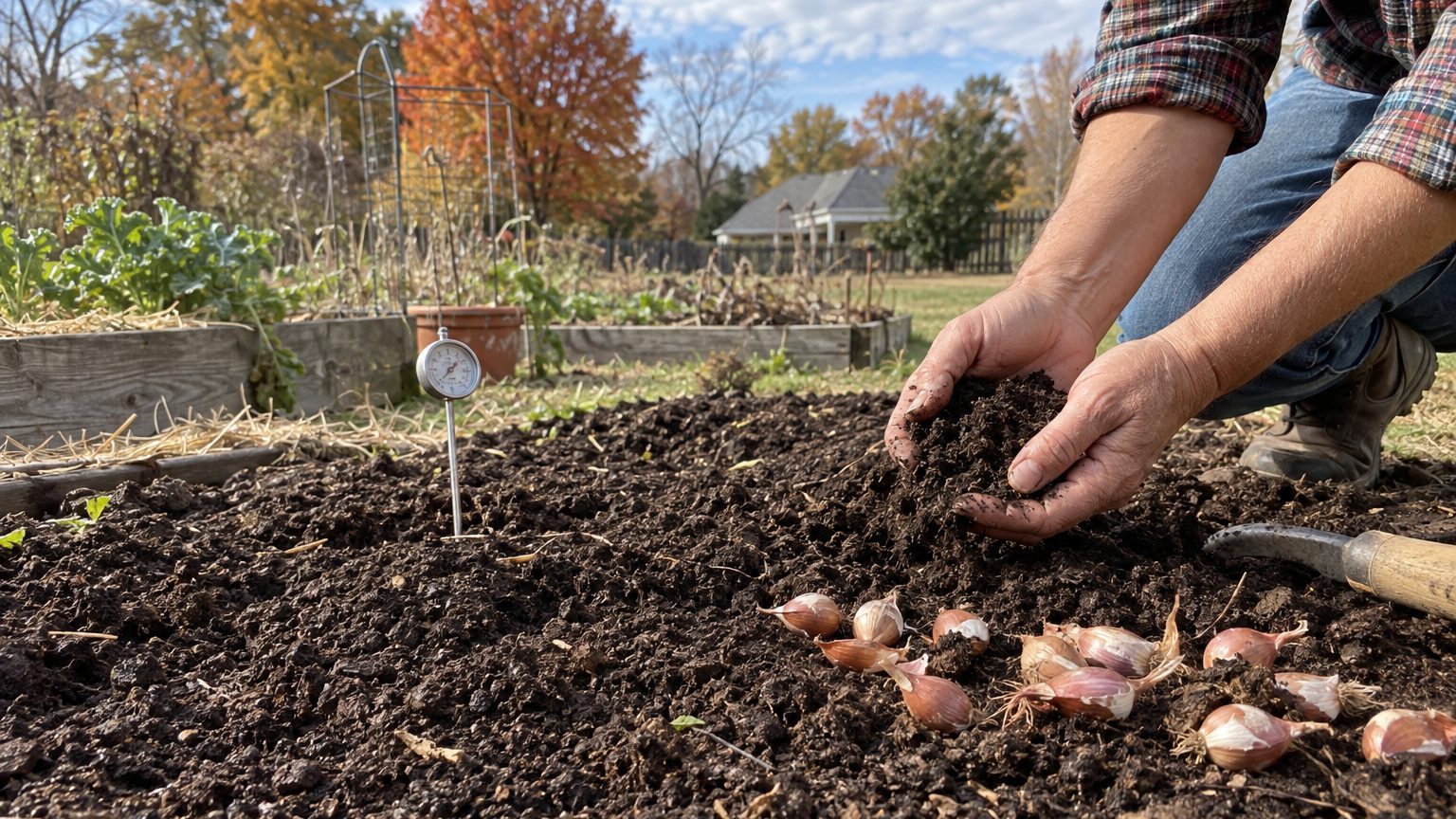

In South Carolina, shallots go in the ground in fall for a bigger, earlier crop, with late winter as the fallback. The Charleston reference station puts the last spring freeze somewhere between February 28 and March 17, and the first fall freeze between November 20 and December 5. Those dates frame the planting windows below. The Upstate sits several weeks tighter, so adjust for where you live.
When the soil is warm enough in South Carolina
Start with the date everyone asks about. At the Charleston station (USW00013880), NOAA’s 1991-2020 Climate Normals put the last spring 32°F freeze between February 28 and March 17, using the 30-70% probability band. That is a probability, not a promise. A freeze after the later date can still happen in any given year, and the band says only that it becomes unlikely.
A frost date is also just a proxy. Shallots don’t care about the calendar. They care about the soil: whether it has drained after winter rain, whether it crumbles instead of smearing, and whether it has warmed enough that roots start working. Soil warms after frost risk ends, not along with it, so the date marks the earliest point to start checking, not the day to plant. Push a hand trowel in. If the soil comes up in a wet, glossy clump, wait.
Shallots are tougher than most spring crops, so the practical sequence runs the other way from tomatoes. The sets can go in while nights are still cool, and the crop’s real deadline is the heat that arrives later. That is why fall is the main window in much of the state. Planting around the weeks that surround the November 20 to December 5 first-freeze band lets roots establish in cool ground and the tops stay compact through winter. The same logic runs the garlic calendar, and the garlic section of this site covers autumn planting in detail. Shallots differ in one way: they are planted as small sets, usually shallower and closer together, and each one multiplies into a cluster instead of forming a single bulb.
A caution on the figures. Peninsular Charleston is milder than the airport station, and the Upstate runs several weeks tighter at both ends. A gardener near Greenville should expect a later spring thaw and an earlier fall freeze than the numbers above. For dates that match your county, Clemson Extension is the right place to confirm, since its agents see local frost patterns every year.
One more point belongs here because it touches food safety. When the tops fall over and dry in late spring or early summer, the bulbs still have to cure, and in a humid state that step is where things go wrong. Inspect each bulb before you store it. The neck should be dry and tight, the skins papery, and the base firm. A soft neck or a moldy base ends the question: that bulb does not go into storage, and looking sound from the outside proves nothing. Curing and storage practice overlaps heavily with garlic, so the garlic pages on this site cover the shared method. For the broader picture of how this crop behaves, the main guide, Growing Shallots: One Bulb In, a Handful Out, sets the baseline.
How long the season lasts here
Count the days between the two dates and you get the real size of the window. Using the same Charleston station and the same 30-70% band, the shortest plausible stretch runs from March 17 to November 20, which is 248 days. The longest runs from February 28 to December 5, which is 280 days.
| Measure | Earliest case | Latest case |
|---|---|---|
| Last spring 32°F freeze | February 28 | March 17 |
| First fall 32°F freeze | November 20 | December 5 |
| Frost-free window | 248 days (March 17 to November 20) | 280 days (February 28 to December 5) |
What does a window of 248 to 280 days allow? Plenty. A season that long is not what limits shallots here. A bulbing crop needs only a fraction of it, so the same bed can take a second planting, and the frost-free count says nothing about the heat that ends the crop’s useful life well before the first fall freeze. The limit is how far into summer the plants can keep growing without stalling.
That makes succession planting realistic. A first planting of sets in fall or very late winter can be followed by a second, staggered a few weeks behind, which spreads the harvest instead of dropping it all in one hot week. The Arizona page shows the opposite problem, where heat compresses everything. Succession timing has its own guide on this site, and it applies here because a long window rewards staggering.
Transplanting also changes in a long season. In a short climate, a transplant is a gamble that pays only if the root check goes well, because there is no time to restart. Here, a setback costs less, since the crop has room to recover. Even so, check roots before you set anything out. Healthy ones are white and firm, not brown, slimy or tangled into a mat.
Keep the Upstate in mind. If your last freeze runs several weeks later and your first comes several weeks earlier than the Charleston band, the window shrinks, and the 248-day floor stops being a safe assumption. In that case, treat the first planting as the main crop and a second as a bonus.
Heat and water in South Carolina
The winter side decides the autumn-versus-spring question.
At the Charleston reference station, the mean daily minimum of the coldest month is 38.9°F. That is the average overnight low, not a record, and it points to winters that rarely lock the ground. The USDA Plant Hardiness Zone Map (2023, built on 1991-2020 normals) lists the state as 7a to 9a, a wide range based on the average annual extreme minimum. Charleston sits at the milder end of what the state offers, and the Upstate sits colder. Your zone is the one for your town, not the state.
On the coast and across much of the Midlands, that mild winter favors fall planting. Sets put in autumn get a long stretch of cool, active root growth and tend to produce larger bulbs earlier than a late-winter planting, which is the reason autumn planting is used at all. The risks in that setting are different from a northern garden’s. Heaving from repeated freeze-thaw is a smaller worry. Waterlogging is the larger one, because winter rain on heavy clay can rot sets before they root. Raised beds or ridged rows solve most of that, and so does keeping organic matter in the mix so the bed drains.
Where winters bite harder, the call flips. In the colder Upstate, a hard freeze on wet ground can push a shallow set out of the soil, and a deep cold snap before roots establish can set back a late fall planting. Gardeners there often do better planting in late winter, as soon as the ground is workable, and accepting a somewhat smaller bulb in return for a safer crop. The Louisiana page covers the humid Gulf Coast version of this trade-off, and it is a useful comparison for the Lowcountry.
Summer is the other half. South Carolina’s long, warm, damp season is a poor environment for ripening onion relatives. Humidity feeds fungal disease on leaves and necks, and slow drying makes curing harder. The practical response is the same whichever season you plant: space plants for airflow, water at the base in the morning, pull mulch back from the neck as bulbs size up, and harvest once the tops have fallen and dried, not before. Then cure in a shaded, ventilated spot, not in a sealed garage.
Which shallots suit South Carolina
Choose by type, not by name. A cultivar recommendation only means something if it has been trialled where you garden. The state’s land-grant extension system is the right source, and Clemson Extension can tell you what has performed in your county.
The 248 to 280 day window is long, so the earliest-maturing types matter less than they would in a northern state. In fact, earliness has another use here: a type that finishes early can be harvested before the worst of the summer heat and humidity, which helps with curing.
Heat is the next filter. Where summers are hot, favor types that handle warmth without bolting early, and give them what helps any bulb in warm soil: airflow around the plant, a light mulch for shade at the root, and even moisture so the bulb doesn’t swell and then stall. Humidity is the filter that matters most, and for a state this damp, disease resistance should be your first criterion, ahead of flavor or size. Ask an extension agent specifically about resistance to the leaf and neck diseases common in humid summers.
- Coast and Lowcountry: plant in fall, prioritize drainage and disease tolerance.
- Midlands: fall planting works in most years; confirm timing locally.
- Upstate: consider late-winter planting, with frost dates several weeks tighter.
Also decide between sets and seed-grown types. Sets are the simplest route. Seed-grown types are a different crop with different timing, and extension guidance is the place to check if you want to try them. Whatever you buy, inspect it before planting: firm, dry, unblemished bulbs only, no soft spots or mold at the base.
Common questions
Is fall or spring better for shallots in South Carolina?
Fall suits the coast and most of the Midlands, because the winter low at the Charleston station averages 38.9°F in its coldest month and roots can grow through the cool season. In the colder Upstate, late winter is often the safer call.
What is the last spring frost date?
At the Charleston station, NOAA’s 1991-2020 normals give February 28 to March 17 for the 30-70% probability band of a 32°F freeze. Inland and Upstate dates run later.
Can I plant a second round of shallots?
The frost-free window is 248 to 280 days at the Charleston station, which leaves room for a staggered second planting. Summer heat, not the calendar, is the practical limit, so ask Clemson Extension about timing for your county.
How do I know a cured shallot is safe to store?
Appearance alone isn’t proof. Check that the neck is dry and tight and the base is firm. A soft neck or a moldy base ends the question, and that bulb should be discarded. Even sound bulbs should be checked regularly, since a single bad one can spoil its neighbors.