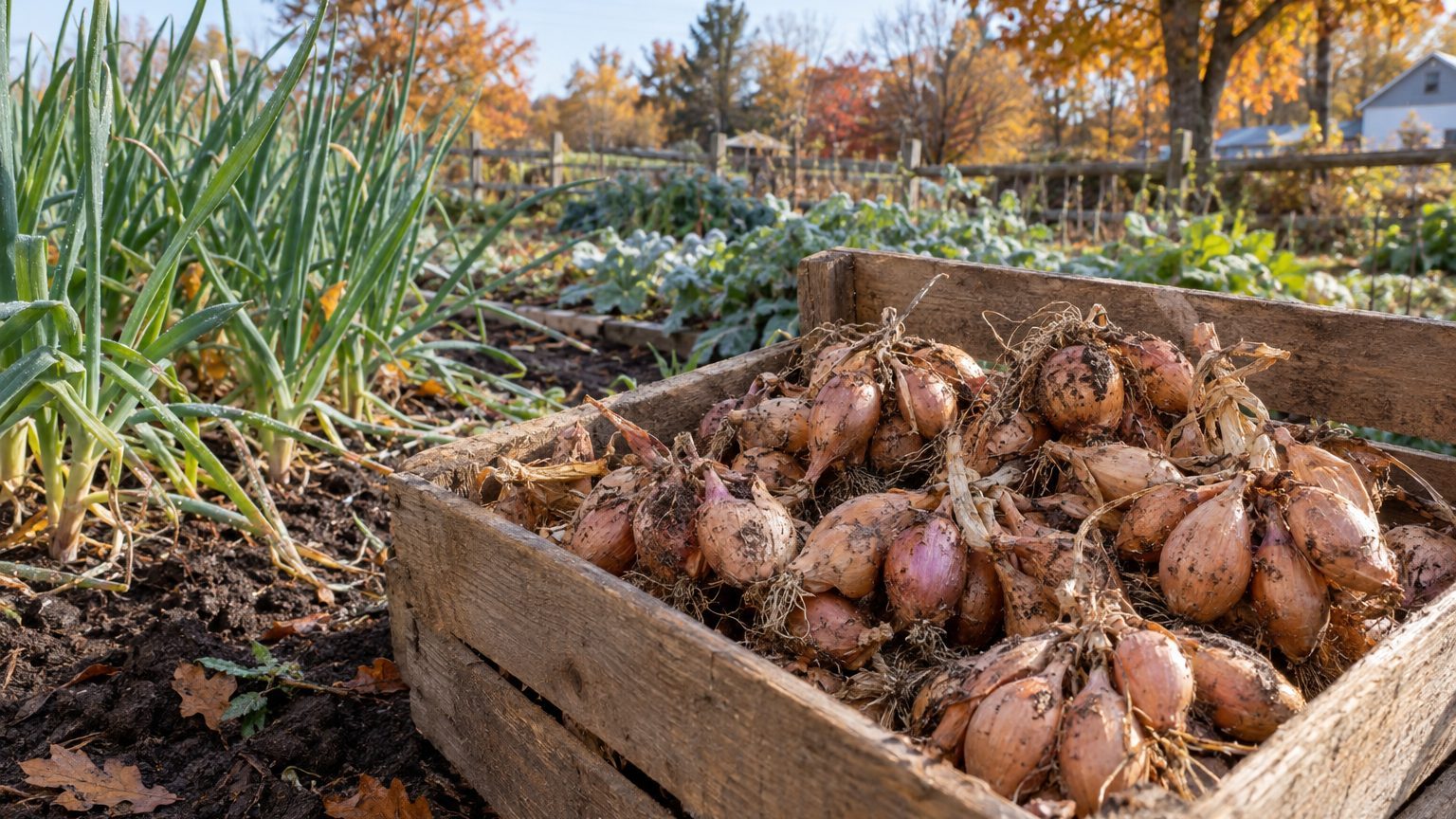

For most South Carolina gardens, the best shallots are multiplier types grown from bulbs and planted in fall. They root through a mild winter and size up in spring, before summer heat and humidity set in. Seed-grown shallots are a workable second choice. Spring-planted, slow-maturing types are the weakest bet in this state.
The short answer for South Carolina
The reasoning starts with the frost dates. For the Charleston reference station (NOAA NCEI 1991-2020 Climate Normals), the last spring frost falls between February 28 and March 17, and the first fall frost between November 20 and December 5. Those dates are a probability, not a promise. They mark the band where the chance of a 32°F freeze sits between 30 and 70 percent, so a freeze can still show up outside them. The numbers come from NOAA’s station data.
The same normals put the mean daily minimum of the coldest month at 38.9°F. A shallot sitting in the ground through that winter is not in danger. That changes the question from “which variety survives?” to “which type finishes before the heat arrives?”
Why bulb-grown multipliers lead
A multiplier shallot planted as a bulb already has a head start. It splits into a cluster of new bulbs, and in a state where winter barely pauses growth, the roots and leaves can work from late fall onward. By the time days lengthen and warm, the plant is ready to bulb up instead of starting from nothing. That timing is what you want in a place where summer shows up early.
Where seed-grown shallots fit
Seed-grown types cost less to start and avoid carrying over disease on old bulbs. They need more weeks from sowing to a usable bulb, though, and that is the catch here. Treat them as a fall or very early start, not a spring project. The table compares the three approaches on the criteria that matter in this state.
| Type | Started from | Best season here | Fit for South Carolina |
|---|---|---|---|
| Multiplier shallots | Bulbs | Fall planting | Strongest match |
| Seed-grown shallots | Seed | Fall or very early start | Workable, less forgiving |
| Slow-maturing types | Bulbs or seed | Spring planting | Weakest match |
For exact timing, see When to Plant Shallots in South Carolina.
What will not work here
Chasing cold hardiness will not help. With a coldest-month minimum of 38.9°F, “extra hardy” is a selling point aimed at northern gardeners, and it does nothing for you. Pick on speed to maturity and rot resistance instead.
Spring planting of slow types is the clearest failure. The last spring frost lands between February 28 and March 17, and warm weather builds fast after that. A shallot started in March has only a short window of cool growth before heat pushes it toward finishing. Small bulbs and thin clusters are the usual result, because the plant never built enough leaf area while conditions were right.
Humidity defeats tight spacing. Shallots crowded into a bed trap moisture around their necks, and the damp, warm stretches of a South Carolina spring invite fungal problems and bulb rot. Give each bulb room, keep mulch thin and pulled back from the bulb itself, and water at the base of the plant, not over the foliage.
Planting too early in fall causes the opposite trouble. Warm soil in September or October can push a bulb to leaf out heavily before the winter slowdown, which leaves soft growth to ride out the freezes that begin once the first fall frost window opens on November 20. Wait for the soil to cool a little. The first fall frost window runs to December 5, so there is no reason to rush.
Finally, do not trust long storage. Shallots cured in humid air and kept in a warm kitchen or garage will sprout or soften sooner than gardeners from drier states expect. Plan to eat the first harvest first, and keep only your best bulbs for replanting.
What changes across South Carolina
South Carolina is not one garden. The USDA Plant Hardiness Zone Map 2023 (built on 1991-2020 normals) lists the state as 7a to 9a, which is a spread, not a single answer. That system rests on one variable, the average annual extreme minimum temperature, so it tells you about winter cold and nothing about summer heat or humidity.
The frost dates above come from a Charleston-area station, and the data carries a warning. Peninsular Charleston is milder than the airport station, and the Upstate runs several weeks tighter at both ends of the season. In practice, the last spring frost comes later and the first fall frost arrives earlier as you move inland and uphill.
If you garden in the Upstate or at higher elevation, shift your thinking in two ways. Plant earlier in fall so the roots establish before the ground chills, and lean harder on mulch over winter, since freezes there are more frequent and arrive sooner. On the coast and on barrier islands, the mild winter allows a slightly later fall planting, but spring heat still arrives early, so choosing fast types still matters.
Check your own zone on the USDA map instead of guessing from the state range, because even neighboring counties can differ. For the full season-by-season picture, Growing Shallots in South Carolina covers site, soil, and care.
Where to check this for your own county
Your state extension service is the best next stop. Clemson Cooperative Extension runs county offices across South Carolina, and the staff there know the soils, disease pressure, and frost patterns in your area.
Look for two things. The first is a local planting calendar for shallots or onions, which should give dates tuned to your county instead of a coastal station. The second is any record of varieties trialled in your county, since a type that performed well in one part of the state may sulk in another.
This page does not have a Clemson shallot calendar on file. The Clemson calendars it has read cover turfgrass, so it does not borrow them. Treat the dates here as a guide, not a schedule.
Plainly, a county recommendation beats a state one, and this page is the state one. It tells you which type to favor and why. Your county office can tell you which week to act.
Checking this against your own garden
Your own observations outrank every date on this page. Three are worth watching.
- Soil warmth by feel. Push a bare hand a few inches into the bed in fall. If it still feels warm, wait. If it feels cool and damp, you are near planting time. A bed that cools sooner than your neighbor’s is likely shaded or sits low.
- The first green shoots. Note how many days pass between planting and the first leaves. Quick emergence points to a warm, sheltered spot. Slow emergence suggests cold air pooling or heavy, wet soil.
- The first flower stalks and leaning tops. When stalks appear or the leaves start to flop, the plant is finishing. If that happens earlier than the calendar suggests, your garden runs warm, and you should plant sooner next fall.
Write down the dates for one season. A single year of notes beats any station average.
Common questions
Are shallots hardy enough for South Carolina winters?
Yes. The mean daily minimum of the coldest month is 38.9°F at the Charleston reference station, and the state spans USDA zones 7a to 9a. Cold is not the limiting factor here, heat and humidity are.
Should I grow shallots from bulbs or from seed?
Bulbs are the safer route because they give a head start in a state with an early, hot spring. Seed works if you start in fall or very early, but it asks more of the calendar.
Can I plant shallots in spring?
You can, but it is the riskiest option. The last spring frost falls between February 28 and March 17 at the reference station, and warm weather follows quickly, so spring-planted shallots have little cool time to grow.
Do I plant on the frost date itself?
No. The dates mark a 30 to 70 percent chance of a 32°F freeze, not a planting instruction. Use them to frame the season, then adjust for your own yard and your county’s guidance.
One detail on the frost data: the Upstate runs several weeks tighter at both ends, so a gardener there has a noticeably shorter frost-free window than the coastal figures suggest.