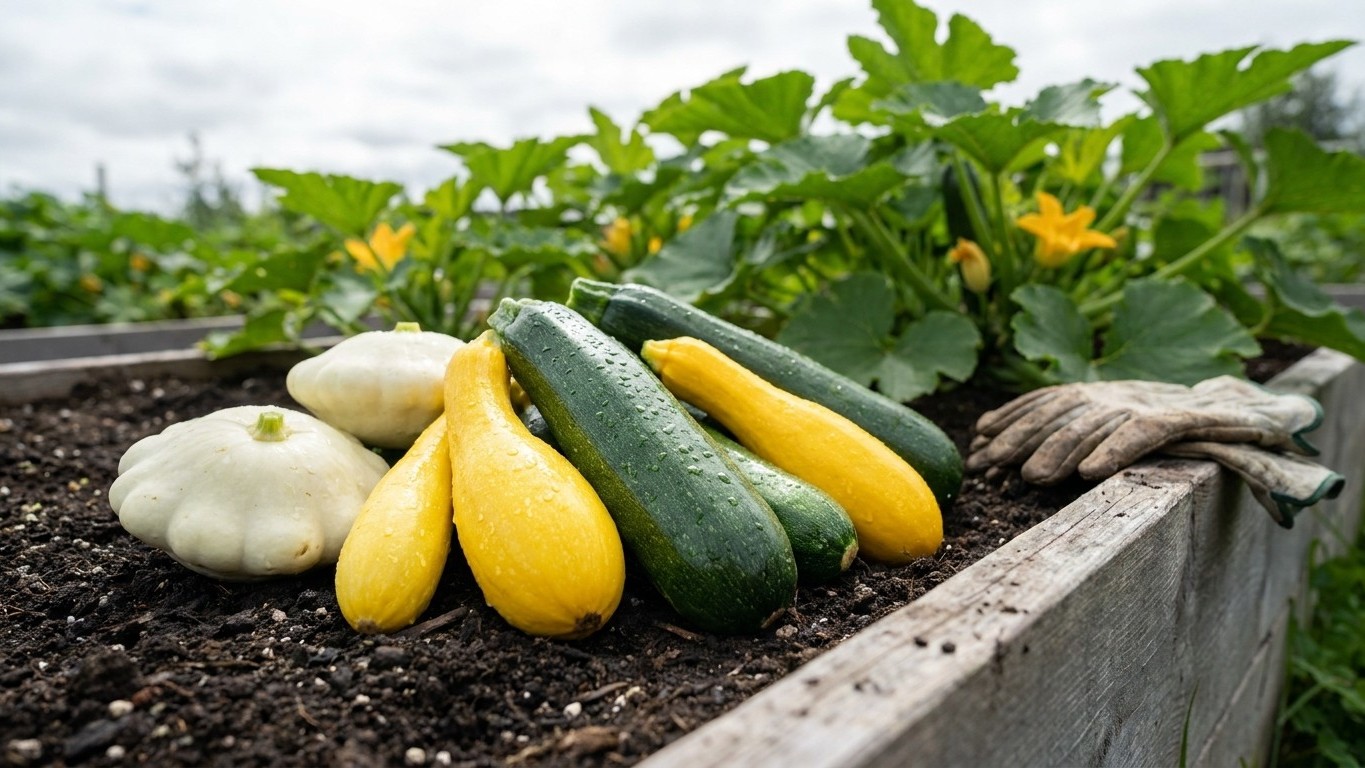

Bush zucchini, yellow crookneck, and yellow straightneck squash are the safest bets across South Carolina, from the Upstate to the coast. Vining types like tromboncino work too, and often outlast the others once squash vine borer season hits, but they need more room and patience.
The short answer for South Carolina
Summer squash is a short-season crop everywhere, but South Carolina’s numbers change what “short” means here. With a last spring frost falling between February 28 and March 17, and the first fall frost not landing until November 20 to December 5, most of the state gets a frost-free stretch well past eight months. That is not the limiting factor for summer squash. Heat is. The reference station logs 55.1 days a year at or above 90°F, and that heat load, not the calendar, decides which types actually keep producing through July and August.
Bush types (zucchini, yellow crookneck, yellow straightneck, pattypan) mature fast, usually somewhere in the 45 to 60 day range from transplant, which matters less for surviving the cold and more for outrunning pests. A bush squash that fruits early and fades by midsummer can simply be replaced with a second or third planting, since the frost-free window is long enough to allow it. Vining types such as tromboncino (a Cucurbita moschata, technically a winter squash grown and eaten as summer squash) take longer, often 60 to 90 days to first harvest, but their thicker, more solid stems resist the borer that guts hollow-stemmed bush varieties. That tradeoff, speed against resilience, is the real decision for a South Carolina garden.
| Type | Growth habit | Typical days to first harvest | Best suited for |
|---|---|---|---|
| Zucchini | Bush | 45-55 | Fast turnover, small yards, succession planting |
| Yellow crookneck | Bush | 50-60 | Traditional Southern favorite, needs airflow |
| Yellow straightneck | Bush | 50-58 | Similar to crookneck, slightly more forgiving |
| Pattypan/scallop | Bush | 50-55 | Containers and tight spaces |
| Tromboncino | Vining | 60-90 | Longer season, vine-borer resistance |
A garden that runs a bush type through May and June, then swaps in tromboncino for the worst of the heat, uses both halves of South Carolina’s long season instead of fighting either one.
What will not work here
A single spring planting meant to carry through to fall frost will not work here. That approach assumes summer squash keeps producing steadily for months, and in a state with 55 days a year over 90°F, it does not. Squash vine borer moths lay eggs as soil warms, and by midsummer a bush plant that looked healthy in May can collapse in a week. Gardeners who plant once and wait are the ones who lose the crop just as tomatoes and okra are peaking.
Weekly watering schedules fail here too, and the rainfall numbers explain why. Summer rain averages about 19.8 inches across June, July, and August, with June the driest month at 6.21 inches, rising to 6.6 in July and 6.97 in August. That sounds like plenty, but it mostly arrives as single thunderstorms rather than steady soaking rain. A downpour that dumps an inch in twenty minutes runs off a compacted or sandy bed before the roots ever use it, and the heat that follows pulls moisture back out of the topsoil within a day or two. A squash plant checked once a week, especially on sandy Coastal Plain soil, is often already stressed by the time anyone notices the leaves wilting at midday.
Tight spacing is the third failure point, and it is a humidity problem more than a sunlight one. Summer squash planted close together to save bed space traps moisture around the leaves, and combined with the same rainfall and heat numbers above, that creates ideal conditions for powdery mildew and downy mildew. Both spread fast in humid air that does not dry out between storms. Wide spacing with real airflow between plants is not a cosmetic choice in this climate; it is what keeps foliage alive long enough to finish a harvest.
Finally, giant or extra-long-season squash bred for cooler, drier summers rarely justifies the space in South Carolina. By the time a 90-day variety would be sizing up, vine borer and mildew pressure has usually already done its damage, and a second planting of a fast bush type would have delivered more food from the same square footage.
What changes across South Carolina
South Carolina is not one growing zone, and treating it as one is the fastest way to plant at the wrong time. The USDA Plant Hardiness Zone Map puts the state across a 7a-9a range, built purely on average annual extreme minimum winter temperature. That spread alone signals real differences in how early the ground warms and how late frost risk lingers, even though hardiness zone itself says nothing directly about summer squash planting dates.
Frost timing tells the more useful part of the story, and it does not move uniformly across the state. The reference station’s last spring frost window (February 28 to March 17) and first fall frost window (November 20 to December 5) describe the Charleston-area airport station specifically. Peninsular Charleston itself runs milder than that airport reading, buffered by the harbor and urban heat. Move inland and upstate, toward the Piedmont and the foothills, and both ends of the frost-free season tighten by several weeks: spring frost lingers later, fall frost arrives earlier. A gardener in Greenville or Spartanburg working from a Lowcountry planting date is planting into ground that has not caught up yet.
There is no single South Carolina planting date for summer squash, because there is no single South Carolina climate. A coastal garden can often get an extra succession planting in that an upstate garden cannot fit before fall frost cuts the season short. Anyone unsure which end of that 7a-9a range applies to their own yard should check the USDA hardiness zone map directly by ZIP code rather than guess from a regional description, since the difference between zone 7a and zone 9a is not small when it comes to how early soil is warm enough for squash seed.
Where to check this for your own county
This page describes South Carolina as a whole, and that is exactly its limit. A state-level frost window or heat average smooths over the real differences between, say, Oconee County in the mountains and Beaufort County on the coast. The next step for a specific answer is Clemson Cooperative Extension, the state’s land-grant extension service.
Two things are worth looking for once there. First, a county-level or regional planting calendar for vegetables, which will translate the frost windows on this page into actual local planting dates rather than a statewide range. Second, any county-specific variety trial results or recommendations for summer squash, since Clemson’s horticulture agents test which bush and vining types actually hold up against local disease and pest pressure, information a general state overview cannot capture. Clemson’s HGIC factsheets follow this same logic for lawn care, publishing separate maintenance calendars for bermudagrass, zoysiagrass, centipedegrass, and St. Augustinegrass rather than one blanket Southern lawn calendar, because timing genuinely differs by what is actually growing in the ground. Vegetable planting guidance works the same way.
A county extension office recommendation will always outrank anything on this page, because it is built from local trial data and local agents watching what actually survives a given county’s summers. This article works from statewide climate normals; a county office works from what has grown, and failed, in gardens down the road. When the two disagree, the local office is the one to trust.
Checking this against your own garden
Every date and average on this page describes a region, not a specific yard, and a reader’s own observations will always settle the question faster than a frost-probability table. Three signs matter more than any calendar.
Soil warmth by feel comes first. Summer squash seed germinates poorly in cold, wet soil no matter what the calendar says. Pushing a bare hand a couple inches into the planting bed in the morning gives a rough but honest read: soil that still feels cold and damp needs another week or two, regardless of what a regional frost date suggests.
The first flush of male flowers is the second signal, and it is often misread. Summer squash typically produces male blooms before female ones, so an early wave of yellow flowers with no fruit forming is normal, not a failure. What matters is how quickly female flowers, the ones with a tiny swollen squash shape behind the petals, follow. A long gap between the two suggests the plant is still adjusting to heat or a nutrient gap, not that anything has gone wrong.
The third is how fast true leaves appear after the seedling’s first round leaves. Quick, vigorous true-leaf growth points to soil and temperature conditions the plant likes; slow, stalled growth after transplant usually means the ground was still a little too cool or the transplant went in with too much root disturbance. None of these three signs need a thermometer or a gauge, just a look at the bed a few times a week, and together they tell a gardener more about their own microclimate than any statewide frost window ever will.