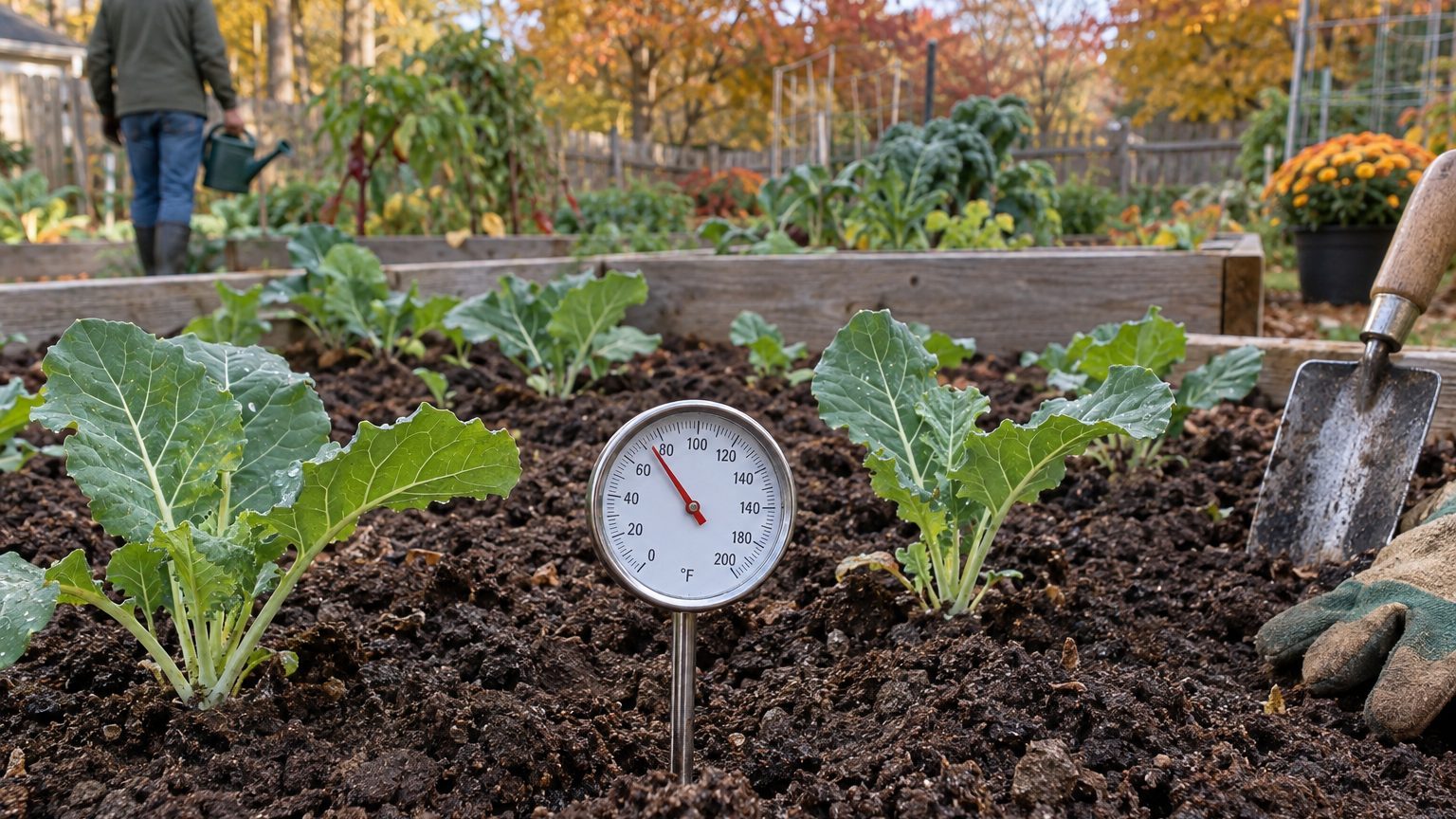

Collards go into South Dakota ground once the soil itself has warmed, not the moment the calendar clears frost risk. Here that usually means the first half of May in the Sioux Falls area, though a short second sowing can still ride the state’s brief autumn before the ground locks up. Winter cold, not summer heat, decides how the bed gets planned.
When the soil is warm enough in South Dakota

The reference station for eastern South Dakota, Sioux Falls (NOAA station USW00014944), puts the last spring frost at a 30-70% probability window running from April 29 to May 9, based on the 1991-2020 Climate Normals. That’s a probability, not a promise: some years the frost breaks earlier, some years it lingers past the window, and a garden a few miles outside Sioux Falls, especially at higher elevation or in a low-lying valley, can run one to two weeks behind that airport reading.
Frost date matters, but it’s a stand-in for the number gardeners actually need: soil temperature. Collard seed germinates poorly in cold, wet ground, and transplants set out too early just sit there, sulking, while the roots stall. The practical fix is to wait until the soil has had a week or two of settled warmth after the frost risk has genuinely passed, rather than planting on the frost date itself. A soil thermometer pushed a few inches down tells you more than any calendar does.
Direct-seeding works for collards in South Dakota’s shorter season, but many gardeners get ahead of the calendar by starting seedlings indoors four to five weeks before that outdoor date, then hardening them off over several days of increasing outdoor exposure before transplanting. This buys real time in a state where the growing window is already tight.
Bed prep is where collards intersect with a wider problem. Collards are brassicas, in the same family as cabbage, kale, mustard, turnip and rutabaga, and they share the same soil-borne diseases and root pests. Planting collards where any of those crops grew in the past two or three seasons carries the trouble forward rather than resolving it. If a rotation plan is already anchoring your garden layout, treat the collard bed as part of that same brassica group, not as a separate patch. Anyone building out a full rotation should check the crop rotation guide elsewhere in this collards and southern greens series before finalizing bed placement.
Skip pesticide products entirely as a first response. Row cover laid down at transplanting, combined with rotating collards away from last year’s brassica ground, handles most early pest pressure without a single application.
How long the season lasts here
Pairing both ends of the frost record gives the real answer. The same Sioux Falls station puts the first fall frost at a 30-70% window of September 24 to October 4. Stretched between the earliest last spring frost and the latest first fall frost, the frost-free season can run as long as 158 days; pulled between the latest spring frost and the earliest fall one, it shrinks to as little as 138 days. Split the difference and a typical year gives South Dakota gardeners something close to 148 days of workable ground, call it roughly four and a half to five months.
That length changes the math on how many collard crops a bed can carry. A season pushing past five months, common in warmer parts of the country, leaves room for a spring sowing and a second planting timed to mature in the cool of fall. South Dakota’s window is tighter than that. For most gardeners here, the practical approach is one main planting, timed either as an early-spring sowing that matures through summer and into fall, or as a mid-summer sowing aimed squarely at the cooler, sweeter growth collards put on once nights turn cold.
That tighter window also changes whether transplants are worth the trouble compared with direct seeding. With five months to spare, direct-seeding twice is a low-risk bet. With 138 to 148 days on the table, a transplant started indoors buys back the two to three weeks a direct-seeded crop would otherwise spend just germinating and putting on first true leaves, time this state’s calendar doesn’t hand out for free. Gardeners weighing a second sowing, or timing a fall-only crop against that October frost window, should work through the succession sowing guide in this same collards and southern greens series before committing bed space.
Heat and water in South Dakota

South Dakota’s climate story for collards isn’t written in summer heat records so much as in one winter number: the mean daily minimum of the coldest month, which sits at 8.5°F at the Sioux Falls reference station (1991-2020 Climate Normals). That figure, not the July high, is what separates a standing winter crop from a strictly autumn one. Collards can shrug off light frost and even a hard freeze or two, holding sweetness and quality through cold snaps that would finish other greens. But a coldest-month average minimum near 8.5°F, paired with a USDA hardiness zone range of 3b-5b across the state, is well past what collard foliage survives standing in the open ground. This is not a pick-through-winter climate for this crop; it’s an autumn crop that runs until the hard, sustained freeze of late fall shuts it down, then gets harvested out rather than left in the row.
Summer conditions matter less here than they do farther south, largely because the growing window doesn’t leave collards sitting through the longest, hottest stretch of a Southern summer in the first place. Exact counts of 90-degree days vary considerably across a state this size, running higher in the southeast than up toward the northern tier, so there’s no single number that describes the whole territory honestly. What does apply broadly is a continental pattern: a wetter, cooler spring giving way to a drier, hotter mid-summer stretch. Collards planted for an early crop can hit that dry patch right as they’re trying to size up, and slow growth combined with any lingering leaf moisture from irrigation or dew is exactly the setup that invites downy mildew and other fungal leaf spot problems. Watering at the soil line rather than overhead, and giving plants enough spacing for air to move between leaves, does more to prevent that than any fungicide applied after spots appear.
A fall-timed sowing sidesteps most of that mid-summer stress altogether, since the plants are just getting established as the hottest weeks pass and are sizing up as the air cools, which is a large part of why fall is the more forgiving target for a single-planting garden in this state.
Which collards suit South Dakota
No cultivar name belongs in this answer, and that’s not a dodge. Seed catalogs list dozens of collard types bred for earliness, cold tolerance, disease resistance and leaf texture, and which of those actually perform well in a Sioux Falls backyard versus a garden near the Black Hills or up along the North Dakota line is exactly the kind of local trial data a general guide like this one can’t responsibly claim to have. What can be said honestly is which traits matter, by type, given the numbers already on the table.
A tight frost-free window of roughly 138 to 148 days rewards earlier-maturing types over long-season ones, since a slow variety may still be sizing up when the first hard fall freeze arrives. Given the modest, uneven summer heat this state sees compared with the Deep South, disease resistance to leaf spot and mildew matters more here than heat tolerance itself, particularly for anyone growing through that dry mid-summer stretch. And because collards can’t stand through this state’s winter the way they can farther south, choose a type suited to a defined harvest window rather than one bred for extended standing.
South Dakota State University Extension maintains current, locally trialled variety recommendations at extension.sdstate.edu, and that’s the resource that actually answers the cultivar question this page won’t. Extension trial data reflects what performed in South Dakota’s own soil and weather in recent seasons, which is worth more than any generic seed catalog description.
At harvest, judge leaves by hand rather than by the calendar: any leaf with a soft, weeping patch or the start of mold at the base gets pulled and composted rather than stored, since collard leaves give no reliable warning once decay starts.