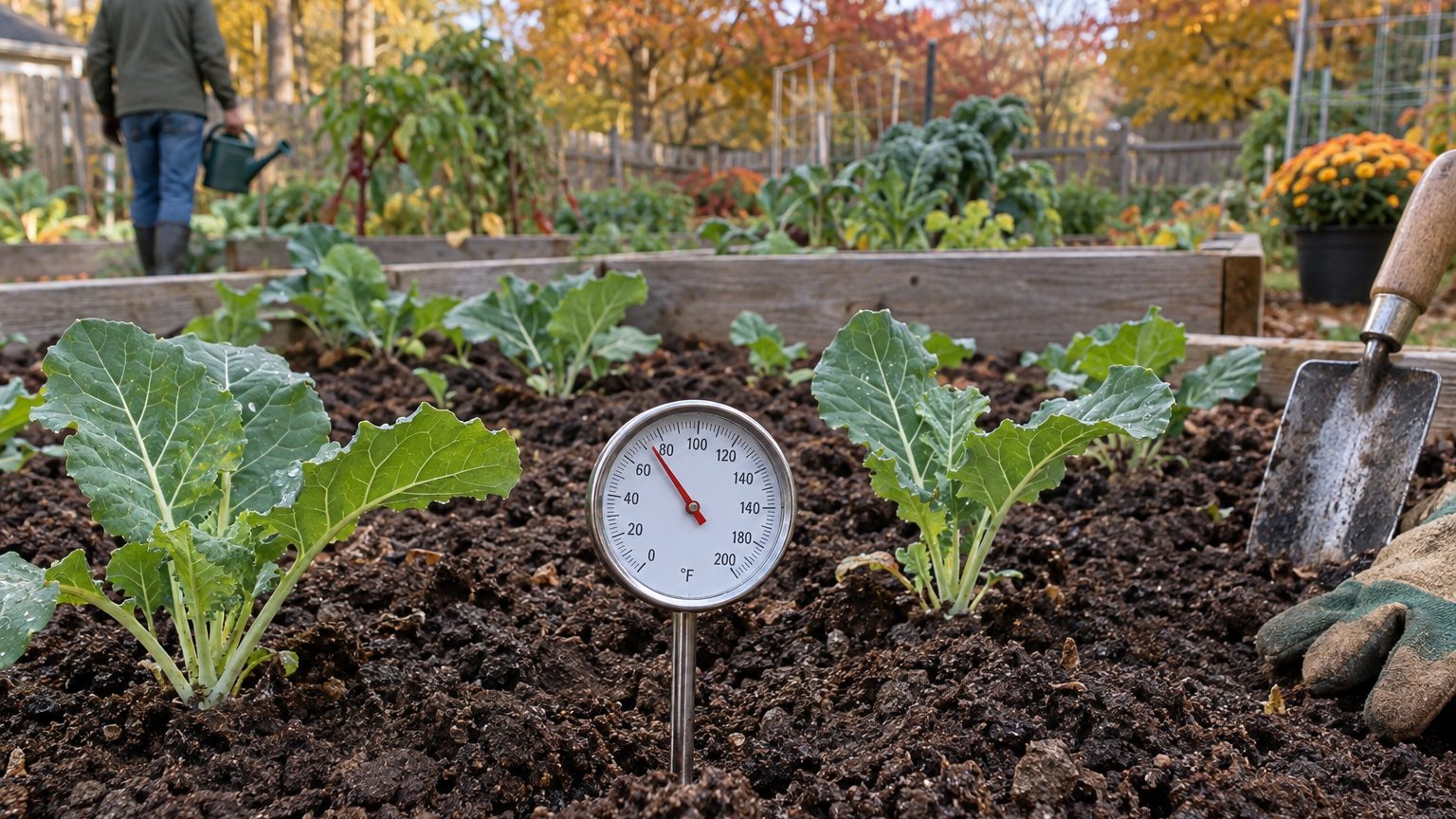

Collards go into Maine ground once the soil itself has warmed, not the morning the frost risk clears on a calendar. That soil-lag, combined with a frost-free window of roughly 170 days and a winter cold enough to end the harvest outright, shapes almost every decision that follows: when to sow, whether a second planting is worth the bed space, and which type of collard actually fits the state’s short, cool growing year.
When the soil is warm enough in Maine

Portland’s NOAA climate station puts the last spring frost between April 22 and May 1 (1991-2020 Climate Normals, 30-70% freeze probability band, station USW00014764, NOAA NCEI). That number is what most Maine gardeners reach for first, and it’s answering the wrong question. A frost date describes when the air stops freezing on a given share of years out of ten. It says nothing about the ground itself.
Collards don’t respond to air temperature the way tomatoes or peppers do. What actually stalls them is cold soil: seed sown into ground still sitting in the 40s F germinates slowly if at all, while the same seed dropped into soil that’s had a week or two of real sun comes up in days. That gap between the air clearing and the ground catching up typically runs two to three weeks in Maine, and it runs longer near the coast, where cool ocean air keeps afternoon soil warming sluggish even after the frost risk has technically passed.
Practically, treat the frost window as a starting gate rather than a planting date. Wait for the soil to show sustained warmth before direct-seeding or setting out transplants, and keep in mind that even a 30-70% probability band is exactly that: a probability, not a guarantee against a cold snap that shows up late.
Maine’s hardiness range spans USDA zones 3b to 6a (2023 map, 1991-2020 normals), wide enough that a planting calendar built for coastal Portland can run two or three weeks off for a garden farther inland or north. Rather than guess at a type meant for a different season length, check which collards the University of Maine Cooperative Extension has actually trialled for the local zone. That’s information a statewide page can’t replace.
How long the season lasts here
Subtract Maine’s two frost windows and the frost-free season lands around 170 to 173 days, depending on which end of each range applies to a given spot: an April 22 last frost to an October 9 first fall frost (Portland station, 1991-2020 normals) works out to 170 days, while a May 1 start to an October 21 finish stretches to 173. Either way, roughly 170 days frost-free is the figure worth writing down.
That length matters for more than counting days. A season in that range comfortably fits one full planting cycle with margin left over, and in the state’s milder pockets it’s long enough to make a second, later sowing timed for a fall harvest realistic rather than reckless. Collards actually improve in flavor after a light frost, so a fall crop maturing into cooler weather isn’t a fallback plan. It’s often the better harvest of the two.
Whether that second sowing is worth the bed space depends on where in Maine the garden sits. Near the coast, with the later end of the fall frost window, there’s enough runway after a spring harvest to get a second stand to a pickable size before the ground locks up. Inland and to the north, where fall frost tends to land closer to the early side of that October range, the math tightens, and pushing a second planting risks a stand that never fills in before cold shuts it down.
This is where starting a second round indoors or in a cold frame a few weeks ahead of the outdoor sowing date buys back some of that lost margin, particularly on the shorter end of the season. The collard growing guide walks through staggering plantings in more depth than fits on a single state page, including how to time a fall-only sowing when the season doesn’t leave room for two full cycles.
Heat and water in Maine

Maine doesn’t run hot. The state’s stations don’t rack up many days above 90°F in a typical summer, and gardeners here are far more likely to fight cool, damp weather than scorching heat, which flips the usual collard playbook used farther south. Where a Deep South garden worries about bolting and reaches for shade cloth to keep leaves from cooking, a Maine garden’s summer risk is slower and wetter: downy mildew and other fungal problems that build fastest when leaves stay damp and nights stay cool, especially through a rainy stretch.
Good spacing for airflow between plants and watering at the soil line rather than overhead does more useful work here than anything sold in a bottle, since fungal pressure climbs fastest on foliage that never gets a chance to dry before evening.
The number that actually decides how a Maine collard bed gets planned isn’t a summer figure at all. It’s winter. Portland’s coldest month averages a daily minimum of 15.6°F (NOAA Climate Normals, 1991-2020), and that single figure separates a “standing crop” garden from an “autumn crop” garden. Where the coldest month stays mild, farther south and along milder coastlines, collards get picked leaf by leaf all winter, standing in the garden from November into March. Maine’s winter minimum rules that out entirely.
That makes collards in Maine strictly an autumn crop: sown or transplanted once the soil warms in late spring, harvested through summer and into fall, and cleared out at or just after the first hard freeze rather than left standing under row cover the way a grower two or three zones warmer might manage. Planning around that hard stop, instead of hoping for a mild winter to stretch the harvest, keeps the season’s last picking from being a surprise.
Which collards suit Maine
None of this points to a single named variety, and that’s deliberate. The right collard for a 170-day, cool-summer, hard-winter garden in coastal Portland isn’t necessarily the right one for a garden two zones colder in Aroostook County, and naming one cultivar for the whole state would mean guessing on the reader’s behalf. What Maine’s numbers do point to is a type.
- Early-maturing types, useful where the shorter end of the season or a planned second sowing leaves less time for a slow stand to fill in.
- Disease-resistant types, worth prioritizing given how often a cool, humid Maine summer runs damp enough for downy mildew and other fungal pressure to take hold.
- Cold-tolerant types, which hold quality through the light frosts that arrive well before the hard freeze, since a touch of cold sweetens collard leaves rather than damaging them.
Collards are brassicas, and that matters for more than picking a type: they share pests and diseases with cabbage, kale and mustard, so a rotation plan that moves collards into a bed that grew any of those crops the year before hasn’t actually rotated anything. The collard growing guide covers rotation planning across the whole brassica family in more depth than a single state page allows.
The reliable shortcut is asking which types the local extension office has actually trialled rather than trusting a name on a seed rack. It’s also worth comparing how the same crop plays out elsewhere: a hot, humid climate like South Carolina’s asks for shade and airflow at the root that a Maine garden rarely needs, while a short, dry continental season like South Dakota’s shares Maine’s tight timing problem without the summer humidity that drives Maine’s disease pressure.
| Territory | USDA Hardiness Zone Range | Main Season Pressure |
|---|---|---|
| Maine | 3b-6a | Cool, damp summers; hard winter freeze ends the crop |
| South Carolina | Warmer than Maine, coastal humidity | Summer heat and humidity, longer standing-crop potential |
| South Dakota | Colder and drier than Maine’s coast | Short season, wide temperature swings |