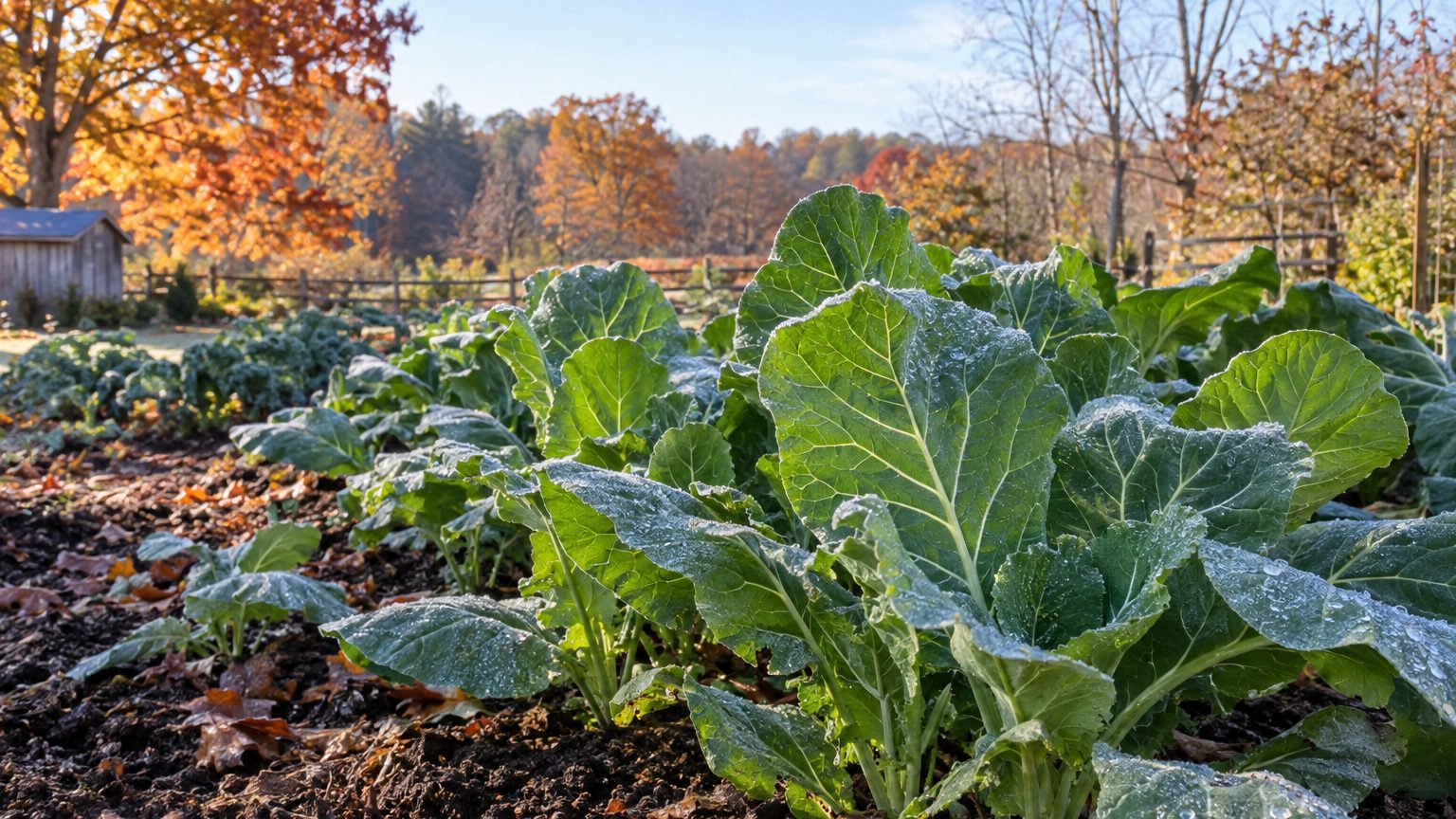

Collards belong to the cabbage family, not to the Deep South, and South Dakota’s cold suits them better than its heat. That leaves two planting windows: one in spring, one in late summer for a fall crop. Both are set by frost dates, and those dates shift a lot from one county to the next. Here is how to place each window, what fails, and how to adjust.
The short answer for South Dakota
Set collard transplants out around the last spring freeze, which for the reference city of Sioux Falls falls in the range April 29 to May 9, and sow or transplant a fall crop early enough to size up before the first freeze, September 24 to October 4. Both ranges come from the NOAA NCEI 1991-2020 Climate Normals for the Sioux Falls airport station (USW00014944).
What those dates actually measure
They are probabilities, not promises. Each range is the stretch of days when the chance of a 32°F freeze sits between 30 and 70 percent. Inside the spring range, a freeze after that date is roughly a coin flip. Inside the fall range, the first freeze has roughly even odds of having already arrived. Nothing here says a freeze cannot come later in spring or earlier in fall.
There is also a caveat about location. These are airport figures for one city. Suburban and rural gardens usually see the last spring frost later and the first fall frost earlier, often by one to two weeks, and more at elevation. Treat the Sioux Falls numbers as the reference city’s, not a state-wide guarantee.
Turning the range into a plan
Collards take a light frost better than tomatoes or peppers, so transplants that have been hardened off can go in near the early end of the spring range, and a cold snap is less of a gamble than it would be for warm-season crops. Seed started indoors should be sown several weeks ahead of your transplant date. Count back from the window rather than from a calendar date copied from somewhere else. Seed sown directly in the ground needs soil that has warmed and dried enough to work without clumping.
For fall, work backward from September 24. Find the days to maturity on your seed packet, add a couple of weeks for slower growth as days shorten, and subtract the total from the start of that range. If you garden in the country, subtract another week or two. This page does not have a South Dakota collard calendar from a state source, so the arithmetic above is the best it can offer until you check with your county office.
What will not work here
The Southern method of setting collards out in fall, harvesting through winter and letting them regrow in spring fails on the northern plains. The coldest month has a mean daily minimum of 8.5°F at the Sioux Falls reference station, and that is an average, not the extreme. A plant that shrugs off a 25°F night does not survive weeks of single digits. Plan on collards as a one-season crop and pull them after the hard freezes.
Slow varieties in a short season
Between the last spring freeze and the first fall freeze, the frost-free stretch is short by Southern standards. Heirloom types bred for a long Southern season and sold with slow maturity times are the ones that lose. A slow variety planted in mid-May may still be small when the September 24 to October 4 window opens. Prefer varieties with shorter maturity on the packet, and check The Best Collards and Greens for South Dakota before you order seed.
The same logic applies to a fall crop started late. Sowing seed in August means fewer than ideal weeks of growth before freezing weather, and cooling nights slow leaf growth further. A fall planting that is not in the ground by midsummer is a gamble, not a schedule.
Cold soil, dry seedbeds, and borrowed dates
Seed pushed into the ground in early April, on the theory that collards are hardy, tends to sit in cold soil and rot or germinate patchily. Hardy leaves do not make cold seed sprout faster. Wait for the ground to warm.
The opposite problem shows up in a fall crop. Seed sown into a shallow bed in midsummer dries out quickly, and a once-a-week watering is not enough for seedlings with roots only an inch or two deep. This page has no summer rainfall figure for South Dakota, so it cannot tell you how dry your July will be. What it can say is that a seedbed drying out between waterings is the usual reason a summer sowing fails. Shade cloth or a thin layer of mulch over the row helps.
The last failure is simple: using the airport date on a rural plot. If your garden sits in a low pocket where cold air settles, or out in open country, the reference dates flatter you by a week or two in both directions.
What changes across South Dakota
South Dakota does not have one hardiness zone. The USDA Plant Hardiness Zone Map (2023, built on 1991-2020 normals) puts the state anywhere from 3b to 5b, so there is no single answer for the whole state. That spread covers several half-zone steps, from the coldest northern and high-elevation ground to the milder southern and eastern edges.
The USDA system rests on one variable, the average annual extreme minimum temperature. It tells you what winter does to perennials, not when the last freeze arrives. Two gardens in the same zone can still differ in frost dates, and a zone number alone should not set your planting date for a crop you treat as an annual. Use it as a rough guide to how harsh the climate is, then rely on frost dates for timing.
If you garden in the north or at altitude, shift the calendar in both directions. Move spring transplanting later, past the reference range, and pull your fall sowing earlier. A reasonable starting adjustment is one to two weeks in each direction from the Sioux Falls dates, and more if you are well above the eastern plains. Choose the quicker varieties, and keep row cover on hand for the shoulder weeks.
Do not guess your own zone from a friend’s or from a plant tag. Look up your location on the USDA Plant Hardiness Zone Map and read it there. Whatever it shows, the frost-date advice above still holds: check locally, then adjust.
Where to check this for your own county
The best local source is the state’s land-grant extension service. South Dakota’s is at https://extension.sdstate.edu/, the address listed in the USDA NIFA Land-Grant University Extension directory. Search there for vegetable planting guides, and look for two things in particular: a planting calendar written for your part of the state, and any variety trials run in or near your county.
A calendar tied to your county tells you which week to put transplants out, using frost records from stations closer to you than Sioux Falls. Variety trials tell you which cultivars actually finished in local conditions, which matters more for collards than any general list does. If the site has no collard-specific page, cabbage-family or cool-season greens guidance is the closest match, since the timing logic is similar. Extension offices also field questions directly, and staff know how a given spring has been running.
Be plain about what this page is. It gives the state-level picture from one reference city, and a county recommendation beats it every time. If the two disagree, go with the county. The broader guide, Growing Collards in South Dakota, covers soil, spacing and harvest once you have a planting date settled.
Checking this against your own garden
Your own observations outrank every date above. Three are worth watching, and none needs equipment.
First, feel the soil. Push your hand a few inches into the bed in the morning. If it feels distinctly cold and stays wet and sticky, it is too early for seed. Beds along a south-facing wall warm days ahead of open ground, and low spots warm last. That difference is your microclimate, and it can be worth a week or more.
Second, watch for the first male catkins on local trees such as willows or cottonwoods. When they open in your yard, compare the date to previous years. If they come early, your spring is running warm. If they come late, hold off on the transplants, whatever the calendar says.
Third, look at seedling leaves. Once the first true leaves appear above the round seed leaves, plants are ready to start hardening off. If they show up slowly, your indoor spot is too cool or dim. In a fall bed, slow true leaves mean the seedbed is too hot or dry. Write the date down each year for all three, and after a couple of seasons you will have a calendar that fits your garden better than any state table.
Common questions
Can I sow collard seed directly in the garden in spring?
Yes, once the soil has warmed enough to work and the worst of the freeze risk has passed. The frost range for the reference city is April 29 to May 9, but rural gardens run later. Transplants give you a head start because the short season leaves little room for a slow start.
Will collards survive a South Dakota winter?
Do not count on it. The coldest month averages a daily minimum of 8.5°F at the Sioux Falls reference station, and the state ranges from USDA zone 3b to 5b. Treat collards as an annual and pull them after hard freezes.
Is a fall crop worth planting?
Often, yes, if you start early enough. Count back from the first fall freeze range of September 24 to October 4, using the days to maturity on the packet, and give yourself extra time if you garden outside the city. Late sowings are the ones that fail.
Should I use the airport dates or my own?
Use your own when you have them. The Sioux Falls figures are a reference, and suburban and rural gardens typically see the last spring frost later and the first fall frost earlier, often by one to two weeks. Your county extension office can give you numbers closer to home.