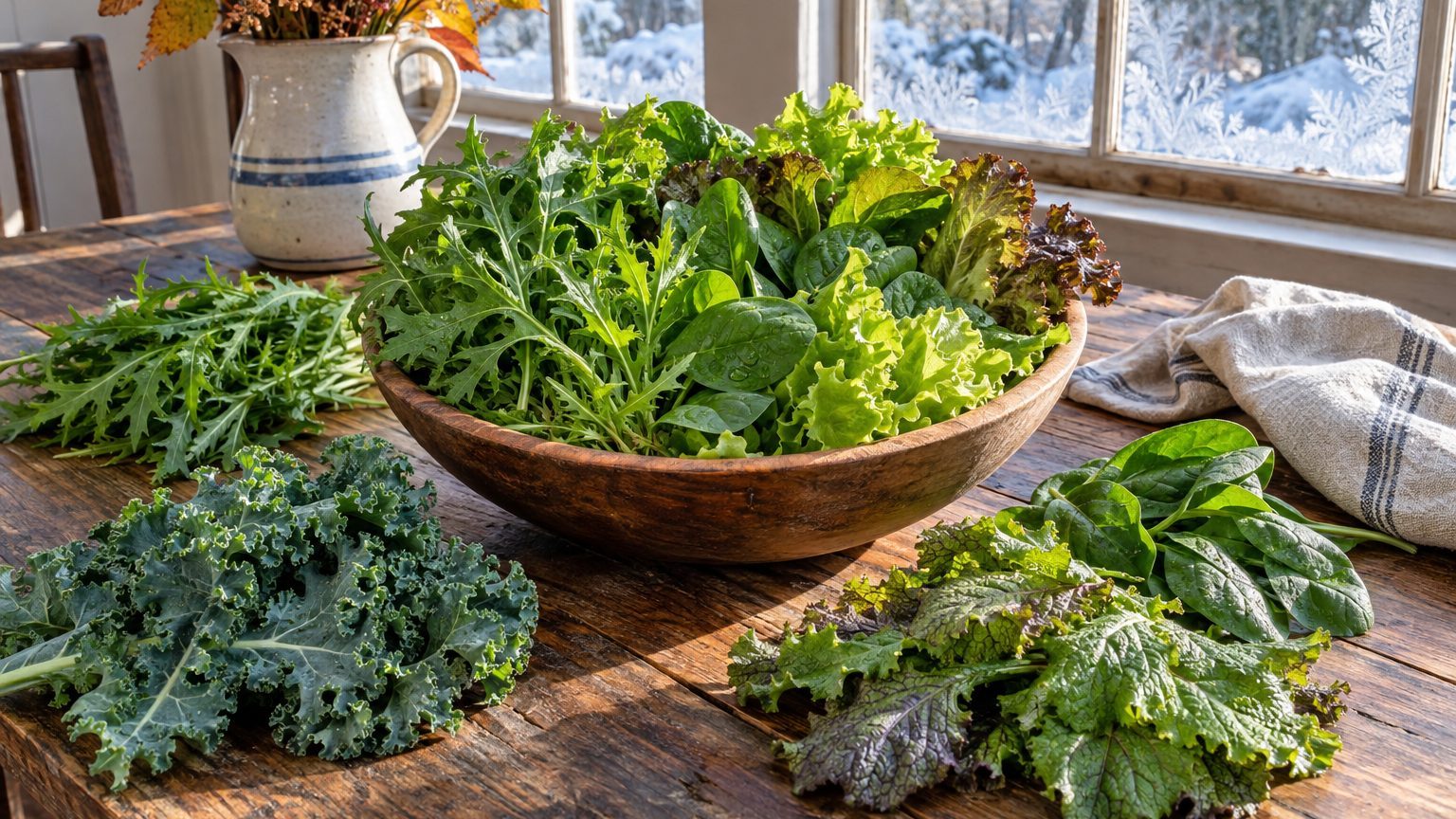

Spinach, mache, claytonia and kale are the winter salads South Dakota gardens can count on. Quick Asian greens and a few cold-tolerant lettuces fill in around them. What you harvest in January depends less on the variety than on cover: a low tunnel or cold frame changes the list more than any seed catalog does. The wider series starts with Winter Salads for South Dakota Gardens.
The short answer for South Dakota
Choose by type, not by variety name. Hardy rosette greens (spinach, mache, claytonia) and kale carry the deep cold, fast Asian greens (tatsoi, mizuna, mustard) give you an autumn harvest, and lettuce works only as a fall crop with protection. The state’s short growing season and hard winter both push toward crops that are nearly full size before the dark weeks arrive.
The numbers behind that come from NOAA’s 1991-2020 Climate Normals for the Sioux Falls reference station. The last spring frost there falls between April 29 and May 9. The first fall frost falls between September 24 and October 4. Both are 32°F freeze probabilities in the 30-70% band. They are not calendar guarantees. They mark the stretch where the chance of a freeze is somewhere between 30 and 70 percent. The coldest month’s mean daily minimum is 8.5°F, and that is an average low, so real nights run colder.
That 8.5°F average is why “winter salad” means something specific here. Hardy greens do not keep growing through January. They hold, going dormant under cold and short days, and you harvest what they put on in autumn. Then they restart early in spring. Plan for two cutting windows, one in fall and one in early spring, with a thin pickings period in between if you have cover.
| Type | Examples | Role in South Dakota |
|---|---|---|
| Hardy rosette greens | Spinach, mache, claytonia | Hold through deep cold; overwinter for the first spring cuts |
| Hardy brassicas | Kale | Standing harvest into early winter; flavor improves after frost |
| Fast Asian greens | Tatsoi, mizuna, mustard | Quick fall cuts; extend with cover |
| Cold-tolerant lettuce | Loose-leaf types | Fall harvest, and only with protection once hard freezes arrive |
This page does not carry a summer heat figure for the state, so it can’t say exactly how hot your soil will be in August. It does matter, though, because late-summer sowing happens in warm ground. Exact sowing windows live on When to Sow Winter Salads in South Dakota.
What will not work here
Start with the clock. The frost-free stretch at the reference station runs from roughly the first week of May to the end of September. That is not a lot of room. Crops that need a long, slow finish, such as full heading lettuce or heading chicories, tend to run out of season before they size up. If a variety’s description says it needs a long cool maturation, it is aimed at a milder place than this.
Open-ground lettuce through the coldest months is the second failure. With a coldest-month average low of 8.5°F, plenty of nights sit well under that, and lettuce leaves are among the first to be killed. Spinach, mache and claytonia shrug off cold that flattens lettuce. A single layer of row cover buys a few degrees, not a different climate. Gardeners who give lettuce a try in January usually end up composting it.
Late sowing fails quietly. Seed that goes in after the fall frost window has already opened, September 24 to October 4 even at the airport, produces seedlings that never reach harvest size. In the darkest weeks, growth nearly stops, so what you cut in December is stored growth. It was made in September and October. A seedling with two tiny leaves going into November is not a salad. It is a plant waiting for March.
The reference-city figures also run optimistic for most gardens. Suburban and rural plots typically see the last spring frost later and the first fall frost earlier than the airport does, often by one to two weeks, and more at elevation. Count back from September 24 and you may be sowing for a fall that, in your yard, started a week earlier.
Summer heat cuts the other way. Sowing in late summer means putting cool-season seed into warm soil. Lettuce and spinach seed often sprout poorly in hot ground, so a shaded bed or a few days of wet burlap over the row helps. Wind is the other local hazard on open ground. A hoop tunnel with loose plastic can tear or lift, so anchor the edges well before the first storm, not after.
What changes across South Dakota
South Dakota is not one garden. The USDA Plant Hardiness Zone Map (2023, built on 1991-2020 normals) places the state across zones 3b to 5b. That is five half-zone steps, so there is no single answer for the state. A gardener in the northern counties and one near the southern border are working with meaningfully different winters.
The zone system is built on one variable, the average annual extreme minimum temperature. It tells you about winter survival. It says nothing about how long your season is or how hot your summer runs. Two gardens in the same zone can still have different first-frost dates, which is why this page keeps its dated figures tied to the reference city instead of to a zone.
If you garden in the north, or at altitude such as the Black Hills, shift three things. Sow earlier, because the fall frost window arrives sooner. Lean harder on the toughest types (mache, claytonia, spinach, kale) and treat lettuce as optional. And plan on sturdier protection: a cold frame or a well-anchored hoop with two layers beats a single sheet of fabric. In the warmer southeast, you gain some margin, but not enough to treat the reference-city dates as safe.
Which zone are you in? Look it up yourself on the USDA Plant Hardiness Zone Map, where you can enter your ZIP code. Do not trust a neighbor’s guess, since zones can change over a short distance in hilly terrain.
Where to check this for your own county
The best local source is South Dakota State University Extension, the state’s land-grant extension service. Its county and regional offices answer garden questions and hear firsthand what fails in the neighborhood. A county recommendation beats a state one every time, and this page is the state one.
Two things are worth hunting for there. The first is a local planting calendar for cool-season vegetables, ideally one built on your nearest weather station, not on Sioux Falls. Check that it covers the crop you are actually growing, since a calendar for spinach will not fit kale. The second is a list of varieties trialled in your area. Trial results tell you which cultivars survived real South Dakota conditions, and that is more useful than a catalog’s cold-hardiness claim.
This page does not hold a verified South Dakota extension calendar, and it will not borrow one from another state’s service. Calendars written for a different climate would send you out at the wrong time. If the extension site has nothing for your crop, call or email the county office and ask what local gardeners sow in late summer, and when they cover it.
Checking this against your own garden
Your own beds outrank every date above. Three observations cost nothing and tell you more than a table can.
- Soil warmth by feel. Push your hand a few inches into the bed in the morning in late summer. If it still feels warm, lettuce and spinach seed may sulk, so wait or shade the row. A bed beside a south-facing wall that stays warm longer is a microclimate you can exploit in October.
- First true leaves. Seedlings with their first true leaves (not just the rounded seed leaves) before the first hard frost have a decent chance of reaching harvest size. Beds where seedlings are still tiny at that point need cover or a later expectation.
- First frost in your yard. Note when frost first browns your tomatoes or whitens the grass, and note which corner goes first. A low spot that frosts days before the rest of the garden is pooling cold air, so put the hardy greens there and keep the lettuce uphill.
Write those dates down for two or three years. After that, you will have a calendar that fits your own ground better than the airport’s.
Common questions
Can I grow salad greens outdoors all winter in South Dakota?
Hardy ones can survive, especially under cover, but they mostly hold rather than grow. With a coldest-month mean daily minimum of 8.5°F at the reference station, plan to harvest what grew in autumn, with a few cuts in midwinter on mild days.
Which green should I try first?
Spinach or mache. Both tolerate hard cold, both overwinter, and both give an early spring cut. Claytonia is a good third.
Are the frost dates on this page my frost dates?
Probably not. They come from the Sioux Falls reference station: April 29 to May 9 for the last spring frost, September 24 to October 4 for the first fall frost. Rural and suburban gardens often see the last spring frost one to two weeks later and the first fall frost one to two weeks earlier, and more at elevation.
Is lettuce worth planting at all?
Yes, as a fall crop with protection. It will not be the backbone of a winter bed, since lettuce leaves are among the first casualties of deep cold. Spinach, mache and kale are the safer winter picks.