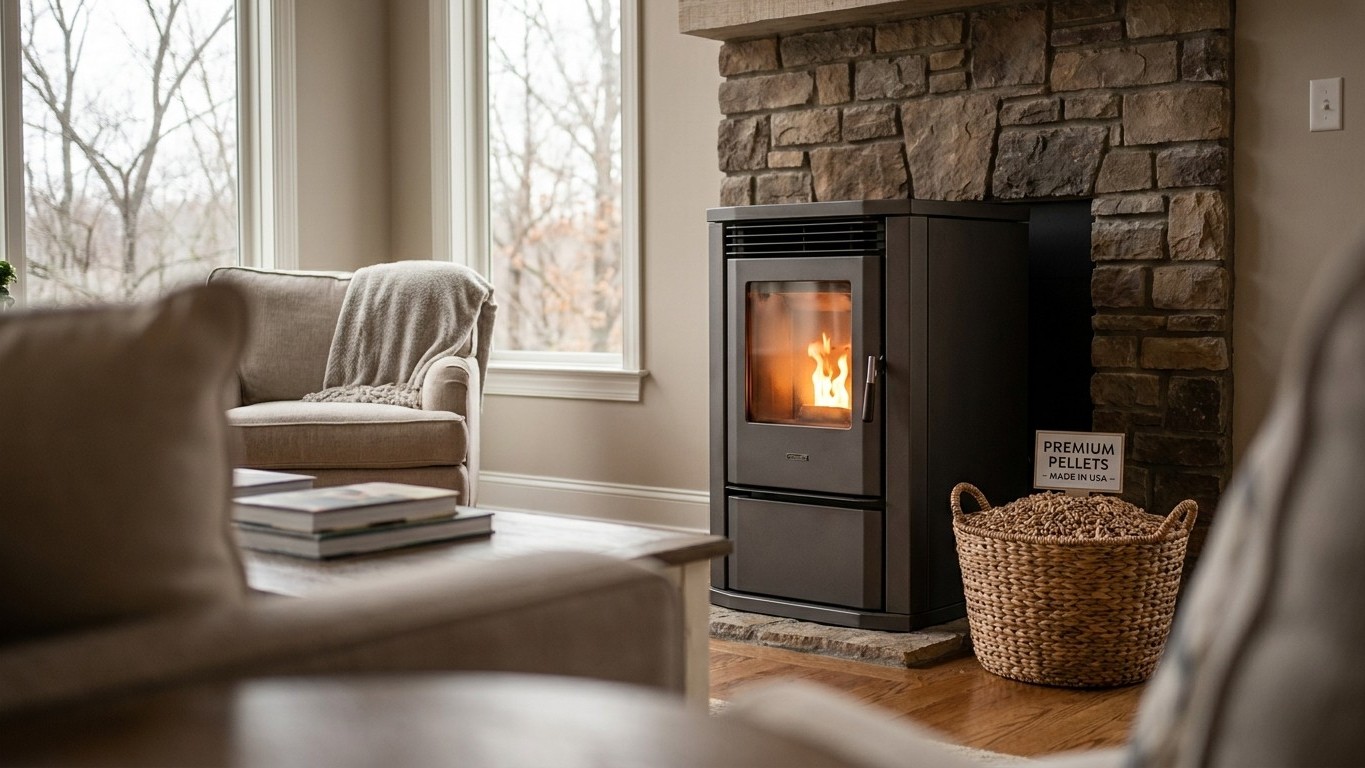

A Tennessee winter isn’t brutal, but it isn’t short either. Nashville’s climate data puts heating demand across roughly seven months, from October through April, with a firm peak in January. That combination, moderate cold stretched over a long season, shapes everything about running a pellet stove here: how many bags you’ll burn, when to buy them, and what a power outage actually costs you in comfort.
How hard the winter works here

The number that matters is 3,364 heating degree days a year, measured at Nashville International Airport under NOAA’s 1991-2020 climate normals. That figure isn’t a temperature. It’s a running tally of how far below 65°F the average day sits, added up across the whole year. Every degree day is fuel burned somewhere in a house, and 3,364 of them puts Middle Tennessee in the moderate range nationally, colder than the Gulf Coast, considerably milder than the Ohio Valley or New England.
What that moderate number hides is length. The heating season here doesn’t slam shut after a few brutal weeks. It opens in October, when the monthly mean temperature first drops below the 65°F threshold NOAA uses to count degree days, and it doesn’t close until May. January carries the heaviest load, with 788 of the year’s degree days packed into that single month, but November, December, February, and March all pull real weight too. A stove here isn’t sprinting through a short, sharp winter. It’s running a long, moderate one.
That distinction changes how you should think about the appliance. In a state with high degree days and a short season, a pellet stove often becomes the primary heat source because the cold is intense but brief. In Tennessee, the math points the other way: demand is spread thin over many weeks rather than concentrated into a few punishing ones. For a reasonably tight, well-insulated house, a pellet stove can genuinely carry the load as a main heat source. For a drafty older home or one with a lot of square footage to cover, it tends to work better as the room you actually live in staying warm, with central heat handling the rest of the house.
One more thing worth saying plainly: Nashville is one station, and Tennessee is not one climate. East Tennessee’s higher elevations, the Smokies and the ridges around Johnson City or Bristol, run measurably colder than the Cumberland Plateau or the western part of the state near Memphis. If you’re heating a house in the mountains, treat 3,364 as a floor, not your number, and expect your own season to run longer and colder than Nashville’s normals suggest.
How many tons a winter takes here
Nobody, no agency, no manufacturer, publishes a tons-per-winter figure for Tennessee, and for good reason: two houses on the same street can burn twice as much fuel as each other depending on how they’re built. What you can do is understand the chain that turns degree days into bags on a pallet.
A standard bag of wood pellets weighs 40 pounds. Fifty bags make a ton. How many tons you burn in a season comes down to how much heat your house actually needs to replace, which is exactly what the degree-day figure above measures. More degree days, more heat lost, more pellets burned to replace it. But that’s the climate side of the equation. The house side moves the number just as much, sometimes more.
- How well the house holds heat — insulation, air sealing, window quality, and even ceiling height all determine how much of the heat your stove makes actually stays in the room instead of leaking out.
- Whether the stove is the only heat source or a supplement — a stove running alongside a furnace or heat pump, covering just the main living space, burns far less over a season than one asked to heat an entire house on its own.
- The setting it runs at — a stove left on a low or medium setting most of the day sips fuel compared with one run wide open to fight a drafty room, and thermostatic models adjust this automatically in ways manual-feed stoves don’t.
Given all that, the honest approach isn’t to hunt for a published average. It’s to count your own bags. Buy a manageable amount for the first winter, track how many bags you go through by the time the season eases up in April or May, and use that as your baseline going forward. One measured season in your own house beats any estimate anyone, including this article, could hand you. For the general framework behind that math, the national page on how many pellets a winter takes walks through the calculation in more detail.
Buying and storing them in this climate
Timing matters more than most people expect. Because Tennessee’s heating season starts building in October, that’s your deadline for having fuel on hand, not the day the temperature actually drops. Wait until a cold snap rolls through the Southeast and pellet shelves at hardware stores and farm supply retailers can empty out fast, especially in smaller towns where inventory doesn’t get restocked overnight. Buying in late summer or early fall, before demand spikes, also tends to land you a better per-ton price than buying reactively in January when everyone else has the same idea.
Storage is where Tennessee’s climate actually works against you. Pellets are just compressed sawdust, held together by the natural lignin in the wood, no glue, no binder. That means moisture is the enemy. Middle and West Tennessee summers run humid, and a garage or shed that isn’t well sealed can hold enough ambient moisture to soften pellets sitting in a paper bag for months before the season even starts. Basements in older homes, especially anything below grade, are a particular risk, since concrete floors sweat during humid stretches even when the space feels dry to the touch.
The fix isn’t complicated, but it does require planning around your specific space: keep bags off the floor, keep them away from exterior walls that can sweat, and don’t assume a garage is dry just because it isn’t raining. When comparing where to buy, compare price per ton rather than per bag, since that’s the only figure that lets you fairly weigh one supplier against another. For the details on stacking, container choices, and how long pellets actually stay usable once opened, the national storage guide and the pellet quality page cover ground this article won’t repeat.
What a winter outage means here
A pellet stove isn’t a wood stove with better packaging. It’s an electrical appliance that happens to burn biomass. The auger that feeds fuel into the burn pot, the fan that pushes combustion air through the fire, the blower that pushes warm air into the room, all of it runs on household current. Lose power, and the stove stops working within minutes, regardless of how full the hopper is.
How much that matters depends entirely on when it happens. An outage in July costs you nothing heating-wise. An outage in January, when Nashville’s normals show the heaviest degree-day load of the year, is a different situation entirely, especially if the stove is doing real work in a house that leans on it. Ice storms are the usual culprit across Middle and East Tennessee, and they have a habit of knocking out power for a day or more at exactly the time a house needs heat most.
What most Tennessee households fall back on says something about how exposed pellet-only heating actually is here. State survey data shows furnaces as the single most common main heating equipment, used in 52% of homes, with central heat pumps in another 35%. On the fuel side, electricity powers 60% of homes’ main heating and natural gas another 35%, while propane accounts for just 3%. Put together, that means most Tennessee homes already lean on electric-dependent systems for their primary heat, which means a widespread outage doesn’t just silence the pellet stove, it often takes out the furnace or heat pump right alongside it.
That’s not a reason to skip a generator or battery backup, just a reason to size it correctly rather than guess. Check the wattage draw listed on your specific stove’s data label, since draw varies by model and by fan speed, and cross-reference it against whatever backup power you’re considering. The national page on pellet stoves and power outages walks through how to think about backup capacity without over- or under-buying.