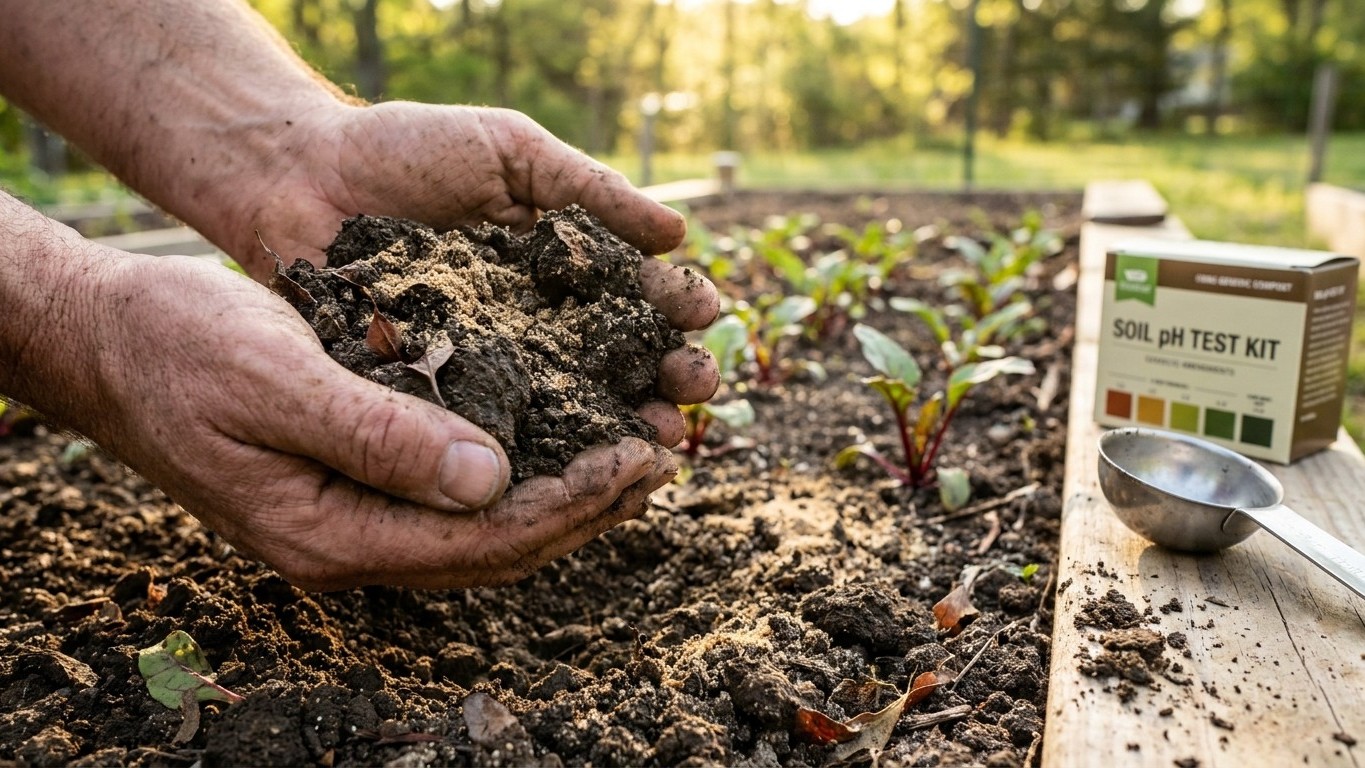

Tennessee’s benchmark soil runs acid and silty, not the loose, well-drained ground beets actually want, and the state’s spring swings enough to put bolting on the table before you’ve even thinned the row. Sow 2 to 3 weeks before the last frost, between March 31 and April 12 depending on where you are, keep the bed watered through the first six weeks, and test your own dirt before you trust any statewide average.
The short answer
Tennessee’s representative soil, the Dickson series, is an Ultisol, the kind of old, heavily weathered ground that’s spent a long time leaching away nutrients. USDA NRCS records the surface horizon at about 11 percent sand, 20 percent clay and 68 percent silt, with organic matter around 1.5 percent and a surface pH near 5.0, which counts as strongly acid. Drainage is rated moderately well drained, not poor, but not the free-draining sandy loam that beets prefer either.
None of that lines up well with what beets actually need. Utah State University Extension describes the ideal bed as deep, sandy and well-drained, rich in organic matter, amended with no more than 1 inch of composted material per 100 square feet. Dickson soil delivers the opposite on two of three counts: it’s silt-heavy rather than sandy, and its organic matter sits well below what a beet root wants to push through without forking or stalling. The acidity is its own problem, and it’s worth understanding in more depth how Beet Soil in Tennessee tends to behave before planting. Beets don’t perform well in strongly acid ground, and a pH near 5.0 is low enough that most gardeners growing in soil like this will need to lime before anything else.
On heat, this page doesn’t have a published count of how many days Tennessee’s growing season climbs past 90 F, and rather than guess at a number, it’s worth being direct about that gap. What matters more is the threshold Utah State University Extension gives: once air temperature passes 85 F and the soil has been dry, beet roots start turning woody. Tennessee summers reliably clear that mark for stretches at a time, which means the heat risk here isn’t a question of if but of how the soil holds moisture when it happens.
None of this is a diagnosis for any one garden. Tennessee spans hundreds of mapped soil series, and the Dickson series is simply the one USDA lists as representative of the state under its State Soils program. A river-bottom garden, a hillside plot, or any yard a builder graded and filled years ago can behave nothing like it. Treat the numbers above as a description of what the region’s ground tends to do, then pull your own soil test before you decide how much lime or compost your bed actually needs.
The six weeks that decide it here
Sowing 2 to 3 weeks before the last frost means the first six weeks of a beet’s life in Tennessee fall squarely in early-to-mid spring, working back from a last-frost window of March 31 to April 12. That’s the stretch that decides whether the crop bolts or grows on normally, because Utah State University Extension is specific on this point: water stress in those first six weeks is what pushes beets into premature flowering. Not heat, not day length on its own, but a dry spell right when the seedling is establishing its root.
Tennessee spring doesn’t move in one direction. It’s a season known for swinging between soaked and dry with little warning, cold fronts dropping heavy rain one week and a run of clear, drying days the next. That variability is exactly the condition that catches beet growers off guard. A bed that looks fine after a wet March can dry out fast once the sun comes out and the wind picks up, and if nobody’s watering during that window, the plant reads it as stress and starts bolting weeks before the root has any size.
The practical takeaway is to treat the six weeks after sowing as a period where soil moisture needs checking regardless of what the sky did the day before. A finger test two inches down tells you more than the forecast does. If the surface has crusted (and on a silt-heavy soil like the Dickson series, it will crust after a hard rain followed by sun), moisture can be sitting just under a hard skin, deceiving anyone who only looks at the top.
East Tennessee and the Cumberland Plateau complicate this further. Both regions run cooler and later in spring than the middle of the state, so a sowing date calculated off a Nashville-area frost window can land too early for growers at higher elevation. Anyone gardening in those areas should push their sowing date later rather than lean on a flatland frost calendar, since the six-week bolting window only means anything if it’s timed to the frost date that actually applies to that ground.
What goes wrong here
- Bolting from an early dry spell. A beet sown 2 to 3 weeks before the last frost hits its most sensitive stretch during Tennessee’s swingy early spring, and a week without rain during those first six weeks is enough to trigger premature flowering. The remedy is straightforward: check soil moisture by hand rather than by memory of recent rain, and water on a schedule during that window instead of waiting for the plant to show stress.
- Woody roots from summer heat plus dry soil. This is a separate failure from bolting, and it shows up later, once temperatures clear 85 F and the bed has gone dry. The fix is consistent watering through the hot stretch, not just at sowing, since it’s the combination of heat and thirst, not heat alone, that turns the root fibrous.
- Stunted growth from strongly acid soil. A surface pH near 5.0, typical of the Dickson series, is low enough to hold back beet growth regardless of watering. A soil test followed by lime, applied according to that test’s recommendation, addresses this before sowing rather than after the row is already struggling.
- Surface crusting on silt-heavy ground. At roughly 68 percent silt, this soil type can seal over after rain, then dry into a crust that seedlings struggle to push through and that traps or sheds water unpredictably. Working in organic matter, up to the 1 inch per 100 square feet ceiling Utah State University Extension recommends, loosens that surface and gives young roots an easier path down.
- Slow, thin roots from low organic matter. At around 1.5 percent organic matter, this soil starts well below what beets prefer for strong root development. Composted material worked in before sowing, again capped at that 1-inch-per-100-square-foot rate, raises fertility without overdoing it.
Checking this against your own county
Everything above describes the Dickson series as USDA’s representative pick for Tennessee, not the ground under any particular garden. Before amending a bed based on it, get an actual soil test done for the property in question. The University of Tennessee Institute of Agriculture Extension runs county offices across the state and can point you to testing and to recommendations calibrated to your specific soil, not a statewide average.
That’s especially worth doing given how different East Tennessee, the Cumberland Plateau and the western part of the state can be from each other, in both soil and frost timing. A county-level test and a local extension recommendation will tell you far more than any state-level figure can, and it’s the only way to know whether your own bed needs lime, compost, better drainage, or some combination of the three.
Common questions
How many days from sowing to harvest for beets in Tennessee?
Beets are direct-sown, not transplanted, so the days-to-harvest count starts at seeding and typically runs 60 to 80 days from that point, not from any later transplant date.
Do I need to lime my soil before growing beets in Tennessee?
If your soil resembles the Dickson series, with a surface pH near 5.0, it’s likely too acid for beets without correction. A soil test will confirm your actual pH and tell you how much lime, if any, your bed needs.
Is bolting the same problem as woody beet roots?
No. Bolting is premature flowering triggered by water stress in the first six weeks after sowing. Woodiness is a texture problem in the root caused by heat above 85 F combined with dry soil later in the season. They have different causes and call for watering at different stages of growth.
Should East Tennessee gardeners use the same sowing date as Middle Tennessee?
No. East Tennessee and the Cumberland Plateau run cooler and their last frost typically arrives later than in Middle Tennessee, so sowing dates calculated for the Nashville area should be pushed back for higher-elevation gardens.