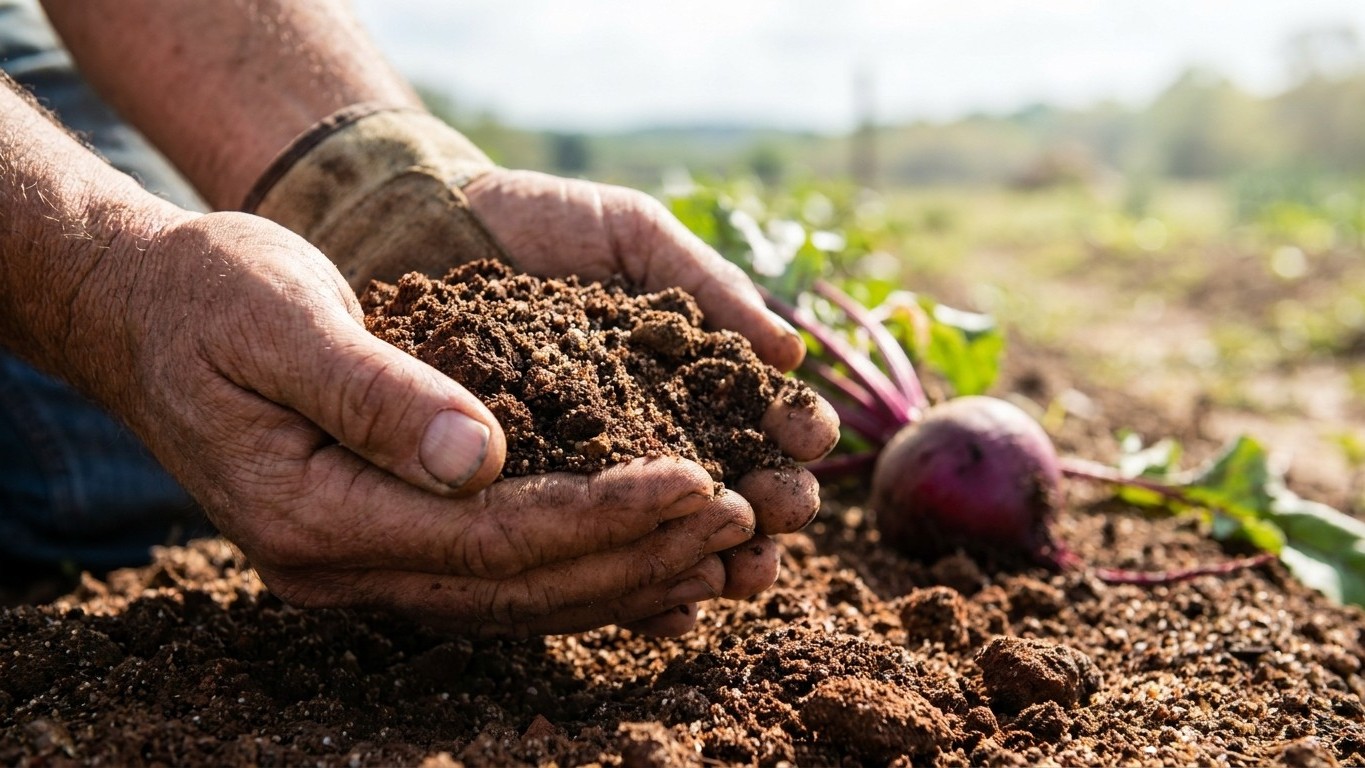

The Dickson series, Tennessee’s representative soil, runs 68 percent silt and only 11 percent sand at the surface, with acid pH around 5.0. Beets want the opposite: loose, sandy ground that drains fast and never crusts. That gap between what the state’s benchmark soil is and what a beet root wants doesn’t rule out beets in Tennessee, but it does mean a gardener who skips the fix (deep loosening, added organic matter) is fighting the ground from day one.
The short answer
Start with the texture. The Dickson series comes in at 11 percent sand, 20 percent clay, and 68 percent silt in its surface horizon, according to USDA NRCS Soil Data Access records for the series. That’s a silt loam, and silt loams have a habit that catches new gardeners off guard: they hold water well enough, then dry into a crust that a beet’s swelling root has to shoulder aside. Drainage class is moderately well drained, not poor, so standing water isn’t usually the issue. Compaction and crusting are.
Organic matter at the surface sits around 1.5 percent, which is on the lean side for a crop that Utah State University Extension says wants ground “rich in organic matter.” The extension’s guidance is specific on how much to add: no more than 1 inch of composted organic matter per 100 square feet, worked into the bed before sowing. More than that, and you risk the kind of loose, nutrient-heavy soil that pushes leafy growth at the expense of the root, or forked roots where the taproot splits around a pocket of undecomposed material.
Then there’s pH. Surface pH on the Dickson series runs about 5.0, which is strongly acid. Beets aren’t the pickiest vegetable about soil chemistry, but they do better closer to neutral, and a bed sitting at 5.0 will tie up some of the nutrients a beet needs to bulk its root rather than just grow top leaves. This is one of the more fixable numbers on this page: lime moves pH, and a soil test tells you how much.
What this page can’t tell you is how many days your particular yard spends above 90 F in a given summer, because that figure isn’t part of the published soil and climate data this article draws from. What the Utah State University Extension source does establish is a working threshold: heat above 85 F combined with water stress is what turns a beet root woody. That’s the number to plan around, not a guess at a seasonal day count.
None of this describes your garden with certainty. Tennessee spans several hundred mapped soil series, from river-bottom alluvium to rocky hillside soils to whatever a builder pushed around with a bulldozer before your house went up. The Dickson series is the state’s representative soil, the one USDA names as characteristic of Tennessee under its State Soils program, not a survey of every backyard. Treat these numbers as the starting assumption, then confirm with an actual soil test from your county extension office before you plant.
The six weeks that decide it here
Beets are sown directly in place, never transplanted, and the standard guidance is to get seed in the ground 2 to 3 weeks before the last spring frost. For the reference station behind this page (USW00013897), that last-frost window runs from March 31 to April 12, based on NOAA NCEI’s 1991-2020 climate normals. Count backward from that window and you land on a sowing date in mid-to-late March for much of Middle Tennessee. East Tennessee and the Cumberland Plateau run cooler and later in spring, so that window shifts later the farther east and higher in elevation you garden.
Why the first six weeks matter so much: that’s the stretch where a beet seedling either gets steady moisture and grows a smooth root, or hits a dry patch and bolts, sending up a flower stalk instead of bulking the root you actually want to eat. The Utah State University Extension source is direct about this mechanism. Water stress in those first six weeks is what triggers premature flowering. It has nothing to do with heat yet. It’s a seedling being asked to establish itself in soil that’s gone dry underneath a crusted silt-loam surface, the exact texture the Dickson series represents.
Middle Tennessee spring is known for swinging rather than settling. Wet stretches that saturate a silt loam bed can be followed within a couple of weeks by drying winds and a run of clear days that pull moisture out of that same bed fast, because a soil this heavy in silt sheds surface water once it crusts but doesn’t hold reserve moisture as well as a sandier soil would. That swing is exactly where bolting risk lives here. A bed that seems adequately moist at sowing time can dry out at the root zone within days if nobody’s checking, and a beet seedling doesn’t recover from that stress by simply growing better once water returns. The flowering signal, once triggered, tends to stick.
The practical takeaway isn’t complicated: sow into the March 31 to April 12 backward-counted window for your area, then treat consistent moisture in the following six weeks as non-negotiable, not something to check on when convenient. Mulch helps here more than most other regions, because it’s specifically fighting the crust-then-crack tendency of a silt-loam surface, not just retaining water in loose sandy ground.
What goes wrong here
- Surface crusting locks seedlings in place. The Dickson series’ 68 percent silt content forms a hard crust after a rain-then-dry cycle, and fine beet seedlings can struggle to push through it. Remedy: keep the top inch of the seedbed loose with a light raking after any hard rain, before the surface fully dries and hardens.
- Early bolting from a dry snap in the first six weeks. This is the water-stress trigger the Utah State University Extension source describes directly, distinct from heat. Remedy: water on a fixed schedule through the first six weeks after sowing rather than waiting for visible wilting, since silt loam can look moist on top while drying underneath.
- Woody roots from summer heat. Once temperatures push past 85 F and the bed also runs short on water, the root toughens rather than staying tender. This is a separate failure from bolting, tied to later-season heat rather than early establishment. Remedy: time harvest before peak summer heat, and keep watering consistent through any hot stretch rather than letting the bed dry between waterings.
- Acid soil limiting root development. Surface pH around 5.0 on the representative series is strongly acid, below where beets perform best. Remedy: get a soil test through your county extension office and apply lime according to its recommendation, not a guess, since lime rates depend on your actual bed’s buffering capacity.
- Forked or misshapen roots from overworked organic matter. Adding more than the recommended 1 inch of composted organic matter per 100 square feet can leave undecomposed pockets that split a growing taproot. Remedy: measure the amendment rather than eyeballing it, and work it in well ahead of sowing so it has time to break down.
Common questions
How many days does it take beets to mature in Tennessee?
Maturity depends on the variety sown, and beets are sown directly in place rather than transplanted, so the count starts at seeding, not at any later stage. This page doesn’t attribute a specific day count to a Tennessee-specific source; check the seed packet for the variety you’re planting, since maturity length varies by variety.
Does the Dickson series mean my whole garden is acidic?
Not necessarily. The Dickson series represents Tennessee as the state’s benchmark soil under USDA’s State Soils program, with a surface pH around 5.0, but a state contains hundreds of distinct soil series. River bottoms, hillside soils, and any yard that’s been graded or filled during construction can differ completely from the Dickson series. A soil test is the only way to know your bed’s actual pH.
Is bolting the same problem as a woody root?
No, and treating them as one problem is a common mistake. Bolting comes from water stress in the first six weeks after sowing, triggering premature flowering instead of root growth. Woodiness comes later, when heat above 85 F combines with water stress on an already-growing root, toughening its texture. Both are moisture failures, but they happen at different growth stages and need attention at different times, not a single “keep it watered” fix.
When should I sow beets if I garden in East Tennessee rather than Middle Tennessee?
Later. The last-frost window used on this page, March 31 to April 12, comes from a Middle Tennessee reference station. East Tennessee and the Cumberland Plateau run cooler and later in spring, so gardeners there should shift their sowing date later than the window given here and confirm timing against their own local frost data rather than applying this window directly.