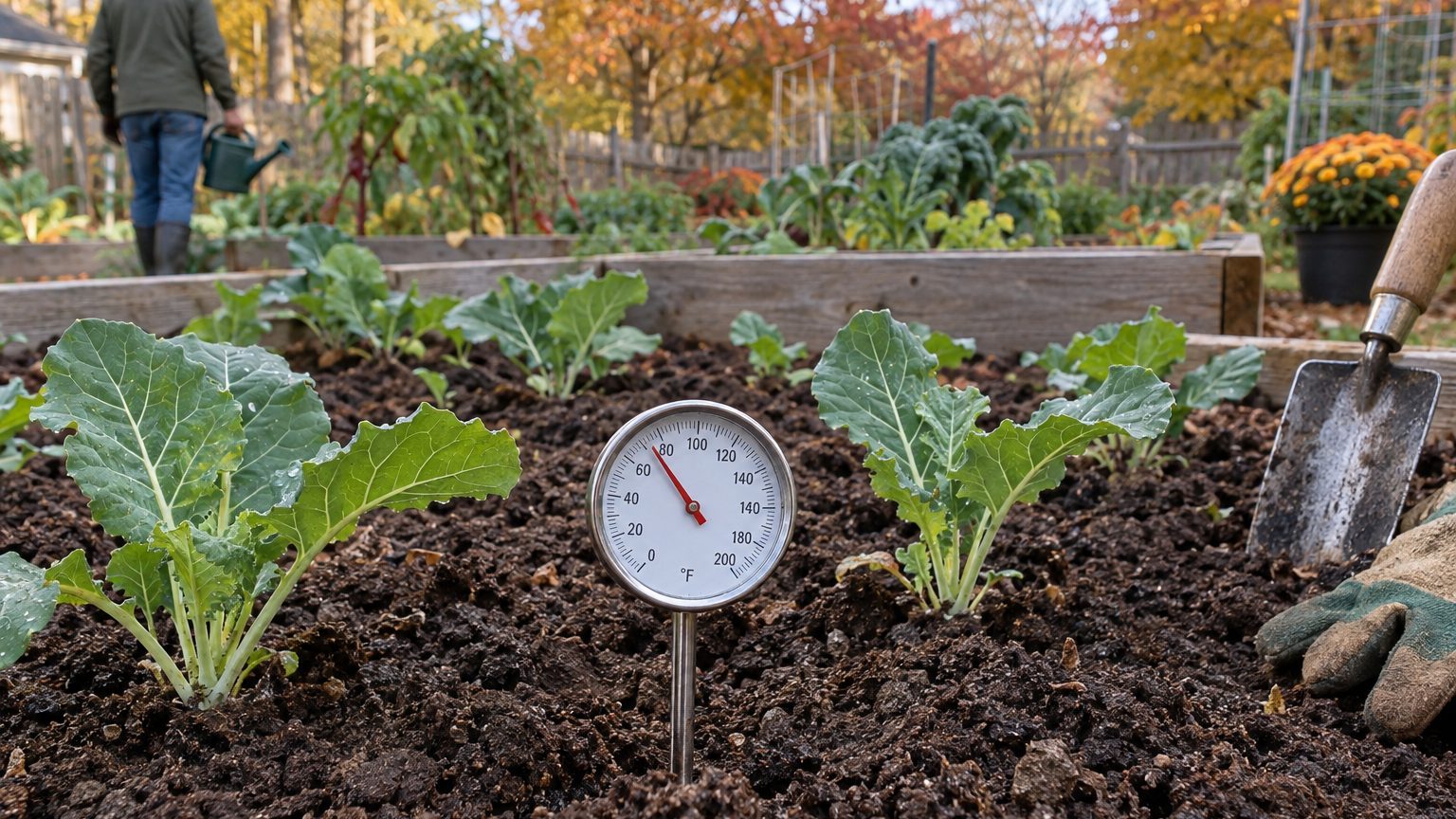

Manitoba’s collard season turns on one thing: how fast the soil warms, not how fast the calendar turns to May. The soil lags behind the air by weeks, and that lag is what decides the planting day here, more than any date printed on a seed packet. Hold off on setting transplants into the ground until the topsoil has actually warmed through, not just until the frost risk has technically passed.
When the soil is warm enough in Manitoba

The date question is the one every Manitoba gardener asks first, and the honest answer starts with an average, not a day you can circle on the calendar. Environment and Climate Change Canada’s 1981-2010 climate normals for the Winnipeg Richardson International Airport station put the average last spring frost at May 23. That figure is a mean, not a guarantee: across the years behind it, frost has landed after that date in roughly half the springs on record, sometimes by a wide margin. Treat May 23 as the midpoint of a risk window rather than a signal to plant.
Why the frost date isn’t the sowing date
Frost risk and soil readiness run on two different clocks, and collards answer to the second one. They don’t germinate or grow on a schedule set by air temperature alone. Cold, wet soil holds seed dormant for weeks even after the air has turned mild and the frost risk has passed on paper. The practical test costs nothing: push a hand a few inches into the bed, and if the ground still feels cold and heavy rather than loose and slightly warm to the touch, the soil hasn’t caught up yet, whatever the thermometer says about the air above it.
This is also why transplants earn their keep in a short-season province. Starting seedlings indoors ahead of the outdoor window, then hardening them off over a week or two of increasing outdoor exposure, lets you set out stocky young plants the moment the soil is ready, instead of waiting on direct-seeded rows to germinate in ground that’s still catching up. Either method works. The difference is only how much of the season you spend waiting on the seed rather than growing the plant.
Manitoba’s Canadian hardiness zone for the Winnipeg area, 3b under Natural Resources Canada’s 1991-2020 plant hardiness mapping, is built from seven climate variables rather than a single low temperature, and it describes conditions at that reference city specifically. Gardens north of Winnipeg, or in low-lying frost pockets anywhere in the province, run colder and later than this figure suggests. Use it as a starting point for your own soil-warming timeline, not as a fixed rule for your own yard.
None of this changes what happens if a late frost does arrive after you’ve already planted. Collard seedlings tolerate a light frost far better than most garden vegetables, and a cold snap that would finish off beans or squash usually just checks their growth for a few days. That tolerance is exactly why the crop is worth growing this far north in the first place, and it’s also why the sowing decision comes down to soil condition, not to shaving a few extra days of safety margin off the frost date.
How long the season lasts here
Stack the two averages from Environment and Climate Change Canada’s 1981-2010 climate normals for Winnipeg Richardson International Airport against each other, and the frost-free window in an average year runs from the last spring frost on May 23 to the first fall frost on September 22, a span of about four months. Both dates are means, so the real window in any given year can run shorter or longer than that, and treating either end as fixed is how a planting plan gets caught out.
What the window allows
Four months is enough room to do more than get one planting to the point of harvest. It’s enough to stagger sowings a few weeks apart through late spring and into early summer, so the bed doesn’t produce one large flush of leaves all at once and then nothing. Collards also hold in the garden far better than most greens once they’re mature, standing through cool weather and even light frost without bolting or turning bitter, which stretches the usable harvest period well past the date any single sowing first reached full size.
Where the season runs shorter than this average, in a year with a late spring frost or an early fall one, that flexibility narrows fast. A single planting timed as early as the soil allows becomes the only realistic option, and the case for starting seedlings indoors rather than direct-seeding gets stronger, because transplants are already weeks ahead of a seed sown straight into the ground the same week. The general guide to growing collards covers how to time a second or third sowing for continuous harvest, worth reading before committing the whole bed to a single planting date.
Either way, the calculation is worth doing on paper before the bed goes in. Count backward from September 22 by however many weeks a planting needs to reach usable size, and check that the result still falls after May 23 with a margin, not right up against it. That margin is what absorbs a late spring or an early fall without costing the harvest outright.
Heat and water in Manitoba

The number that actually plans this bed isn’t a summer figure at all. It’s how cold the coldest month gets, because that decides whether collards can stand in the garden through winter or whether the season ends outright at the first hard freeze. Environment and Climate Change Canada’s 1981-2010 climate normals for Winnipeg put the mean daily minimum of the coldest month at -21.4°C, and at that depth of cold, nothing left uncovered in the ground survives it.
Why the winter low decides more than the summer heat
In places where the coldest month stays mild, collards can turn into a standing crop, picked leaf by leaf from November into the following spring, gaining sweetness after each cold snap rather than losing the planting entirely. British Columbia’s coastal gardens are the clearest example of that pattern on this site, and the guide to growing collards in British Columbia lays out how that standing harvest works where winters allow it. Manitoba’s winter low rules that out. Here collards are an autumn crop, full stop, and the planning question is how far past the average first fall frost a harvest can be stretched before a hard freeze finishes the bed, not how to keep it going all winter.
On the heat side, this page doesn’t have a local count of days above 30°C to draw on, and that absence is itself useful information. Manitoba’s summers don’t put the kind of sustained heat stress on a brassica bed that shortens the growing window in a hot-summer state. Collards actually prefer cool growing conditions, and a Manitoba summer, short as it is, rarely pushes them toward the bitterness or premature flowering that heat causes further south. The bigger risk here runs the other way. A cool, damp stretch in mid-summer, more than a scorching one, is what brings on downy mildew and other fungal trouble on brassica leaves, since the organisms behind both favor moisture and moderate temperatures over dry heat.
Without a local rainfall figure to cite, the safest working assumption is to manage moisture by hand rather than by expectation. Space plants far enough apart that air can move between the leaves after a rain, water at the soil line rather than overhead when you can, and check the undersides of lower leaves through any damp week for the pale, fuzzy patches that mark mildew starting in before it spreads through the bed.
Which collards suit Manitoba
This page won’t name a variety, and that refusal is deliberate. Which collard performs best in a given year depends on trials run in that region’s own soil and weather, and Manitoba’s provincial agriculture department is the body positioned to say which types have actually done well on local test plots, not a general gardening page written for the whole continent. Check current recommendations through Manitoba Agriculture before ordering seed.
What to ask your extension service
What this page can do is narrow the type of collard worth asking about, based on the season length and cold pattern already covered above.
- An early-maturing type, since the frost-free window runs to roughly four months in an average year and a slow one leaves too little margin
- Good tolerance of light frost, so the harvest can run past the average first fall frost on September 22 rather than stopping cold at it
- Disease resistance as a first filter rather than an afterthought, given how readily downy mildew and similar fungal problems move through brassica leaves in a damp stretch
That last point matters beyond variety choice. Collards are a brassica, in the same family as cabbage, kale, mustard, and also turnip and rutabaga, and they share pest and disease pressure with all of them. A rotation plan that moves collards into a bed that grew any of those crops within the past few years hasn’t actually rotated anything, whatever the calendar says about it being a different plot from last spring’s cabbage. Gardeners working a similarly short and cold-prone season face the same short list of priorities, and the guide to growing collards in South Dakota works through the same early-type, frost-tolerant reasoning against that state’s own frost dates.
Seed packets and catalogues list days to maturity for named cultivars, and those figures come from the catalogue itself, counted from transplant, and they shift by a week or so with the weather in any given year. Cross whatever figure is printed on the packet against the roughly four-month window worked out earlier, rather than assuming the number already accounts for a short Manitoba season. It doesn’t. That check is the one step between picking a type on paper and it actually maturing in a garden a long way north of where most of these varieties were originally trialled.