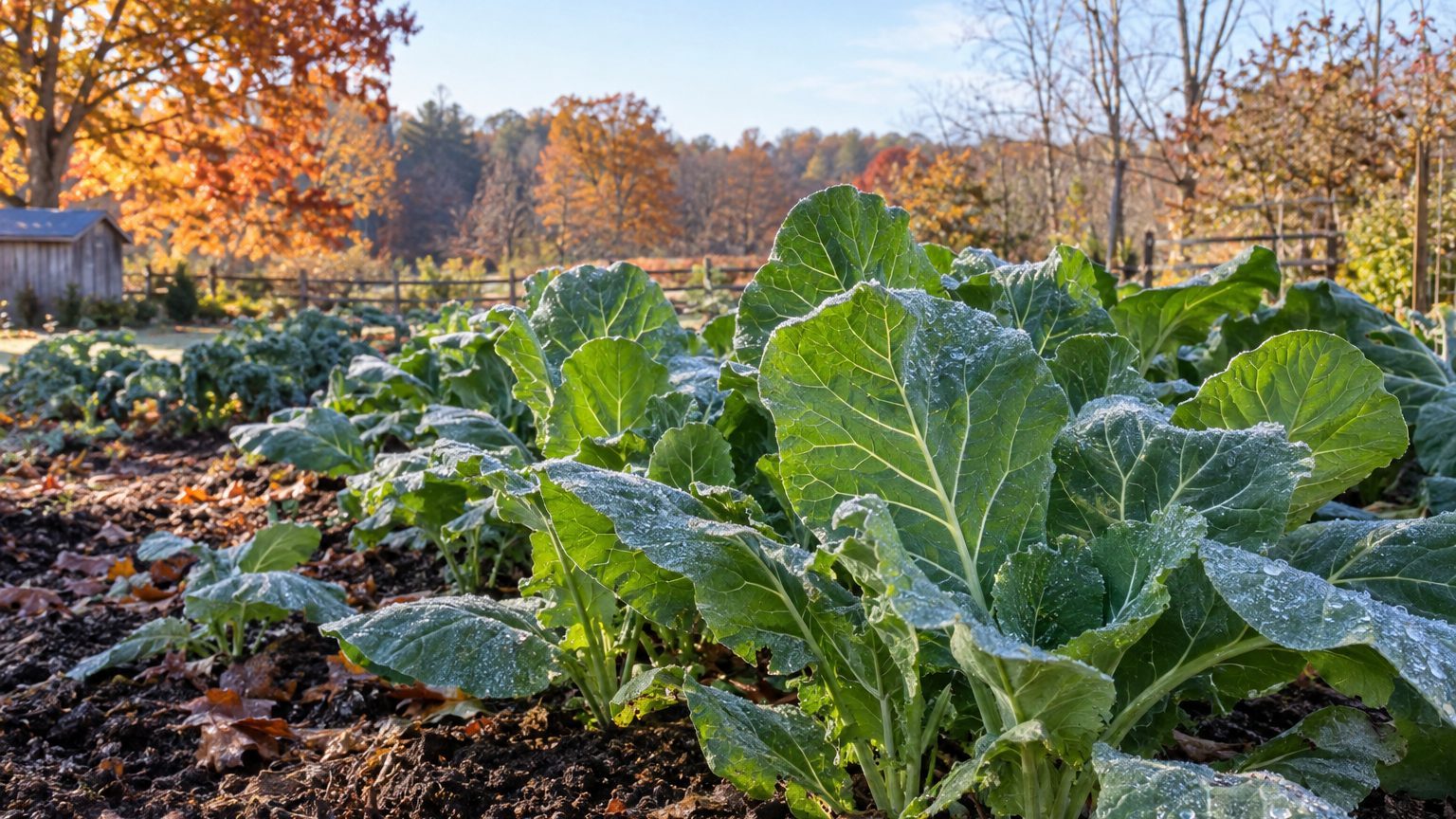

Texas has no single collard planting date. The state runs from Gulf Coast humidity to Panhandle winters, and the frost figures this page can stand behind come from Houston, the mild end. They anchor a fall-first calendar that fits that corner of the state and no other. If you are farther north or higher up, treat what follows as a starting point, and see Growing Collards in Texas for the crop itself.
The short answer for Texas
In the Houston area, collards go in for a fall-to-winter crop, timed by counting backward from a first-freeze window of December 1 to December 19. A second, shorter sowing can go in ahead of the last-freeze window of February 4 to March 1. Those two windows are the whole calendar, and both come from one weather station.
Here is what the dates are a probability of. NOAA’s 1991-2020 Climate Normals, measured at the Bush Intercontinental station (IAH), give the dates when the chance of a 32F freeze sits between 30 and 70 percent. Nothing is promised on those days. February 4 does not mean you are safe afterward, and December 19 does not mean the first freeze has arrived. The band tells you when a freeze stops being a rare surprise and starts being a coin flip.
Why does a fall crop win in this climate? The same NOAA normals put the mean daily minimum of Houston’s coldest month at 43.7F. That is an average of nights, not a record low, but it shows that a typical Houston winter night sits well above what stops a hardy green. Cold is rarely what limits collards here. Heat at the front end and heat at the back end do the limiting, which is why the winter months are the crop’s home ground.
To turn the window into a sowing date, read the days to maturity on your seed packet and count backward from the first-freeze band. That gives a latest sensible sowing date. Planting a bit earlier than that date leaves room for a slow start, and a fast-growing variety can be sown later than a slow one. Our guide to The Best Collards and Greens for Texas covers how varieties differ.
One more wrinkle, even inside the Houston area: Hobby airport runs about two weeks milder than IAH. A gardener near the bayous south of downtown may sit closer to Hobby’s numbers than to the ones above.
What will not work here

The biggest failure is borrowing Houston’s calendar for the rest of the state. The Panhandle freezes months earlier in fall and months later in spring. A Panhandle gardener who sows on a Houston schedule is planting seedlings that meet a hard freeze before they have real roots. Dallas, Fort Worth, and the Hill Country sit between those extremes and differ again, and this page does not have their frost dates. If your winter is colder than Houston’s, count back from your own first freeze, not December 1 to December 19.
Late spring sowing also disappoints. The last-freeze band closes on March 1, and the Gulf Coast warms fast after that. Collards sown late in spring mature into heat, and heat pushes them toward tough, bitter leaves and early bolting. Spring works only if you sow as soon as the freeze odds fade and accept that the harvest will be short.
Weekly watering is another trap, and it bites hardest in the sowing season. Fall collards go in during late-summer heat, when the top layer of soil dries fast. Seedlings with shallow roots cannot ride out a once-a-week soak. Until they are established, they need light, frequent watering, checked by touch rather than by calendar. A thick mulch helps hold the moisture.
Humid Gulf air punishes crowding. Collards packed shoulder to shoulder keep their leaves wet after every rain or heavy dew, and that invites leaf disease and gives caterpillars cover. Follow the spacing on the seed packet, and go wider if your beds stay damp. The variety you choose matters here too, since some grow bigger leaves that need more room.
Finally, do not read the 43.7F figure as a promise of mild winters. It is an average of nightly lows, and the freeze-probability bands exist precisely because Houston does get nights at 32F. A row of fresh transplants can take a hit from one of those nights. Keep a sheet or frost cloth handy through the December window and into February.
What changes across Texas
The USDA Plant Hardiness Zone Map (2023 edition, built on 1991-2020 normals) places Texas anywhere from 6a-10a. That spread is huge, and it means there is no single answer for the state. The zone system rests on one variable, the average annual extreme minimum temperature, so it tells you how cold the worst nights get, not when the first one arrives or how hot your summer runs.
For a reader in the north or at altitude, the shift runs in one direction on both ends of the season. The first freeze comes earlier than Houston’s December window, so the fall sowing has to start sooner and the seedlings need more time to size up before hard cold. In spring, the last freeze comes later, so any early sowing waits longer. How much sooner or later depends on where you are. This page does not have figures for North Texas, the Panhandle, or the Hill Country, and it will not guess at them.
Colder places have one advantage. A shorter, cooler summer means fall seedlings have an easier time in late summer than they do on the Gulf, and the heat problem in spring arrives later. The trade is a smaller margin on the cold side, since a hard freeze in a colder zone can end the crop where a Houston freeze would only nip it.
Which zone are you in? Look it up yourself on the USDA map, which lets you search by ZIP code, and do not assume it from a neighbor’s advice or a regional label. Then pair the zone with your local first-freeze date, because the zone alone will not tell you when to sow.
Where to check this for your own county
Texas A&M AgriLife Extension is the state’s land-grant extension service, and its address is https://agrilifeextension.tamu.edu/. Every county has an office, and the county page is where a general recommendation becomes a usable one.
Once there, look for two things. The first is the local vegetable planting calendar for your county. It gives sowing windows for cool-season crops like collards, and it accounts for frost and heat where you actually garden. The second is the list of varieties that have been trialled in your county or a neighboring one. A collard that performs on the Gulf Coast may not be the one that does best in the Panhandle, and a trial result from your own soil and climate is worth more than any catalog description.
Search for your county’s vegetable planting guide first, and if the site does not show one, call or email the county office. Extension agents field seasonal questions from home gardeners every year, and they know local surprises, such as which microclimates hold frost, that no statewide page can capture.
A county recommendation beats a state one, and this page is the state one. It covers what can be said responsibly from a single reference station and a hardiness map. Where your extension office disagrees with the dates here, follow the extension office.
Checking this against your own garden
Your own yard outranks every date on this page. Three observations will tell you more about your microclimate than a regional average can.
- Soil warmth by feel. Push a finger into the bed to the depth of your first knuckle in the morning and again in the afternoon. Soil that still feels hot late in the day is too warm for tender seedlings, and soil that stays cool in the evening tells you fall has arrived in your bed.
- The first true leaves. Collard seedlings first push up two round seed leaves, and the true leaves, the ones with the familiar collard shape, follow. If yours are slow, the bed is running too hot, too cool, or too dry. If they show quickly, you have found a good spot.
- Frost on the car or the lawn. Note which mornings leave a white coating and where it shows up first. Low corners and open ground frost earlier than beds beside a south-facing wall or the house, and that difference is your own microclimate at work.
Write those observations down for a season. After one year, you will have a personal calendar that fits your yard better than any state table.
If you follow the almanac, here is when to plant collard greens by the moon. It is a tradition, not a proven method.
Common questions
Can I sow collards in spring in Texas?
In the Houston area, yes, after the last-freeze band of February 4 to March 1 begins to fade, but the season is short because heat arrives quickly. Fall sowing is the more reliable route.
Do the Houston dates work for Dallas, San Antonio, or Amarillo?
No. The Houston figures are the mild Gulf end, and this page does not have frost dates for other regions. Use your own county’s first-freeze date or your extension office’s calendar.
Will a freeze kill my collards?
Collards are among the hardier garden greens, and established plants often come through a light freeze. Young transplants are far more vulnerable, so cover them on nights when 32F is forecast, especially in the December window.
Why does the frost window come as a range instead of one date?
Because it is a probability band. NOAA’s 30-70 percent range marks the stretch when a 32F freeze goes from unlikely to likely. Even within Houston the band shifts, with Hobby airport running about two weeks milder than IAH.