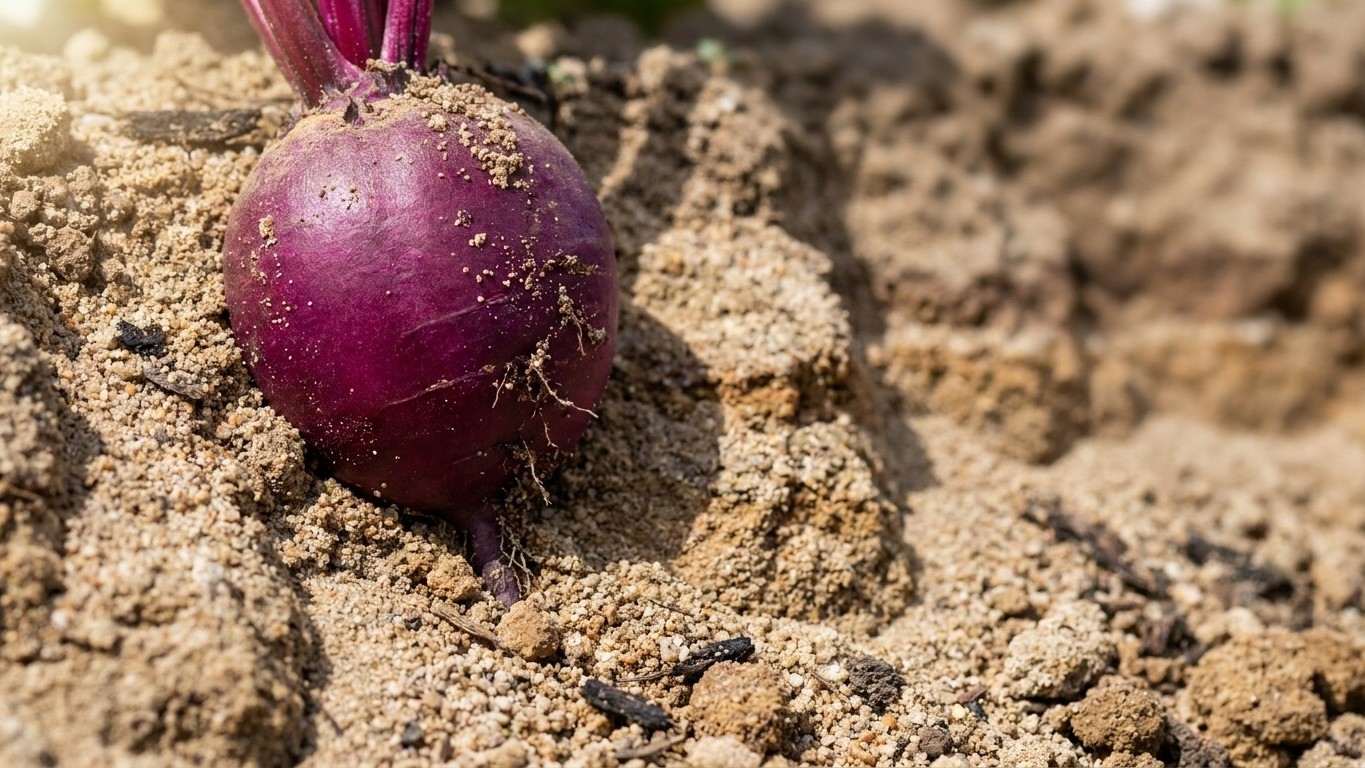

Pull beets about 60 to 80 days after seeding, before heat above 85 F and a dry spell turn the root woody. The surprise comes after the harvest. Once the tops are cut off, the roots keep best at 33 to 36 F, not at the 32 F that suits most other root crops, because colder storage brings more black spot and rot. The dates below come from Houston, the mild Gulf end of a very large state.
The short answer
Texas’s state soil is the Houston Black series, a Vertisol, and USDA records its mapped surface layer as 20 percent sand, 54 percent clay and 26 percent silt. The pH is about 7.9, which is alkaline. Organic matter sits near 3.0 percent, and drainage is moderately well. It is a shrink-swell clay, the kind that cracks open when dry and turns to glue when wet. Utah State University Extension says beets want deep, sandy, well-drained soil rich in organic matter. Houston Black is nearly the reverse of that, so a beet planted in it is working against the ground. A state spans hundreds of soil series, though, and these figures describe the soil that represents Texas, not the bed behind your house. Treat them as a starting point, and let a soil test give you your own numbers.
What heavy clay does to a root
A root has to swell in ground that is more than half clay. After a soaking rain, that clay hangs onto water around the root. After a dry stretch, it cracks and the root zone dries out fast. Both swings matter for beets, as the next section explains. Extension’s advice on amending is restrained: no more than 1 inch of composted organic matter per 100 sq ft. More detail on the root’s side of this is in Beet Soil in Texas: What the Root Will Meet.
The pull date and the cold-storage trap
Heat above 85 F combined with water stress makes the root woody. That is a late-season failure, separate from the early-season one covered below. How many days a year Houston passes 90 F is not among the figures verified for this page, so there is no count to quote here. The 85 F line from Extension is the one to watch. Count 60 to 80 days from the day the seed goes in the ground (beets are sown in place, never transplanted), and pull before the weather crosses that line.
Then top them. Bunched beets with leaves last only 10 to 14 days. USDA Agricultural Handbook 66 puts topped roots at 33 to 36 F and 98 percent relative humidity, and says storage at 32 to 34 F produces more black spot and rot than slightly warmer storage. The full chapter is in the USDA handbook.
The six weeks that decide it here
Sow beets 2 to 3 weeks before the last spring frost, and the first six weeks of the crop fall in a known stretch of the calendar. In Houston, NOAA NCEI’s freeze-probability data (the 30 to 70 percent band, IAH airport station) puts the last 32 F freeze between February 4 and March 1. Counting back puts sowing at roughly mid-January through mid-February. The first six weeks then run from late February into late March. Hobby airport runs about two weeks milder than IAH, so even inside one metro area the window slides.
The Gulf Coast spring in those weeks usually swings. Cold fronts come through, warm days follow, and heavy rain alternates with dry runs. That is the pattern that sets up the bolting risk. Extension is specific that water stress in the first six weeks causes premature flowering, and on Houston Black the stress arrives in the dry gaps between rains. A week without rain lets the clay crack and the seed row dry out, and the seedling has little root to reach with. A wet stretch does a different kind of harm, because clay that turns to glue is slow to drain. The bolting risk sits in the dry gaps, so that is when a hose or a soaker line earns its keep.
Same plan, different calendar
None of this is a Texas planting calendar. The state spans four USDA zones, and the Houston figures are the mild end. The Panhandle freezes months earlier in fall and later in spring, and the Hill Country and North Texas each differ again. The method travels but the dates do not: find your own last frost date, subtract 2 to 3 weeks, and watch the water for the six weeks after sowing. For the full picture of the crop, see Growing Beets in Texas.
What goes wrong here
- Bolting from early thirst. Water stress in the first six weeks sends the plant to flower instead of building a root. On cracking clay, the dry gaps between spring rains are the danger. Remedy: keep the seed row evenly moist from sowing through week six, and check it during every dry spell rather than waiting for the leaves to wilt.
- Woody roots from later heat. Heat above 85 F with water stress toughens the root, and this is a different failure from bolting. Remedy: sow early enough that 60 to 80 days from seeding ends before the heat arrives, and keep watering steady in the final weeks.
- Glue and cracks in the bed. Houston Black-type clay turns sticky when wet and splits when dry, and a root has to push through both. Remedy: skip working the bed while it is wet, add no more than 1 inch of compost per 100 sq ft as Extension advises, and test your own soil. Your ground may be sandier, or much worse.
- Pests on top of all that. Leaf and root damage is its own story, covered in What Eats Beet in Texas, and When.
- Storing at the coldest setting. Roots held at 32 to 34 F develop more black spot and rot than roots held a little warmer. Remedy: aim for 33 to 36 F and 98 percent humidity, and check the temperature with a thermometer instead of trusting the dial.
- Leaving the leaves on. Bunched beets last 10 to 14 days at 32 F or above, and no longer. Remedy: top them first, the same day you pull them.
- Saving the small roots. Large roots keep much better because they lose water and shrivel more slowly. Remedy: eat the small ones first and put the big ones in storage.
Common questions
How long after sowing are beets ready to pull?
Plan on 60 to 80 days counted from seeding. Beets are sown in place, so there is no transplant date to count from. A mid-January sowing in Houston lands the harvest roughly between mid-March and early April, but that is arithmetic on Houston’s calendar, not a promise for every Texas garden.
Does the Houston window work for the rest of Texas?
No. Houston’s last-freeze window of February 4 to March 1 is the mild Gulf end. The Panhandle, North Texas and the Hill Country all freeze on different schedules, so use your own last frost date and sow 2 to 3 weeks ahead of it.
Why not store beets at the coldest setting?
USDA Handbook 66 reports more black spot and rot at 32 to 34 F than at slightly warmer temperatures, and it gives 33 to 36 F for topped roots. Cold that suits other root crops is wrong for this one, so a refrigerator thermometer is worth more than the dial.
Which beets should go into storage, and which should I eat first?
Keep the big roots and eat the small ones first, since small roots shrivel faster. Cut the tops off first, because bunched beets with greens last only 10 to 14 days. If you ever hold a large harvest in a pit or cellar, the handbook’s limits are no colder than 31 F and no warmer than 41 F.