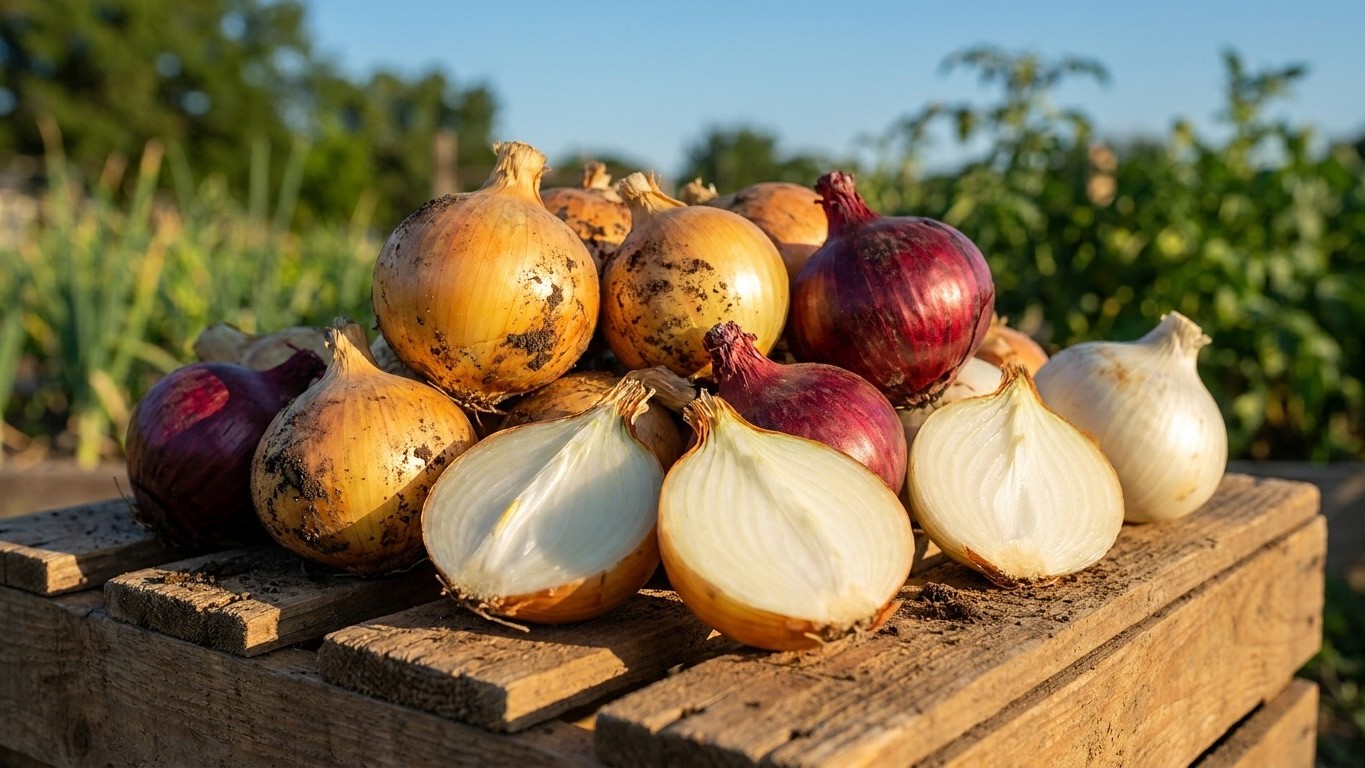

Short-day onions are the only group that reliably bulbs in Texas. At 29.98°N, the reference latitude for Houston, the longest day of the year brings just 13 hours and 56 minutes of daylight, well short of the 14-to-16-hour trigger that long-day varieties need. That single fact rules out most of the onion varieties sold in this country and points straight to a short list that actually works here.
The short answer for Texas

Onions do not respond to temperature the way tomatoes or peppers do. They respond to day length. A bulb starts forming when the number of daylight hours crosses a genetic threshold built into the variety, and nothing else, not heat, not fertilizer, not luck, moves that threshold. Houston’s 13 hours 56 minutes on the summer solstice sits comfortably above the roughly 12-hour mark that triggers short-day onions, but nowhere near the 14-to-16-hour window that long-day types are bred for. That gap is the whole story for gardeners across most of the state.
Five documented varieties have published ranges that cover this latitude outright: Texas Grano 1015Y, Vidora, and Red Sensation, all short-day types rated for 25 to 35°N, along with Gabriella and Madalyn, short-day varieties rated for 20 to 35°N. None of these last two has a dedicated page on this site, but both are worth naming because their catalogue range squarely includes 29.98°N.
Two more sit close enough to the edge of their published range to deserve a mention with a caveat. Red Rock (30 to 36°N) and White Castle (30 to 38°N) both start just above this latitude. A degree and a half is not a hard wall, since bulbing thresholds are a continuum rather than a cutoff, so gardeners at 29.98°N sit right at the blurred lower boundary for these two. They may bulb here. They are not a safe bet the way the five short-day varieties above are.
Everything else on the standard seed rack, the long-day types bred for the North and the intermediate-day types bred for the transition zone, needs day lengths this latitude simply never reaches, even at the peak of summer.
What will not work here
This is the part of the conversation seed racks and big-box garden centers routinely skip. A long-day onion planted in Texas does not struggle, does not underperform, does not give you a smaller crop. It gives you no crop. The plant spends the season building leaves, waiting for a day length that never arrives, and by the time cooler fall weather sets in, the bulb never formed and the plant rots in the ground. Twenty-four varieties on this site’s list fall into that category for anyone gardening near 29.98°N.
Long-day varieties, all excluded
- Ailsa Craig (38 to 60°N), needs a summer day length this latitude never reaches
- Barolo (38 to 55°N), same shortfall, no bulb forms
- Blush (38 to 55°N), bred for far-northern summers
- Bridger (35 to 50°N), lower bound still above this latitude
- Frontier (40 to 50°N), needs roughly 14 to 16 hours of daylight
- New York Early (38 to 50°N), leaves only, then rot
- Patterson (38 to 55°N), a storage onion for northern gardens
- Powell (43 to 47°N), the narrowest, most northern range on the list
- Red Carpet (40 to 45°N), day length never triggers bulbing here
- Redwing (43 to 65°N), bred for near-subarctic summer daylight
- Rossa di Milano (38 to 50°N), same story, no exception
- Safrane (42 to 50°N), far outside reach
- Talon (42 to 50°N), needs a summer day this state does not have
- Walla Walla Sweet (35 to 55°N), a Pacific Northwest classic, not a Texas one
Intermediate-day varieties, also excluded
- Cabernet (35 to 45°N), still above this latitude’s ceiling
- Calibra (35 to 45°N), same gap
- Candy (33 to 40°N), the lower bound is three degrees north of Houston
- Elsye (32 to 45°N), outside the range even at its lowest edge
- Expression (32 to 45°N), same shortfall
- Monastrell (35 to 46°N), needs a longer summer day
- Red Long of Florence (38 to 50°N), well north of Texas
- Red Long of Tropea (35 to 48°N), outside reach
- Scout (32 to 46°N), lower bound still above 29.98°N
- Sierra Blanca (32 to 45°N), same gap
Plant any of these along the Gulf Coast or in central Texas and the outcome is not disappointing, it is nonexistent: a season of green tops and a fall harvest of nothing worth pulling.
What changes across Texas
Texas is not one latitude, and the advice above bends depending on where in the state a garden sits. The reference figures here come from Houston, at 29.98°N, but the state runs from roughly 26°N near Brownsville and the Rio Grande Valley up to about 36°N along the Panhandle border with Oklahoma. That is close to ten degrees of latitude, more than enough to shift which onion group actually makes sense.
| Region | Approximate latitude | What changes |
|---|---|---|
| Rio Grande Valley (Brownsville area) | ~26°N | Even shorter summer days than Houston’s 13:56; short-day varieties bulb earliest here and fall planting can start sooner |
| Houston / Gulf Coast (reference city) | 29.98°N | 13 hours 56 minutes on the longest day; the five documented short-day varieties match this reference directly |
| Texas Panhandle | ~36°N | Longer summer days, moving into the published range of some intermediate-day varieties such as Candy (33 to 40°N) or Scout (32 to 46°N) |
A gardener in Amarillo is not gardening on the same day-length budget as one in Corpus Christi, even though both are technically “Texas.” Anyone within a couple hundred miles of the Red River or the Panhandle border should treat the short-day recommendation above as a starting point, not a rule, and check their own latitude before ruling out an intermediate-day variety altogether.
Sweet now, or onions that last
The onions bred for Houston’s day length are also, by chemistry, the ones that will not carry you through the winter. Pungency in an onion comes from volatile sulfur compounds, and those same compounds are what protect a bulb in storage. Fewer of them means a milder, sweeter onion at harvest, but also a bulb with a shorter shelf life. According to University of Missouri Extension, “as a rule, ‘sweet’ onions do not store as well as the more pungent types,” a trade-off that has nothing to do with variety marketing and everything to do with the compounds themselves.
Short-day varieties like Texas Grano 1015Y, Vidora, and Red Sensation run toward the sweet, low-sulfur end of that spectrum, which is exactly what the region’s day length selects for. That is good news at the cutting board in June, less good news for the pantry. Long-day onions grown further north, the pungent, sulfur-heavy storage types like the ones excluded above, are bred for exactly the opposite outcome: sharper raw, but capable of holding through months of cold storage.
The practical result: a Texas onion crop is built for eating within a few months of harvest, not for lasting through the year. By March, a Gulf Coast pantry stocked only with short-day onions from spring planting is likely running low or empty, while a northern grower’s long-day storage onions are often still holding up in a cool, dark corner of the garage. That is not a failure of technique. It is the direct chemical cost of growing a variety suited to a latitude where the day never gets long enough to build the sulfur load that keeps a bulb firm past winter.
Checking this against your own garden
Every figure in this article is anchored to Houston’s 29.98°N. That is a solid reference point for the Gulf Coast and much of central and south Texas, but it is not a substitute for knowing your own coordinates, especially if your garden sits closer to the Panhandle, the Hill Country’s higher elevations, or the far edge of the Rio Grande Valley.
- Look up your own latitude if you garden more than roughly 100 miles from Houston, since even a couple of degrees shifts which day-length group actually fits
- Confirm your local average first and last frost dates, since they determine when to set out transplants or sow seed, separate from the day-length question that determines bulbing
- Call your county extension office for site-specific onion variety trial data; Texas A&M AgriLife Extension offices track regional performance that a state-wide article cannot capture
- Check whether your garden sits in a microclimate, such as an urban heat pocket or a low-lying cold sink, that shifts your effective planting window even though your latitude stays the same
A latitude figure tells you which group of onions has a chance. It does not replace a soil test, a frost record, or a conversation with someone who has watched onions grow three counties over.