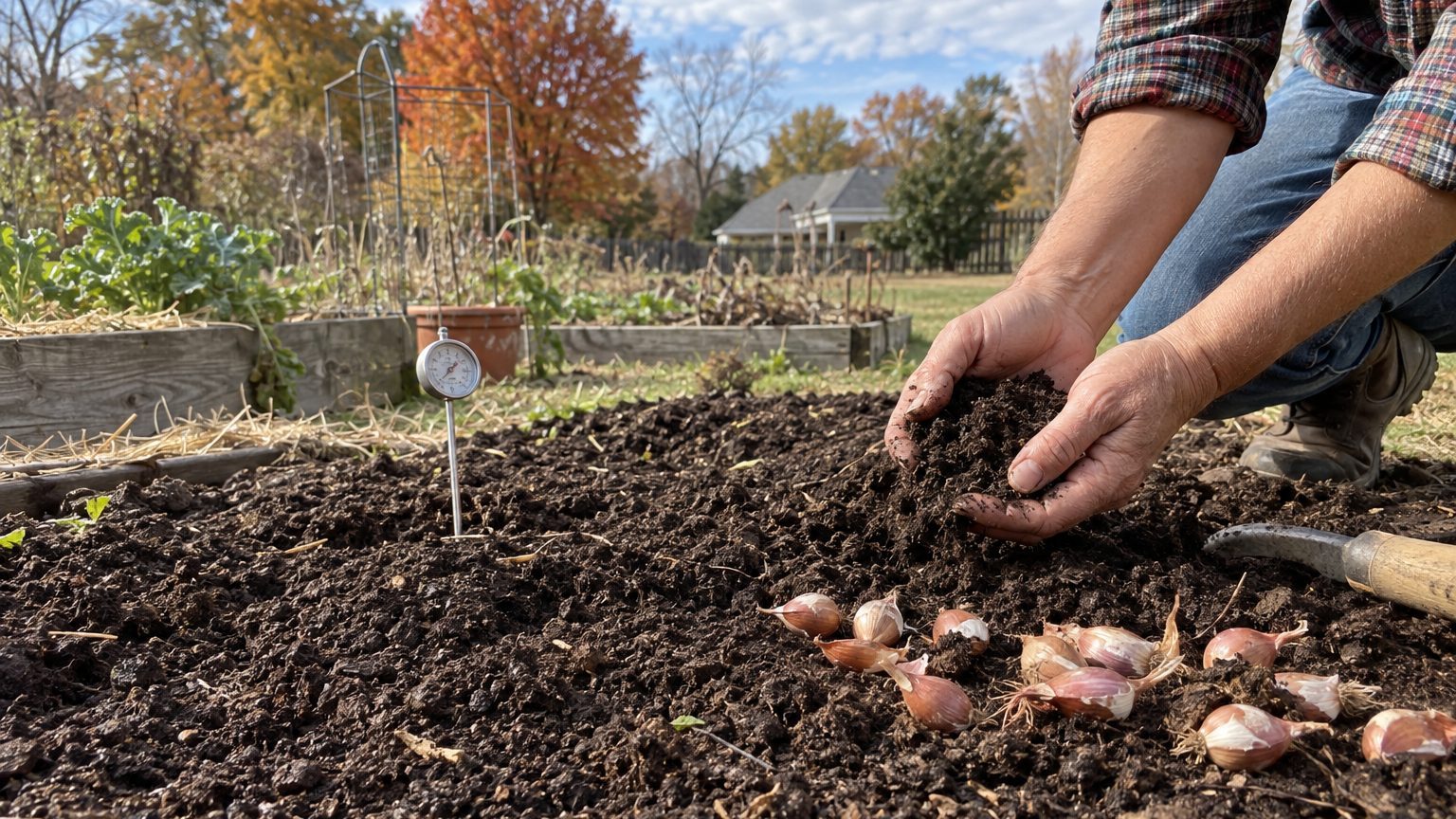

In Houston, shallots belong in the ground during the cool months, because the coldest month there averages a daily minimum of 43.7°F. Elsewhere in Texas the answer shifts with the winter. Houston’s climate normals sit at the mild Gulf end of a state that spans USDA zones 6a to 10a, so read every date below as a Gulf Coast date and not as a statewide calendar.
When the soil is warm enough in Texas
The last spring frost at Houston Intercontinental (station USW00012960, IAH) falls between February 4 and March 1, according to the NOAA NCEI 1991-2020 Climate Normals, drawn from the 30 to 70 percent band of 32°F freeze probabilities. That is a probability, not a promise, and one cold snap after the later date would not break any rule of meteorology.
Frost is also only a stand-in for what shallots care about. They respond to the soil, and soil lags the air. The ground warms after the frost risk ends, not at the same moment, so a bed can be frost-free in late February and still be cold and soggy at root depth. Pushing a set into that soil early gains nothing. A kitchen thermometer pressed a few inches down tells you more than the calendar.
For a Houston gardener the frost date matters less for spring planting than for the autumn-planted crop, which is the main one on the Gulf. Sets go in during the cool months, root through a winter that rarely freezes the ground hard, and bulb up as days lengthen in spring. Spring planting works as a fallback, but plants started late have less time to size up before heat arrives.
Why this is not a Texas calendar
Even inside Houston the numbers move. Hobby airport runs about two weeks milder than IAH. Go north and the picture breaks entirely: the Panhandle freezes months earlier in autumn and months later in spring, and North Texas and the Hill Country each have their own pattern. The USDA Plant Hardiness Zone Map (2023, built on 1991-2020 normals) puts the state anywhere from 6a to 10a. A gardener in Amarillo who follows a Houston planting date is simply guessing.
What carries over from garlic
Shallots share most of their habits with garlic: autumn planting, curing, storage and allium rotation. The differences are small but real. Shallot sets are smaller than garlic cloves and sit shallow, with the tip at or just under the surface. One set multiplies into a cluster. And the rotation rule is the same one: keep shallots off ground that held onions, garlic or leeks recently. Our Growing Shallots: One Bulb In, a Handful Out guide walks through the national basics.
How long the season lasts here
Houston’s first fall frost arrives between December 1 and December 19 (same station, same NOAA band). Set that against the spring dates and the frost-free stretch runs from about 275 days at its shortest to about 318 days at its longest. That is a little over nine months in the tight case and more than ten in the generous one.
| Case | Last spring frost | First fall frost | Frost-free span |
|---|---|---|---|
| Shortest | March 1 | December 1 | 275 days |
| Longest | February 4 | December 19 | 318 days |
The span comes from the two NOAA bands for IAH. It describes one airport, not Texas, and the same subtraction in the Panhandle would give a far smaller number.
What does a window this long allow? First, a second sowing. A gardener with a short season gets one planting and lives with it. On the Gulf you can stagger plantings, putting in a first batch early in the planting period and a second a few weeks later, so that not every bulb is ready on the same weekend.
Second, it takes the pressure off transplanting. Where the season is short, starting plants indoors or buying started plants only pays if the roots are healthy, which means checking them for white, firm growth before committing the bed. With nine-plus frost-free months, direct-planted sets have room to catch up, so a poor transplant is a loss you can recover from.
One caution on reading the number. Frost-free days are not shallot-growing days. A cool-season crop does its best work in the cooler stretch, and a Houston summer is no place for a bulb that is still sizing up. The long window gives you flexibility in when to plant. It does not stretch the time shallots actually enjoy. Compare how this plays out next door in Growing Shallots in Louisiana, where the Gulf climate is similar, or in Growing Shallots in Maryland, where a much shorter season changes the arithmetic.
Heat and water in Texas
Anyone who has spent a Gulf Coast July knows the general shape: hot, humid and often wet. The winter is what decides the autumn-versus-spring question.
Houston’s coldest month has a mean daily minimum of 43.7°F (NOAA 1991-2020 normals). That is the average nightly low, not the record low, and it describes a winter where the ground rarely freezes hard. Under those conditions autumn-planted sets root in cool soil and carry that head start into spring. The payoff is larger bulbs, earlier, which is the reason autumn planting exists.
Where the ground freezes hard and stays wet, the same strategy fails. Sets sitting in saturated soil can rot, and repeated freezing and thawing can heave them out of the ground. Parts of the Panhandle sit in USDA zone 6a territory, and there spring planting is the safer call. The state’s range from 6a to 10a is the whole story in a sentence: one crop, two opposite recommendations.
Heat and moisture still shape the season on the Gulf, even without a day count. Shallots planted in autumn are meant to finish before the worst of summer, which is why earlier is better than later. Humidity is a disease question as much as a comfort one. Fungal problems such as downy mildew favor warm, damp, still conditions. The defenses are practical: raised or well-drained beds so roots never sit in standing water, spacing that lets air move between plants, mulch kept off the bulb necks, and rotation away from other alliums.
Watering follows the same logic. Shallots want even moisture while they establish and grow, then drier ground as the tops fall over and the bulbs finish. A wet spring can undo a good autumn planting, so drainage matters more than any watering schedule.
Which shallots suit Texas
The only variety advice worth following is the kind trialled where you garden, and Texas is too large for one list. A type that thrives near the Gulf may struggle in the Panhandle.
What can be said honestly is how to reason by type. A short season favors the earliest-maturing types, and in a hot one you want plants that stay healthy with good airflow and some shade at the root zone, which in practice means mulch and spacing. In a humid climate like the Gulf Coast, disease resistance becomes the first criterion, ahead of size or flavor. Sets from a reputable supplier and seed-grown types each have a place, and the choice depends on how much time you have before heat arrives.
For named recommendations, go to Texas A&M AgriLife Extension. County offices there know which varieties have been trialled locally, which planting window fits your area, and what disease pressure looks like in your part of the state. Ask three things: which types performed best in local trials, when to plant in your county, and which problems showed up in recent seasons.
Curing and storage deserve the same caution as variety choice. Cure shallots in a dry, shaded, ventilated spot until the necks are fully dry, then inspect each bulb before putting it away. Look for a firm neck, intact skins and a clean base. A soft neck or a moldy base ends the question: that bulb goes in the compost, not the pantry. A bulb that looks sound is not guaranteed sound, so check them again from time to time rather than trusting a single inspection, and give no bulb a pass on appearance alone.
Common questions
When should I plant shallots in Houston?
Autumn is the standard window on the Gulf, with sets going in during the cool months. The frost dates here (February 4 to March 1 for spring, December 1 to December 19 for fall at IAH) frame the season, but check your own conditions or your county extension office for exact timing.
Can I plant shallots in spring in Texas?
Yes, and in colder parts of the state it is the better choice. Plant once the soil is workable and no longer waterlogged. Expect smaller plants than an autumn planting would give in a mild-winter area, since less time remains before heat arrives.
Does the Houston schedule work for Dallas or the Panhandle?
No. Houston is the mild Gulf end of a state spanning USDA zones 6a to 10a. Dallas, the Hill Country and the Panhandle each freeze differently, so use your local extension office’s dates instead.
How can I tell if a cured shallot is safe to keep?
Inspect the neck and base. Firm neck, dry skins and a clean base are what you want to see. A soft neck or a moldy base means the bulb should be discarded. Appearance alone does not guarantee a bulb is sound, so recheck stored bulbs periodically.