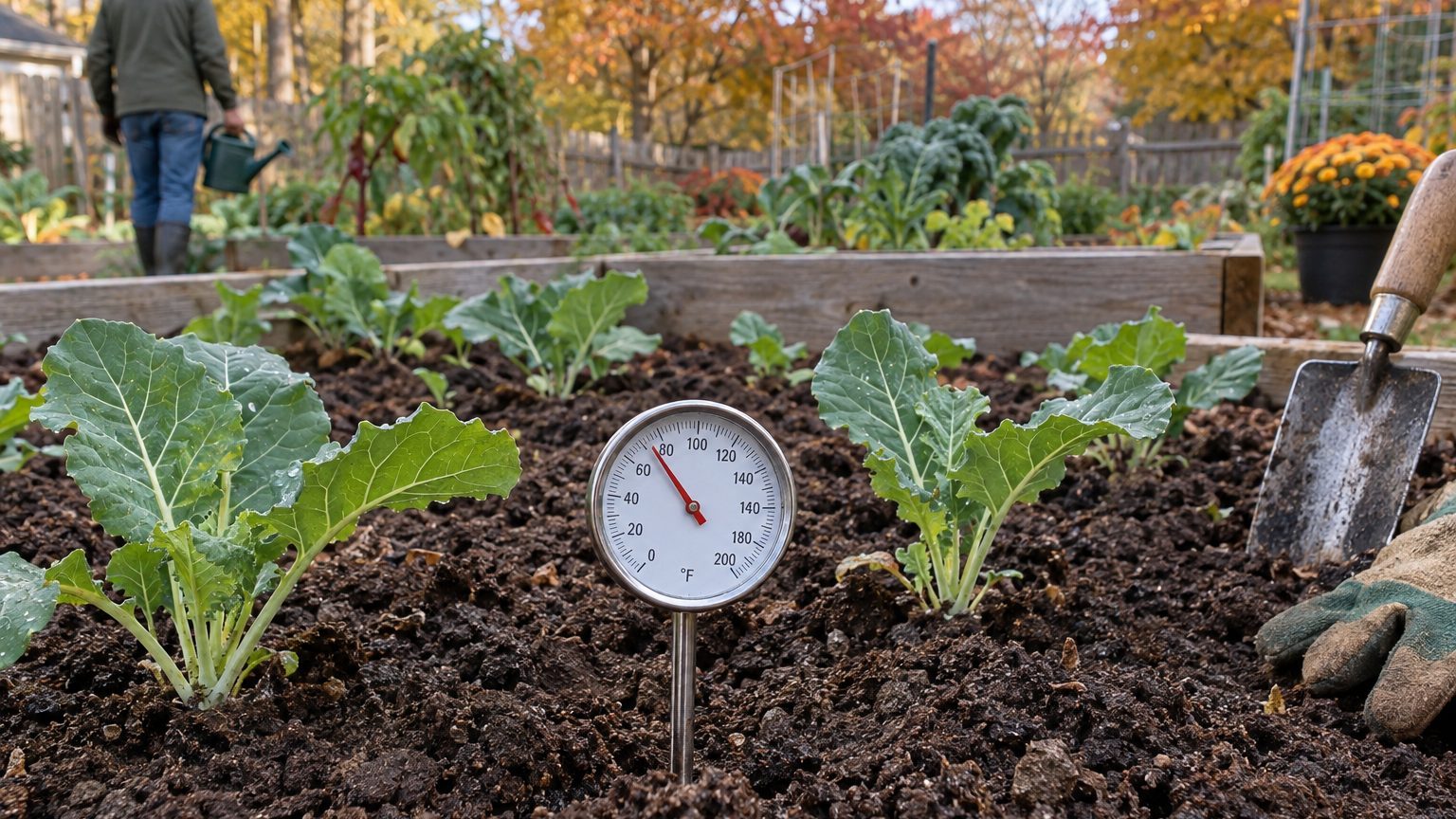

New York City’s frost dates say collards can go into the ground in early April, but the plant itself is waiting on something else entirely: soil temperature. Get that wrong and you’ll set out seedlings into ground too cold to feed them, no matter what the calendar says.
When the soil is warm enough in New York

NOAA’s 1991-2020 climate normals put the last spring freeze at Central Park (the Big Apple’s reference station, coded USW00094728) somewhere between March 23 and April 3. That’s a 30-70% probability band, not a guarantee, and it’s worth saying plainly: a frost date is a probability, not a promise. Some years the last freeze lands well outside that window in either direction.
Frost matters, but it’s a proxy for the number gardeners actually need, which is soil temperature. Collard seed germinates poorly in cold, wet soil, and transplants sulk when their roots sit in ground that hasn’t caught up with the air. In practice, that means waiting one to two weeks past the last frost date before direct-seeding or setting out transplants, letting the top few inches of bed warm past the point where germination is sluggish. Gardeners who jump the gun by planting the day frost risk clears often end up with the same maturity date as neighbors who waited, because the seedlings simply stall until the soil catches up.
One caution before going further: Central Park is a dense urban heat island. Upstate New York and the Adirondacks freeze earlier in fall and thaw later in spring, sometimes by three or four weeks compared to the city. Anyone gardening north of the metro area should treat the Central Park dates as a floor, not a target, and lean on their local Cornell Cooperative Extension office for a station closer to home.
On cultivar choice, this page won’t name one. Seed racks and catalogs carry dozens of collard types bred for different maturity speeds, leaf textures and disease tolerances, and the ones that actually perform in New York’s soils and summers are the ones your local extension service has trialled, not whatever a national blog happens to favor. Reach out to Cornell Cooperative Extension for the varieties recommended for your county.
A last note on family: collards are brassicas, in the same clan as cabbage, kale, mustard, turnip and rutabaga. They share the same soil-borne diseases and the same pest pressure, so a bed that grew any of those crops last year hasn’t been rotated just because it’s growing something with a different name. See the crop rotation guide in this collection before deciding where to plant.
How long the season lasts here
Pairing both Central Park frost windows gives the length of the frost-free season. Taking the earliest possible last spring frost (March 23) against the latest possible first fall frost (November 27) yields a season as long as 249 days. Taking the opposite pairing, the latest spring frost (April 3) against the earliest fall frost (November 14), shrinks it to 225 days. Either way, New York City sits on a 225 to 249 day frost-free window, which is generous by Northeast standards.
That length changes what’s worth attempting. A window that long doesn’t just fit one collard planting, it comfortably fits a second. Gardeners can direct-seed or transplant in spring for an early-summer harvest, then sow again in mid-to-late summer for a crop that matures as the weather cools, which collards actually prefer since cool nights sweeten the leaves rather than making them bitter. The site’s succession sowing guide walks through spacing those two sowings so the second crop isn’t competing with bolting spring plants for the same bed.
A short window changes the math entirely. Where the frost-free stretch runs closer to 225 days, or where a gardener is working from an upstate station with a much later spring thaw and earlier fall freeze, the first planting effectively becomes the only planting. In that situation, whether to direct-seed or transplant stops being a minor preference and becomes a real decision: transplants buy two to three weeks of head start, but only if the seedlings are checked for root health before they go in the ground, since a root-bound or damaged transplant loses most of that advantage once it’s in the bed.
New York City’s own window sits comfortably on the long end of that range, which is one advantage of gardening in the metro area rather than further north or at higher elevation, even with the trade-off of a slightly later spring thaw caused by the urban heat island effect working the other direction in autumn.
Heat and water in New York

This is where the winter, not the summer, does the deciding. New York’s coldest month averages a daily minimum of 27.9°F at the city reference station, per NOAA’s 1991-2020 normals, a figure that sits well below the threshold where collards can be left standing in the garden through winter. That single number settles the entire planning question for this crop here.
In Territories where the coldest month’s average minimum stays mild, collards behave as a standing crop: gardeners pick individual leaves from November clear through March, and the plant tolerates repeated light frost without much damage. New York doesn’t offer that. With a coldest-month average minimum near 28°F, the ground here is looking at hard freezes as a routine winter feature, not an occasional event, and collards left in the bed through a New York winter will be killed back well before spring. That makes collards an autumn crop in this territory: something planted for a fall harvest that wraps up at the first hard freeze, not a plant meant to overwinter in place.
Specific counts for days above 90°F and summer rainfall totals for New York City aren’t part of the verified figures behind this page, so no numbers are offered here that this page can’t source. What the coldest-month figure does confirm is that the growing plan for New York collards centers on timing the fall harvest around that hard freeze risk, not on managing extreme summer heat. Gardeners who do face a stretch of hot, humid weather during the summer sowing window should still watch for the usual signs of stress, wilting at midday, slow leaf expansion, and increased susceptibility to fungal disease in humid stretches, but the deciding factor for how this bed gets planned across the year is the winter low, not a summer heat count this page doesn’t have on record.
New York’s hardiness zone range spans 3b to 7b across the state, according to the USDA Plant Hardiness Zone Map built on 1991-2020 normals. That’s a wide range for a single state, driven by elevation and distance from the coast, and it means a gardener in the Hudson Valley or the Adirondacks is working with a meaningfully colder baseline than the New York City figures cited here. Anyone outside the immediate metro area should check their own zone before assuming the city’s numbers apply.
Which collards suit New York
Reasoning from the facts above rather than from any single cultivar’s name gets you most of the way to a sound choice. A frost-free window running 225 to 249 days is generous enough to favor almost any maturity speed, but a gardener treating collards strictly as an autumn crop, given the region’s cold winter minimum, should lean toward the earlier-maturing types within whatever selection their local extension office recommends, since an early-maturing planting gives more cushion against an unusually early hard freeze upstate or at higher elevation.
Humidity during the growing season raises the second criterion. In a Northeast summer with damp, humid stretches, fungal and bacterial leaf diseases spread faster on collards planted too tightly, so airflow between plants matters as much as which type gets chosen. Types bred with disease resistance as a trait, again best identified through extension trial results rather than seed-packet marketing, tend to hold up better through a humid New York summer than types selected purely for leaf size or color.
None of this points to a specific variety, and that’s deliberate. The types trialled and recommended for New York conditions change from year to year as extension programs test new releases against the state’s disease pressure and cold tolerance requirements, and a name printed on this page today could be outperformed by something newer within a couple of seasons. The only recommendation that holds up is to check Cornell Cooperative Extension’s current collard trial results for your county before buying seed.
One last practical note tied to storage rather than planting: any collard leaves held after harvest should be inspected before use, not assumed safe because they look fine from a distance. A soft patch, a weeping spot, or a moldy crown on stored greens ends the question regardless of how short a time they’ve been kept, and that inspection habit matters more than any stated keeping duration this page could offer.