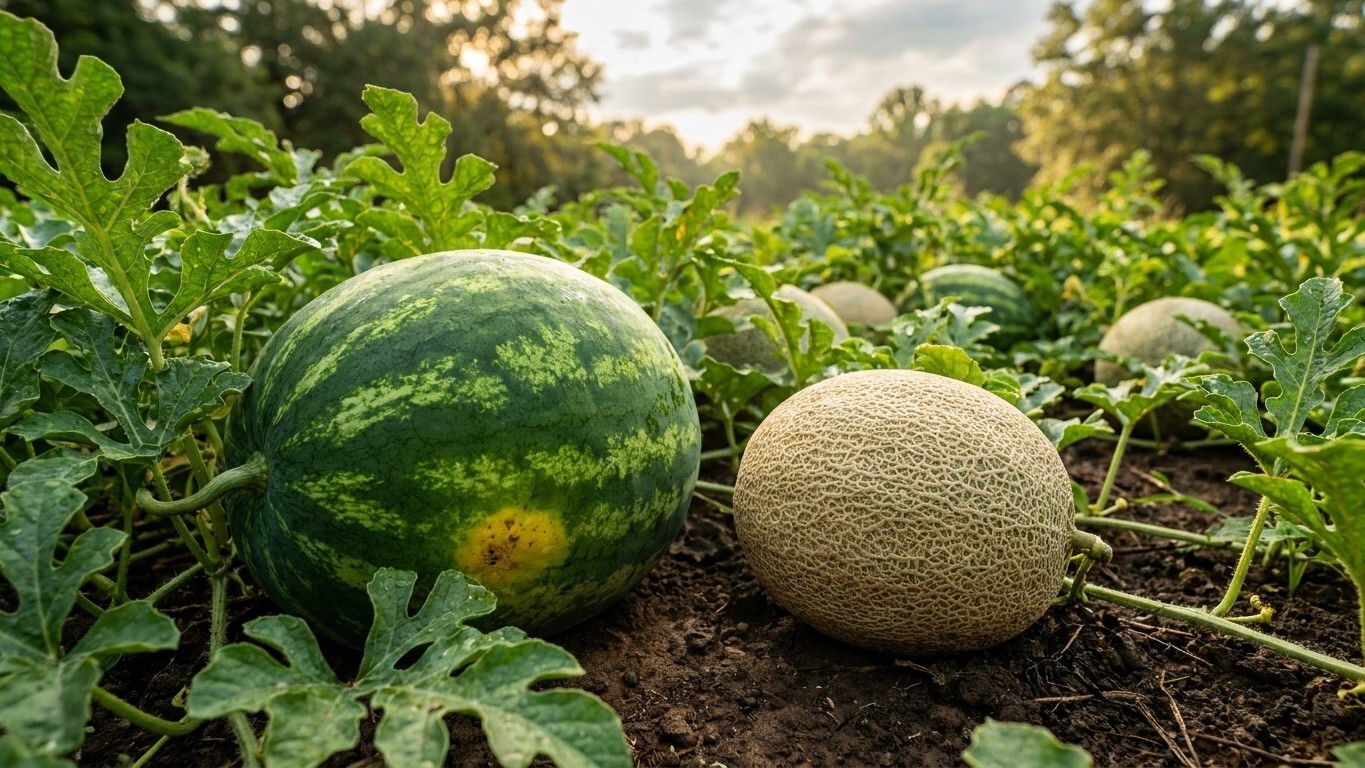

Short-season, heat-tolerant melons are the safe bet almost Everywhere in Utah: icebox watermelons and early cantaloupes finish reliably even where the growing season runs tight. Full-size watermelons and honeydews can work too, but only in the warmer valleys, and only with help from black plastic or row cover to push the harvest date earlier.
The short answer for Utah
At the reference station used for these figures (Salt Lake City), the frost-free window runs from a last spring frost of April 12 to April 29, out to a first fall frost of October 18 to October 29. Stack the earliest start against the latest end and the widest possible window is 200 days. Stack the latest start against the earliest end and the tightest window is 172 days. That’s the range at one valley station alone, before accounting for the rest of the state.
A 172-to-200-day window is generous for melons in the 65-to-90-day maturity class, and workable for the 90-to-100-day class if the reader starts seedlings indoors or uses plastic mulch to warm the soil early. It stops being generous the moment elevation climbs or the reader gardens north of the valley floor, because the frost dates above are specific to that one station, not the state.
The other number that matters here is heat load: 52.1 days a year averaging 90F or hotter at that same reference station. That’s a long, dry heat stretch, and it favors melons bred to set fruit under sustained warmth rather than varieties developed for shorter, cooler summers.
| Melon type | Typical days to maturity | Fit for the Utah window |
|---|---|---|
| Icebox watermelon | 65-75 | Reliable across the frost-free range, even at the tight end |
| Cantaloupe / muskmelon | 75-90 | Reliable at 189+ days, tight at 172 |
| Full-size watermelon | 85-100 | Workable only near the 200-day end, or with an early start |
| Honeydew | 85-100 | Same constraint as full-size watermelon, plus needs sustained heat to sweeten |
Put plainly: if the growing season on a given plot is closer to 172 days than 200, icebox watermelon and early cantaloupe are the varieties worth the garden space. If it’s closer to 200, a full-size watermelon or a honeydew becomes realistic without extra tricks.
What will not work here
The clearest failure mode in Utah is a melon that needs more days than the season gives it. A 100-day honeydew planted after the last frost date in a spot with a 172-day window has almost no margin: it needs the fruit finished before the first fall frost arrives, and a single cool, late spring pushes the sowing date back further still. That’s not a soil problem or a watering mistake. It’s a calendar mismatch, and no amount of fertilizer fixes it.
The second failure mode is watering on a weekly schedule through a summer built like this one. July averages just 0.49 inches of rain at the reference station, the driest month of the year, with June at 0.95 and August at 0.58. Add 52.1 days above 90F and the water a melon vine loses to evaporation on a single hot week can outpace what a weekly soak replaces, especially once fruit is sizing up. Melons watered too infrequently during that stretch tend to split fruit, drop blossoms, or stall growth right when they should be putting on the most size. This is a dry-summer problem, not a humid one: Utah’s low summer rainfall means the risk here is under-watering, not the fungal pressure that close spacing causes in wetter states.
Sandy soil sharpens this further. An inch of rain, or an inch from a hose, moves through sand in a day, so a garden on sandy ground during a 90F stretch can need water every two to three days just to keep pace, regardless of what the calendar says a melon “usually” needs. Clay holds moisture longer, which changes the math but doesn’t remove the underlying issue: 52.1 hot days and roughly two inches of summer rain total is a dry combination, and any variety chosen without planning for supplemental water is choosing to fail partway through fruit set.
What changes across Utah
Utah spans USDA hardiness zones 4a through 9a, under the USDA Plant Hardiness Zone Map’s 2023 update, built on average annual extreme minimum winter temperatures. That’s not a small spread. A 4a garden at high elevation and a 9a garden in the state’s warmest low-elevation pockets are running two different melon seasons entirely, even though both sit inside “Utah” on a map.
The frost dates and heat-day figures cited above come from one reference station, Salt Lake City, sitting in a mild valley. Most of the state is higher and colder than that station, which means later last-frost dates, earlier first-fall-frost dates, and fewer than 52.1 days above 90F in a typical year. Southern Utah runs the other direction: warmer, with a longer frost-free stretch and more heat-stress days than the reference station logs.
What that means in practice: a reader gardening at elevation or in the northern part of the state should treat the 172-day end of the window as optimistic, not the middle case, and lean toward icebox watermelon and early cantaloupe rather than anything in the 90-to-100-day class. A reader in a warmer, lower valley in the south has more room to try a full-size watermelon or honeydew, and more heat to ripen it properly. Neither reader should guess which zone they’re in from this page. The USDA’s interactive map is built for exactly that lookup, and it’s a five-minute check against a zip code or county, not a state-wide average.
Where to check this for your own county
This page gives Utah’s state-level picture, built from one reference station and a statewide hardiness range. That’s useful for deciding what type of melon to plant, but it’s not a substitute for a county-level planting calendar, and Utah State University Extension publishes exactly that.
The extension service is at extension.usu.edu. Two things are worth looking for once there. First, the local planting calendar for the reader’s own county, which will reflect that county’s actual frost dates rather than the Salt Lake City normals cited throughout this page. Second, any variety trial results for melons grown in that county specifically, since USU Extension and county offices periodically report on which cantaloupe, watermelon, or specialty melon varieties actually performed well in local trial plots, under local heat and local water conditions.
A county recommendation beats a state recommendation every time, for the simple reason that it’s built from data closer to the reader’s own soil and sky. This page is the state one: a starting point for deciding melon type by season length and heat load, not the final word on which named variety to buy. Treat it as the first filter, and let the county office narrow it down from there.
Checking this against your own garden
Every date on this page is a normal, a 30-year average built from one weather station. A reader’s own plot will run early, late, or right on schedule depending on slope, soil, and shelter, and three things in the garden itself will say more than any calendar entry.
Soil warmth by feel is the first check. Melon seed germinates poorly in cold soil, and a hand pressed a few inches into the bed in spring tells a reader plainly whether the ground has caught up to the calendar or is still lagging behind it, regardless of what the last-frost date says that week.
The first flush of male flowers is the second. Melon plants produce male blossoms before female ones, and a garden throwing male flowers early is signaling that it’s running warm for the season, a useful cue for a reader gardening at elevation or in a known cool pocket where the state averages don’t quite apply.
The first true leaves, the set that appears after the initial seed leaves, mark the point where a seedling has moved past its most frost-vulnerable stage and started real growth. A reader watching for that milestone, rather than counting days from a printed frost date, is reading their own microclimate directly, which is exactly what outranks every figure on this page.