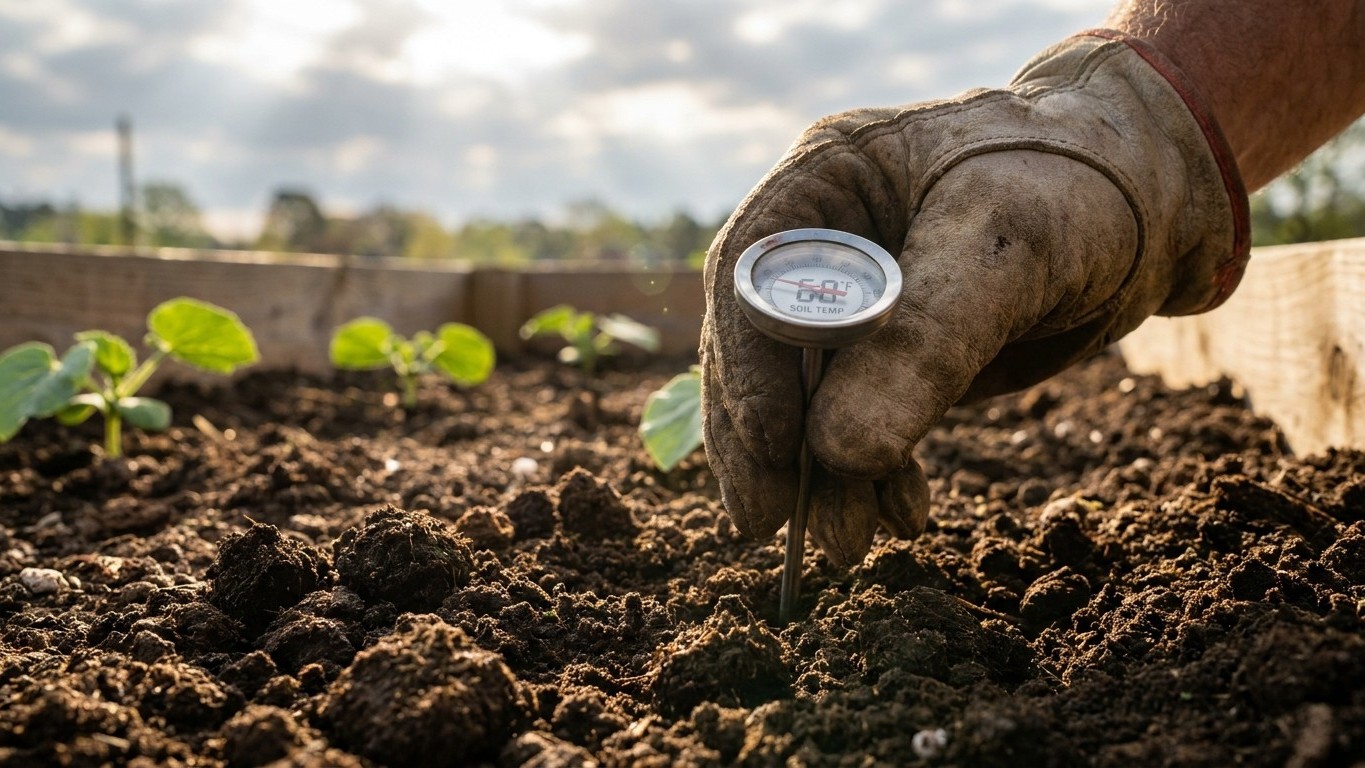

In most of Utah, melon seed and transplants go into the ground only after the soil itself has warmed, which usually lands somewhere between late April and mid-May depending on elevation. The growing window that follows is long enough for full-season types, but summer heat and near-desert rainfall make irrigation the real deciding factor, not the calendar.
When the soil is warm enough in Utah
The question every Utah gardener asks first is simple: when can melons actually go in? At the NOAA reference station in Salt Lake City (USW00024127), the last spring frost falls somewhere between April 12 and April 29, based on the 1991-2020 Climate Normals and the 30-70% freeze probability band. That’s not a single date, it’s a spread, and it reflects a real range of years rather than one official day to circle on a calendar.
Frost is a proxy, not the actual trigger. Melons don’t wait for frost risk to end, they wait for the soil itself to warm through, and soil lags behind air temperature by days or sometimes weeks. A garden bed can sit frost-free and still be too cold at root depth for melon seed to germinate reliably. That gap between “no more frost” and “warm enough soil” is exactly where a lot of early-planted melon seed rots or simply sits without sprouting.
Salt Lake City sits in a comparatively mild valley, and that matters here more than almost anywhere else in the country. Most of Utah sits at higher elevation and stays colder longer into spring, while the low-elevation basins of southern Utah warm earlier and hold heat longer into fall. A frost date pulled from the Salt Lake reference station describes that valley, not the mountain benches above it or the desert floor below St. George.
Warming the soil rather than the air
Because the frost window can’t be shortened, gardeners work on the soil side instead. Black plastic mulch laid a couple of weeks before planting raises soil temperature several degrees by trapping solar heat. Raised beds warm faster than flat ground because they drain and drain, and drier soil heats faster than saturated soil. Row cover over young seedlings buys a margin against a late cold snap without forcing an earlier true planting date.
None of this substitutes for checking soil temperature directly with a simple probe thermometer before committing seed to the ground. For which melon types have actually performed well at a given elevation and which planting windows local growers use, Utah State University Extension (extension.usu.edu) keeps trial data specific to the state’s different growing regions, and that’s a far better source than any general date.
How long the season lasts here
Subtracting the two frost windows gives a real answer, and it’s a generous one. Using the earliest last spring frost (April 12) against the latest first fall frost (October 29), the frost-free window can stretch to roughly 200 days. Using the later end of spring (April 29) against the earlier end of fall (October 18), the same window narrows to about 172 days. Either way, that’s a long season by melon standards, since melons are a crop that typically wants a solid three to four months of warmth from seed to harvest.
A window this long changes the strategy, not just the timing. Where a short season forces a single sowing and makes every week count, a 170-to-200-day window leaves room for a second, later sowing of a quicker-maturing type, planted a few weeks after the first, as insurance against an early-season failure or simply to spread harvest over more weeks rather than getting one glut. Gardeners working a shorter window elsewhere in the cocon don’t have that luxury; here, it’s a real option worth planning for. The site’s succession sowing guide covers how to stagger those plantings so the second round doesn’t collide with the first for water and space.
The length of the window also affects whether transplanting is worth the trouble. Melons dislike root disturbance, and direct-sown seed generally outperforms transplants when the season is long enough to absorb the slower start. With close to six months of frost-free growing available in the Salt Lake valley, there’s little pressure to rush transplants into the ground early just to squeeze out a few extra weeks, the way a grower with a 100-day window might feel forced to. That said, at higher elevations where the effective season runs shorter than the valley numbers suggest, starting seed indoors a few weeks ahead and setting out hardened transplants once soil has warmed can still make sense, and checking for root binding before transplanting matters more in that case, since a pot-bound seedling loses time it can’t easily make back in a compressed season.
Heat and water in Utah
Melons build sugar and size from accumulated warmth more than from calendar days, and by that measure Utah’s valley climate does real work for them. The Salt Lake City reference station averages 52.1 days a year at or above 90°F, a substantial heat load that pushes melon vines toward the vigorous growth and sugar development they’re built for. That’s not a small-summer climate where growers need to hunt for the earliest possible type just to get a ripe melon before fall, it’s one where the heat itself is rarely the limiting factor.
Rainfall is a different story entirely. Summer rain across June, July and August totals only about 2.0 inches at the same reference station, a small fraction of the 15.5 inches that falls over a full year there. July, the peak of melon vine growth and fruit sizing, is the driest month of the three at just 0.49 inches; June comes in at 0.95 inches and August at 0.58 inches. Put plainly, Utah’s summer is hot and it is dry, and for melons that combination hands almost the entire outcome to irrigation.
What that combination means for the vine
With little rain to rely on, water becomes the variable that decides fruit size through most of the season, and the final two or three weeks before harvest decide sugar content, since that’s when consistent, moderate moisture (not drought stress, not a flood right before picking) lets the fruit finish sweetening rather than cracking or going watery. Drip irrigation or soaker hoses that deliver water at the root zone, paired with mulch to slow evaporation under that 90°F-plus heat load, do more for a Utah melon patch than almost any other single practice.
These are normals from one reference station, not a guarantee for any specific yard. A slope, a city heat pocket, or simply gardening at a different elevation than the Salt Lake valley changes both the heat count and the rainfall total, sometimes substantially. And how far that 2 inches of summer rain actually goes depends on the soil underneath it: a sandy plot lets a summer thunderstorm drain through within hours, while clay holds it for days, so two gardens receiving identical rainfall can need very different watering schedules. A rain gauge on the actual plot, checked against the soil’s own drainage, tells a grower more than any regional average.
Which melons suit Utah
None of this points to a single named variety, and that’s deliberate. The types trialled and recommended for a given elevation in Utah are something Utah State University Extension (extension.usu.edu) tracks directly, region by region, and that local trial data is worth more than any generic list, because a type that thrives in the St. George area’s warm low desert may struggle at a cooler mountain-valley elevation two hours north.
What the facts here do support is reasoning by type rather than by name. The frost-free window running 170 to 200 days is long enough that gardeners aren’t locked into only the earliest-maturing types the way a shorter-season territory would be; there’s room for full-season melons that need more time to size up and sweeten. The heat load, over 52 days a year above 90°F at the reference station, favors types bred with good heat tolerance and benefits from giving vines airflow and some shade at the root zone during the hottest stretch, since a stressed root system under intense heat slows fruit development even when the top growth looks fine.
The dry summer cuts disease pressure that plagues melon growers in humid regions, but it doesn’t erase it. Overhead irrigation or a wet spell can still bring on powdery mildew, especially as vines thicken later in the season, so disease resistance is still worth checking for rather than assuming Utah’s dryness handles it alone. The statewide USDA hardiness zone range runs from 4a in the coldest mountain valleys to 9a in the warmest low-elevation pockets of the south (USDA Plant Hardiness Zone Map, 2023 update, based on 1991-2020 averages), and Salt Lake City itself, the valley behind the frost and heat data above, sits well within the milder half of that spread. That range alone says enough: a type suited to a 9a pocket near St. George is not the same recommendation as one suited to a colder 5a mountain valley, and no single name on this page could honestly cover both. That’s exactly why the local extension office, not a general gardening article, is where the actual variety choice belongs.