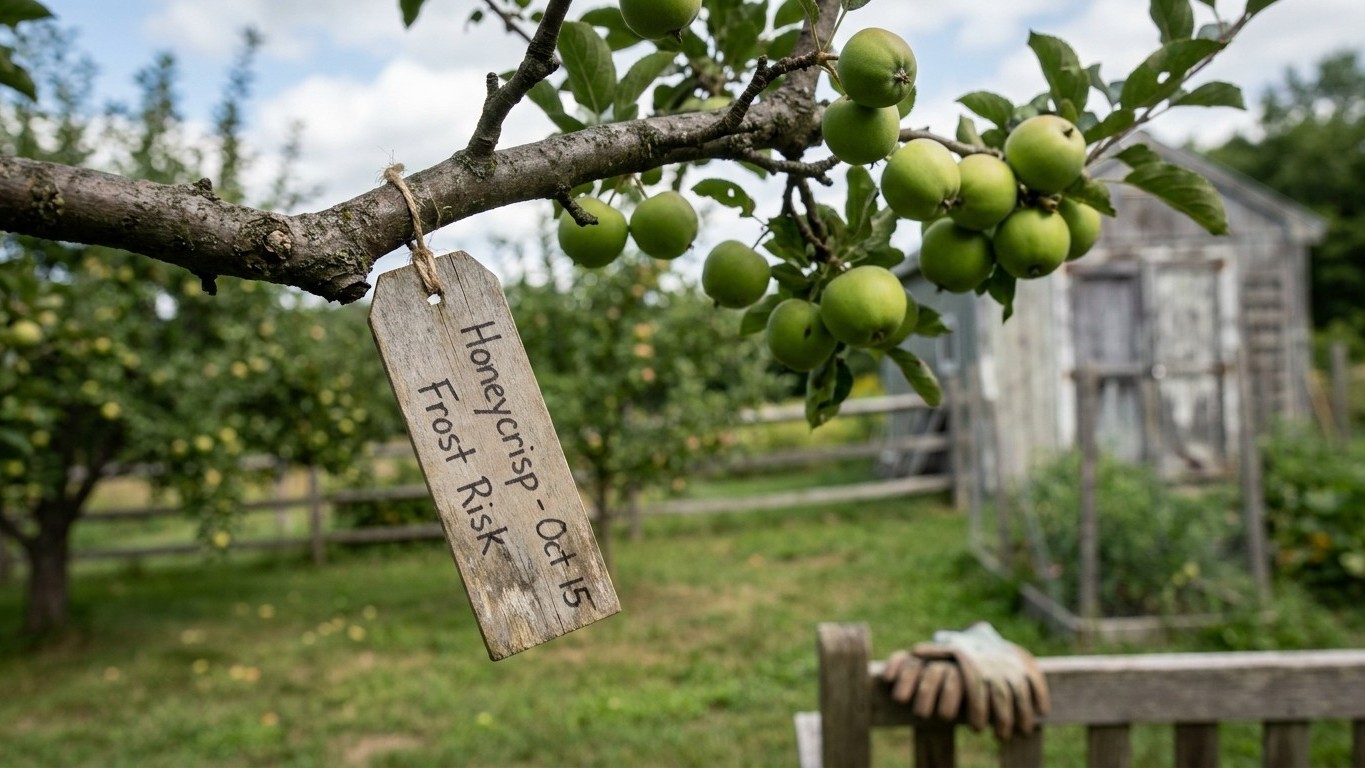

Apples grow reliably across most of Vermont, though the coldest pockets need a narrower variety list. Burlington’s climate, per NOAA’s NCEI 1991-2020 normals, has a coldest-month minimum of 10.2°F, and the USDA hardiness map puts the whole state at zones 3b to 5b depending on elevation and distance from Lake Champlain. Start by matching a variety’s published hardiness rating to your own end of that range before you plant anything else.
Can you grow apples in Vermont
Vermont apples do fine in the cold — that’s not the part that trips growers up. What gets a Vermont crop most years isn’t January’s deep freeze, it’s a warm April tricking the blossoms into opening early, right before a frost comes through and kills them. So before you pick a variety, figure out where your ground sits: a slope drains cold air away overnight, while a low hollow traps it, and that difference decides whether the same tree blooms safely or gets burned. Walk your site first, then match a variety’s hardiness rating to it.
That Burlington figure describes the mildest corner of the state. The lake moderates both the winter low and the length of the growing season, so a variety that performs well in a Burlington dooryard can fail two hundred feet higher in the Green Mountains, where the same winter brings a longer, colder dormancy and a shorter gap between frosts. Elevation and distance from the lake matter as much as the zone number on a nursery tag, so treat 3b to 5b as a range to locate yourself within, not one answer for the whole state.
Site selection can buy a grower an extra half zone of effective hardiness. Cold air drains downhill and pools in low ground, so a slope above a valley floor stays several degrees warmer on a still, clear night than the flat bottomland below it. Vermont orchardists have used this for generations, planting apples on hillsides rather than in the low fields better suited to hay or corn.
For growers in the coldest pockets, the safer strategy is to lean toward the hardiest end of the apple lineup rather than varieties bred for the mid-Atlantic market. Growers near the lake, or in a sheltered valley, have more room to try varieties that would struggle further inland. Either way, winter cold is rarely what actually costs a Vermont grower their crop. A hardy cultivar tolerates the temperatures this state delivers without damage most years. The real threat to a season’s harvest is spring frost timing — see The Vermont Apple Calendar, Stage by Stage for how that risk shifts as the trees move through bloom.
Which varieties suit this climate

Once you know your rough position within Vermont’s 3b to 5b range, filter The Best Apple Varieties for Vermont against two separate things: published cold hardiness and winter chill. Hardiness tells you whether the tree survives the winter. Chill tells you whether it flowers on a normal schedule the following spring, and it is the filter most casual planting guides skip entirely.
Hardy varieties by published rating
Among varieties commonly rated to zone 3, ‘Wealthy’ and ‘Haralson’, both older Minnesota-bred selections, and ‘Honeycrisp’, also a University of Minnesota release, appear on catalogue lists reaching into the coldest parts of New England. ‘Liberty’, ‘William’s Pride’ and ‘Freedom’ are scab-resistant selections from Cornell’s Geneva breeding program, rated to zone 4, useful where a grower wants to spray less. ‘McIntosh’ and its cross ‘Cortland’, both catalogued to roughly zone 4, are the varieties most associated with Vermont orchards historically and remain reliable near the lake and in similar milder pockets.
| Variety | Published hardiness | Bloom season | Notes |
|---|---|---|---|
| ‘Wealthy’ | Zone 3 | Mid | Old Minnesota variety, very cold-hardy |
| ‘Haralson’ | Zone 3 | Mid | Tart, University of Minnesota origin |
| ‘Honeycrisp’ | Zone 3-4 | Mid to late | University of Minnesota, widely sold |
| ‘Liberty’ | Zone 4 | Mid to late | Cornell Geneva, scab-resistant |
| ‘William’s Pride’ | Zone 4 | Mid | Early ripening, disease-resistant |
| ‘McIntosh’ | Zone 4 | Mid | Traditional Vermont variety |
| ‘Cortland’ | Zone 4 | Mid | McIntosh cross, similar bloom time |
The winter chill filter
Winter chill is the count of cold hours a tree needs before it will break dormancy evenly. Vermont’s winters sit at the high end of the chill scale, the opposite problem from a grower in Georgia or coastal California, where a low-chill variety is bred to flower after a mild winter that never delivers enough cold hours for a Northern selection. None of the varieties listed above have a chill problem in Vermont. The risk runs the other direction: a low-chill, Southern-bred variety planted here would break dormancy erratically, if at all, giving a thin, staggered bloom instead of the clean flush a hardy Northern selection produces on schedule. Treat “sold in warmer climates” on a nursery listing as a warning sign rather than a feature. Compare that to a state like Oregon, where growers west of the Cascades work with a mild-winter chill profile entirely different from Vermont’s, and a variety chosen for that climate would be the wrong pick here in either direction.
No state-specific variety list is cited here beyond what UVM Extension publishes directly, covered in Local Help below. Where a nursery catalogue and a state list disagree, follow the state list. A catalogue rating is written to sell a tree across the whole country; an extension service is describing what actually fruits in this state. Treat the catalogue zone as a first filter and the state list as the answer.
Planting a pair that works here
Apple trees need cross-pollination from a genetically different variety blooming at the same time, and at least one tree in the pair needs pollen that is actually fertile. Plant a single tree, or two trees that bloom weeks apart, and the result is a nice ornamental with little fruit.
Among the varieties suited to Vermont’s climate, bloom time clusters well enough to make pairing straightforward. ‘McIntosh’ and ‘Cortland’ bloom together and pollinate each other reliably, which is part of why the pair shows up in so many older Vermont dooryards. ‘Liberty’ and ‘William’s Pride’ also overlap closely enough to work, with the added benefit that both carry disease resistance. ‘Honeycrisp’ blooms mid to late and will accept pollen from most of the varieties above, but its own pollen is considered weak, so it should not be relied on as the only pollen source for a third tree.
A handful of well-known apple varieties, including ‘Rhode Island Greening’, ‘Gravenstein’ and ‘Jonagold’, are triploids: their flowers produce almost no viable pollen of their own. A triploid can still carry a heavy crop, but only if two other, pollen-fertile varieties are blooming nearby to service both it and each other. None of the varieties recommended above for Vermont’s coldest pockets are triploid, but a grower adding one of these three to an existing pair needs a third tree in the mix, not just a second.
Bees do the actual work of moving pollen, and they forage poorly in cool, windy weather, so a pair planted in an exposed, cold spot can bloom right on schedule and still set little fruit if pollinators can’t fly on the days that matter. Placing the pair somewhere sheltered from wind, close enough together that a single hive or wild bee population covers both trees, improves the odds no matter which varieties you’ve chosen.
The frost that costs a crop here

Vermont’s real threat to an apple harvest is not winter cold. It is a late spring freeze that arrives after the buds have already opened. At Burlington, NOAA’s NCEI 1991-2020 climate normals put the last spring freeze (32°F) in the window of April 30 to May 10, and colder inland valleys and the Northeast Kingdom typically run later than that Champlain Valley figure.
The stage the buds are at when the freeze hits decides everything. A hard freeze while the tree is fully dormant does no damage at all. Bark and buds tolerate winter temperatures Vermont’s coldest pockets rarely exceed. The vulnerable window opens once the buds swell and show color, first at pink bud just before bloom, then through full flower and petal fall. A freeze at pink bud can kill a large share of that year’s flowers outright, and the tree itself shows no visible injury afterward. The wood, the leaves and next year’s fruit buds are unaffected. Only this year’s crop is lost, because the flower froze, not the branch.
There is no reliable way to warm a whole mature orchard on a frost night, but a home grower with one or two trees has real options. Covering a small tree with row cover or an old sheet before a clear, calm, frost-prone night helps trap ground heat around the buds. On a tree large enough to justify it, overhead sprinklers can help too, since the heat released as water freezes on the bud can hold the tissue closer to 32°F than the surrounding air. Site selection matters again here: a hillside above a valley floor lets frost drain away downhill instead of settling around the blossoms.
The other real protection is simply blooming later. A variety cataloged as late-blooming pushes its most vulnerable days closer to, or past, the tail end of the frost window, trading a slightly shorter growing season for a genuine reduction in frost exposure. This isn’t unique to cold states. A high-elevation orchard in a state as far south as New Mexico faces a similar spring frost risk despite the milder latitude, for the same reason: altitude delays the last freeze the way northern latitude does.
The apple year in Vermont
Timing apple care by the calendar month is unreliable in a state where the frost window itself shifts by weeks between the Champlain Valley and the Northeast Kingdom. Track the tree’s own stage instead, anchored on Burlington’s NOAA-recorded frost dates as a reference point, and shift everything later on a colder site.
Dormancy through green tip
From leaf drop through late winter, the tree is fully dormant. This is the window for pruning, since cuts made while the tree is inactive heal cleanest and the bare branch structure is easiest to read. Dormant oil and copper sprays, where disease pressure calls for them, go on before green tip, the early-spring point when the first small green leaf tips push through the bud scales.
Pink, bloom and petal fall
Pink bud follows green tip by roughly a couple of weeks and is the most frost-vulnerable stage described above, arriving in much of Vermont somewhere close to the Burlington-referenced April 30 to May 10 last-frost window, and later at higher elevation. Full bloom, when open flowers are visible and pollinators are working, typically follows within a week or two after that window closes, though a colder site pushes the whole sequence back further. Petal fall, when the spent blossoms drop and tiny fruitlets remain, marks the point where frost risk to the flowers has largely passed, though a hard late freeze can still catch a slow-blooming tree off guard.
Fruit set through harvest
Fruit set follows petal fall by a few weeks, and this is the point to thin overcrowded clusters down to one fruit each, which improves fruit size and reduces limb breakage later in the season. Harvest for most varieties suited to Vermont runs from late summer into the weeks before the Burlington-referenced first fall frost of October 3 to October 13, per NOAA’s NCEI normals, though many storage varieties, ‘Cortland’ among them, tolerate a light frost on the tree without harm to fruit already set. UVM Extension’s own seasonal guidance walks through this same sequence with county-level adjustments, worth checking against your own site.
Local help
For a variety list built specifically for Vermont’s growing conditions, and for current spray-timing guidance tied to your county’s disease and pest pressure, contact UVM Extension. Extension staff can also help place your particular site within the state’s 3b to 5b hardiness range and flag whether your land runs colder than the nearest weather station suggests.
Common questions
How long until a newly planted apple tree in Vermont bears fruit?
Most nursery-grown apple trees on standard rootstock take several years before producing a meaningful crop, with trees on semi-dwarf rootstock generally bearing sooner than trees on full-size rootstock. Cold winters and short seasons don’t change that timeline much on their own, but a frost that kills a young tree’s first bloom can delay the first real harvest by another year.
My site is a low, frost-prone hollow. Can I still grow apples there?
You can, but expect more frost-related crop loss than a neighbor on higher ground. Cold air pools in low spots on clear, still nights, so a hollow sits colder at bud break than a slope just a short distance away. Leaning on a late-blooming, cold-hardy variety and picking the highest, best-drained ground available on the property both help.
Do I really need two different apple varieties, or will one tree produce fruit alone?
Nearly all apple varieties need a genetically different variety blooming nearby to set a real crop. A few varieties are described as partially self-fruitful, but even those set more and larger fruit with a compatible second tree or a neighbor’s tree within bee range.
Why did my tree bloom heavily but set almost no apples?
The most common causes are a late frost at or after pink bud that killed the flowers invisibly, cold or wet weather during bloom that kept bees from flying, or no compatible pollinator blooming at the same time. A tree that blooms well but sets nothing most years is worth checking against all three before assuming a disease problem.
Can I grow apple trees in containers to get through Vermont winters?
It’s difficult over the long term. A container-grown root system sits well above ground level and experiences colder temperatures than the same variety’s roots would in open soil, often colder than the tree’s hardiness rating accounts for. Growers who try this usually need to move the pot into an unheated garage or bury it against a building’s foundation for the winter months, which limits the practice to a small dwarf tree rather than anything larger.