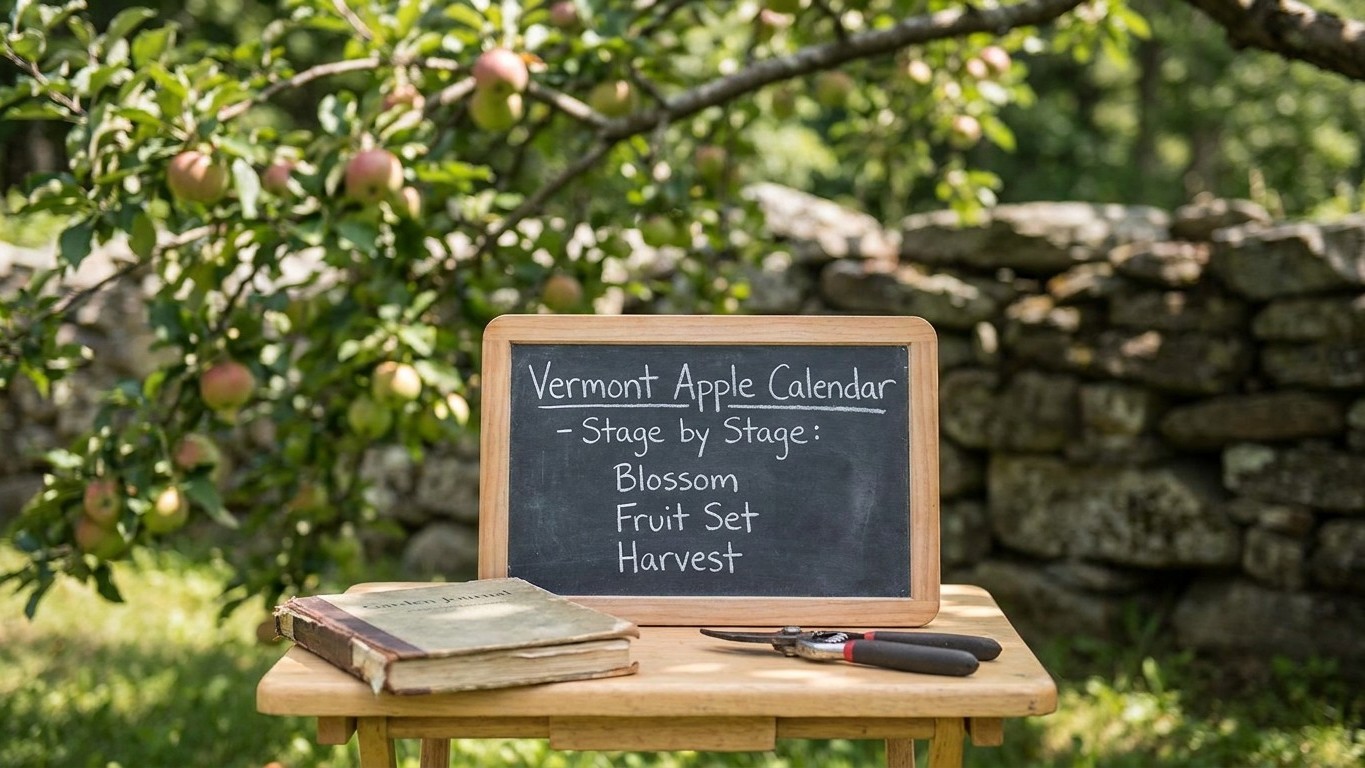

Vermont’s apple season runs from dormant buds in late winter to full-color fruit in fall, and every stage in between tracks off two numbers: NOAA’s 1991-2020 climate normals put Burlington’s last spring freeze at April 30 to May 10, and its first fall freeze at October 3 to October 13. Those two windows, not the calendar month, decide when bloom is safe and when the last apples need to come off. Check which stage your trees are actually in before you spray, thin, or pick, since a warm week can push the whole sequence ahead by days.
The short answer for Vermont
Vermont’s apple year turns on two dates, and neither one is on the calendar you’re looking at. Burlington’s last spring freeze lands somewhere between April 30 and May 10, and that window — not the month, not the temperature outside today — decides whether bloom is safe. So before you spray, thin, or prune anything, walk out and check what stage your buds are actually showing, because a warm week can push the whole sequence ahead of that window without asking your permission first.
Those two ranges are ranges for a reason. NOAA defines them as the band where a 32°F freeze has a 30 to 70 percent chance of occurring, not a single date, so a Champlain Valley grower who plans around one date alone is planning around only one edge of a real spread. The same caution applies at the other end of the season: an early October freeze is well within normal, even in a mild year.
What the answer depends on locally is elevation and distance from Lake Champlain’s moderating water. Burlington’s numbers describe the mildest corner of the state. Higher ground and the interior run on a shorter clock, which shifts when each stage below actually lands, even though the order of the stages never changes.
If you haven’t chosen or planted your trees yet, the rootstock and site decisions belong on Growing Apples in Vermont. This calendar picks up from an established tree already in the ground.
Working through it

Each stage below is triggered by the tree’s own temperature accumulation, not by a date on the wall, so treat the timing here as sequence, not schedule. Use Burlington’s frost windows only as the outer edges; the stage itself tells you where you actually stand.
Dormancy

From leaf drop through late winter the tree is fully dormant, and this is the stage for structural pruning: removing crossing limbs, water sprouts, and anything broken by winter weight. Cuts made now heal before sap starts moving, and pruning during dormancy avoids opening live wood to disease pressure that shows up once growth resumes. This stage runs right through Burlington’s coldest weeks, when NOAA’s 1991-2020 normals put the average daily minimum for the coldest month at 10.2°F. That figure describes how cold an ordinary night gets there, not how low a hard cold snap can push the mercury, and it is what rules out marginal varieties long before bloom timing becomes a question.
Green tip

Buds swell and split to show a sliver of green. This is the last safe window for a dormant oil spray against overwintering mite and scale eggs, because oil applied once leaf tissue is exposed can burn it. Green tip typically arrives well before Burlington’s last-freeze window closes, so a hard freeze at this stage is normal and the buds tolerate it without damage.
Pink

Flower buds show color but haven’t opened. Cold tolerance drops sharply from here on: an unopened pink bud survives a harder freeze than an open blossom will. This is also the point to finish any fungicide program aimed at scab before flowers open and pollinators are working the orchard.
Bloom

Open blossoms are the most frost-sensitive stage in the entire calendar, and in most years bloom in the Champlain Valley lands inside or just after Burlington’s last-freeze window of April 30 to May 10. A freeze at open bloom can kill the flower outright and take the year’s crop with it, which is the biggest reason variety choice matters as much as it does here. For cultivars whose bloom timing runs late enough to sit closer to the safe side of that window, see The Best Apple Varieties for Vermont.
Petal fall

Petals drop and a tiny green fruitlet is left behind. Frost risk drops sharply once petals fall, but it isn’t zero, and a freeze here can still mark the young fruit’s skin even without killing the flower first.
Fruit set

Fruitlets size up from pea to marble size, and this is when to thin, cutting clusters down to one or two fruit so the remaining apples size properly and the tree doesn’t overset and skip a year. Thinning finished by this stage also cuts down on limb breakage later, once a full crop adds real weight.
Harvest
Ripening dates spread from late summer into October depending on variety, and the back end of the season is bounded by Burlington’s first fall freeze of October 3 to October 13. A hard freeze after that window can still leave fruit usable if it’s picked promptly, but flavor and storage life both drop once the tree itself has been frosted.
What changes across Vermont
Burlington’s numbers describe the Champlain Valley, and they come with a plain caution attached in NOAA’s own data: this is the mildest corner of the state. Lake Champlain holds summer heat into fall, which delays the first freeze there, and it also buffers spring cold snaps enough to push the last freeze window earlier than most of inland Vermont sees. Move away from the lake and both windows compress from the outside in: spring freezes linger later, fall freezes arrive sooner, and the safe season in between gets shorter.
The Green Mountains run this way largely on elevation. Cold air is denser and sinks, so valley floors and low pockets in the mountains hold frost long after nearby slopes have cleared, which makes site selection, and not just soil, a real orchard decision there. The Northeast Kingdom in the state’s far northeast corner runs cold for a different reason: it sits well inland from any large lake’s moderating effect, in continental air that swings colder at both ends of the season.
NOAA’s caution on the Burlington figures notes plainly that the Green Mountains and the Northeast Kingdom run substantially shorter seasons than the Champlain Valley. Neither region has its own published freeze-date normal in this dataset, so growers there should treat Burlington’s dates as the mild edge of what to expect, not as their own calendar.
| Region | How it runs relative to Burlington | Main driver |
|---|---|---|
| Champlain Valley | Mildest of the three: spring frost risk clears earliest, fall frost risk begins latest | Lake Champlain’s moderating water |
| Green Mountains | Shorter season, cold pockets settle in low ground | Elevation and cold air drainage |
| Northeast Kingdom | Shorter season, colder at both ends | Distance from the lake, continental air |
The mistakes this climate punishes
Blooming into the last frost
An early-blooming variety opens its flowers before the risk of frost has passed, and in the Champlain Valley that risk runs, on NOAA’s normals, right up to May 10 in a typical year. A variety on the early side of the bloom range can be in full flower while frost is still a live possibility, and a single hard freeze at open bloom can erase most of that year’s crop. This shows up as a near-total fruit failure the same season the freeze hits, with no warning beyond the frost advisory itself. Knowing where a given variety’s bloom timing sits matters more here than in a state where the frost window closes sooner.
Trusting a mild winter with a tender variety
Burlington’s own winters run a coldest-month average minimum of 10.2°F under NOAA’s 1991-2020 normals, and that figure describes an ordinary cold night in the mildest part of the state, not a floor. A variety or rootstock bred for gentler winters can come through several easy years undamaged and then take real trunk or graft-union injury the first time a true cold snap arrives, and the damage often doesn’t show until the following spring, when part of the tree fails to leaf out. This risk rises with elevation and distance from the lake, where the ordinary cold night runs colder still.
Feeding too late in the season
Nitrogen applied in mid to late summer pushes soft new growth right when the tree should be hardening off for winter. That new growth is the first tissue to die back when Burlington’s first fall freeze arrives, on NOAA’s normals, sometime between October 3 and October 13, and inland sites see that freeze earlier still. The fix is timing, not avoidance: feed early enough in the season that new growth has time to mature before the nights turn, and stop well before harvest.
Checking this against your county
Every figure above comes from one station in the Champlain Valley, and Vermont’s terrain is varied enough that a real county-by-county freeze calendar is worth getting before you set a season’s spray or thinning schedule against it. UVM Extension, the University of Vermont’s land-grant extension service, is the right place to check local frost records, pest advisories, and county-specific planting guidance against what Burlington’s normals suggest. A call to the county office is worth more than extrapolating from a single lakeside station, especially for a Green Mountain or Northeast Kingdom site.
Common questions
When should I spray my apple trees in Vermont?
Timing goes by stage, not date: dormant oil belongs at green tip, before leaf tissue is exposed, and any scab program should finish by pink, before blossoms open and pollinators are active. Match the spray to the stage on your own trees rather than a date on a calendar, since a warm spring can pull every stage forward by a week or more.
Can I grow apples at higher elevation in Vermont?
Yes, but the growing season runs shorter than the Champlain Valley’s, and NOAA’s caution on the Burlington data specifically flags the Green Mountains as running a substantially shorter season. Pick a site with good air drainage so frost doesn’t pool in a low spot, and lean toward varieties known for later, more frost-tolerant bloom timing.
Why did my apple tree bloom and then lose all its flowers to frost?
An open blossom is the most frost-tender stage in the whole calendar, far more sensitive than the bud stages before it. If bloom landed inside or near Burlington’s last-freeze window of April 30 to May 10, or earlier still in a warm spring, a single freeze night is enough to kill the open flowers outright.
How do I know what stage my apple tree is in?
Look at the buds and flowers themselves rather than the date on the wall: tight brown buds mean dormancy, a sliver of green means green tip, unopened rosy buds mean pink, open white flowers mean bloom, and scattered petals with a small green swelling behind them mark petal fall. Checking the tree directly is the only reliable read, since the same stage can land on different days from one year, or one hillside, to the next.