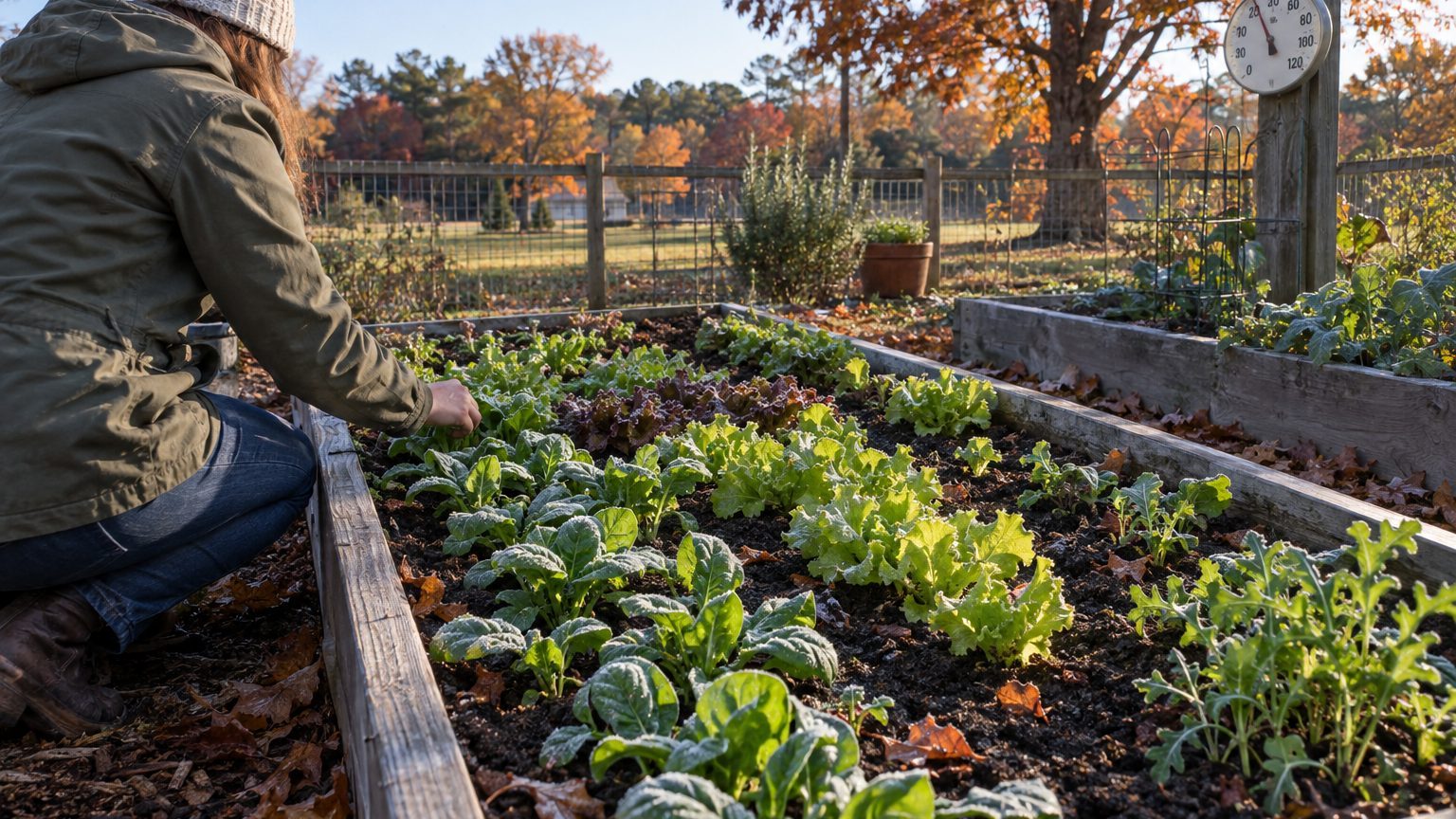

Sow winter salads in Vermont in late summer, counting backward from your first fall freeze, so the plants are nearly full size before the short days stall their growth. Cold-hardy greens can also go in during spring, once the soil is workable. The dates below come from Burlington, the mildest corner of the state, so most gardeners should start earlier than they suggest. This page belongs to our Winter Salads for Vermont Gardens guide.
The short answer for Vermont
Finish outdoor sowing for winter harvest well before the first fall freeze, which in Burlington falls between October 3 and October 13. For spring sowing, the last freeze falls between April 30 and May 10. Both ranges are probabilities, not forecasts.
They come from the NOAA 1991-2020 Climate Normals and mark the span where the probability of a 32°F freeze sits between 30% and 70%. A date inside that band is closer to a weighted coin flip than a deadline.
| Marker | Burlington value | What it measures |
|---|---|---|
| Last spring frost | April 30 to May 10 | 32°F freeze probability, 30-70% band |
| First fall frost | October 3 to October 13 | 32°F freeze probability, 30-70% band |
| Coldest month, average low | 12.9°F | Mean daily minimum, not a record low |
Counting backward from October
A winter salad bed works like a pantry. The plants grow in fall, then mostly hold. What you pick in December and January is growth stored before the light faded. So the sowing date is judged by how big the plants are when growth slows, not by the first frost itself. Hardy greens shrug off light freezes.
This page does not carry days-to-maturity figures for individual varieties. Your seed packet does. Take that number, count back from the October 3 to 13 window, and add a cushion, because fall growth crawls compared with summer growth.
Today is October 6, 2026, which puts Burlington inside its own freeze window. Seed sown in an open bed now will go into winter small. Treat it as an experiment, and aim for late summer next year.
Spring sowing
The April 30 to May 10 band matters less for hardy greens, which tolerate cold soil and can go in as soon as the bed is workable. It matters more for tender crops you might interplant, which should wait until the band has passed.
What will not work here
A short season punishes the slow. In Burlington, the mildest part of the state, the growing window closes between October 3 and October 13. Anywhere colder, it closes sooner. A variety that needs a long run to size up, sown in early autumn, will reach winter as a seedling. Seedlings sit in the snow. They do not harvest.
Cold and the open bed
The coldest month at the Burlington reference station averages a daily low of 12.9°F. That is an average, so plenty of nights run colder. Tender lettuces left uncovered in an open bed will not make it through. Hardy spinach and other cold-tolerant greens can, usually with a layer of protection over them. Our rundown of The Best Winter Salads for Vermont sorts out which is which.
Sowing on the frost date and hoping fails for a different reason. Cold soil slows germination, so a seed sown at the start of the freeze window may take weeks to emerge. By then the days are short, and the plant has no time to build the leaf area it needs.
Warm soil, damp air and snow
Late-summer sowing has its own problem. The seed goes into soil still warm from August, and lettuce in particular can refuse to sprout in a hot bed. Sow at dusk, shade the row, and keep it moist until it comes up.
Vermont’s damp autumns punish crowding. Plants spaced tight stay wet, and wet leaves in cool air invite rot and mildew. Thin early, even when it feels wasteful.
Snow load is the quiet killer of winter structures. A flimsy low tunnel that holds up in November can collapse under a wet snowfall in January. Brace the hoops, and clear the covers when the snow comes.
The biggest failure is borrowing Burlington’s dates for a farm in the Green Mountains or the Northeast Kingdom. Those areas run substantially shorter, so the same calendar there means sowing too late.
What changes across Vermont
The USDA Plant Hardiness Zone Map (2023 edition, built on 1991-2020 normals) puts Vermont at zones 3b to 5b. That is a wide spread, several half-zone steps from end to end, and it means there is no single answer for the state. The zone system rests on one variable, the average annual extreme minimum temperature. It tells you about winter cold. It does not tell you how long the growing season is, or how much snow will insulate your bed.
If you garden north or high
Gardeners in the north and at elevation should shift in three ways:
- Sow earlier in late summer, because the freeze arrives sooner than Burlington’s October 3 to 13 band.
- Pick faster-maturing varieties, since less time is available to size up.
- Plan more protection, and expect the harvest to end earlier and restart later.
The valley edge near Lake Champlain sits at the milder end of the range. Hill gardens a few miles away can sit in a different zone entirely. Even within one property, cold air drains downhill and pools in low corners, so the bottom of a slope can freeze while the top stays clear.
Look up your own location on the USDA Plant Hardiness Zone Map instead of guessing from a neighbor’s experience. This page will not tell you which zone you are in, and a town name is not a precise enough address for the map to settle it.
Where to check this for your own county
Start with University of Vermont Extension, the state’s land-grant extension service. Look for two things: a planting calendar written for your area, and any varieties trialled in your county. A trial result tells you what actually grew in local soil and local cold, which a seed catalog cannot.
Extension calendars are often written per crop, not per state, since different plants work on different schedules. So search for the crop you plan to grow rather than a general “fall garden” page. This page does not have a county-level Vermont calendar, and I would rather say so than guess one.
A county recommendation beats a state one, and this page is the state one. Its dates come from a single Burlington station, on a lake, in the mildest corner of Vermont. That makes a useful reference point, but not the final word for a garden two mountain ranges east.
Checking this against your own garden
Your own observations outrank every date above. Three are worth watching.
Three signals to track
Soil warmth, by feel. Push your hand into the bed in the morning, a few inches down. In late summer, soil that still feels warm means lettuce seed may sulk. In spring, soil that feels cold and damp means hardy seed will sit. Compare beds. The one that warms first is your early microclimate.
First true leaves. After the seed leaves, the first true leaves show how fast a seedling is really growing. If they take weeks to appear in fall, your bed is running cool or shaded, and you should sow earlier next year.
The first flush of male flowers on squash. Male blooms open before female ones. Note the date each year and compare it with when frost arrived. Over a few seasons, this gives you a personal marker for how your site runs against the state calendar.
Jot all three in a notebook. Two years of notes will beat this page.
Common questions
Can I still sow winter salads in early October in Vermont?
You can, but expect small plants. Burlington’s freeze band runs October 3 to October 13, and colder places have already passed it. Treat an October sowing as a trial, preferably under cover.
Do Burlington’s frost dates apply to my town?
Probably not exactly. Burlington is the mildest corner of the state. The Green Mountains and the Northeast Kingdom run substantially shorter, so adjust earlier.
What does the 12.9°F figure mean?
It is the mean daily minimum of the coldest month at the Burlington reference station. It is not a record low, so some nights will be colder. It tells you whether a plant survives winter here at all.
Does frost kill winter salads?
Hardy greens handle a light freeze, and a touch of frost can even sweeten them. Tender lettuces are a different story. At Burlington’s 12.9°F average January low, the second group needs real cover.