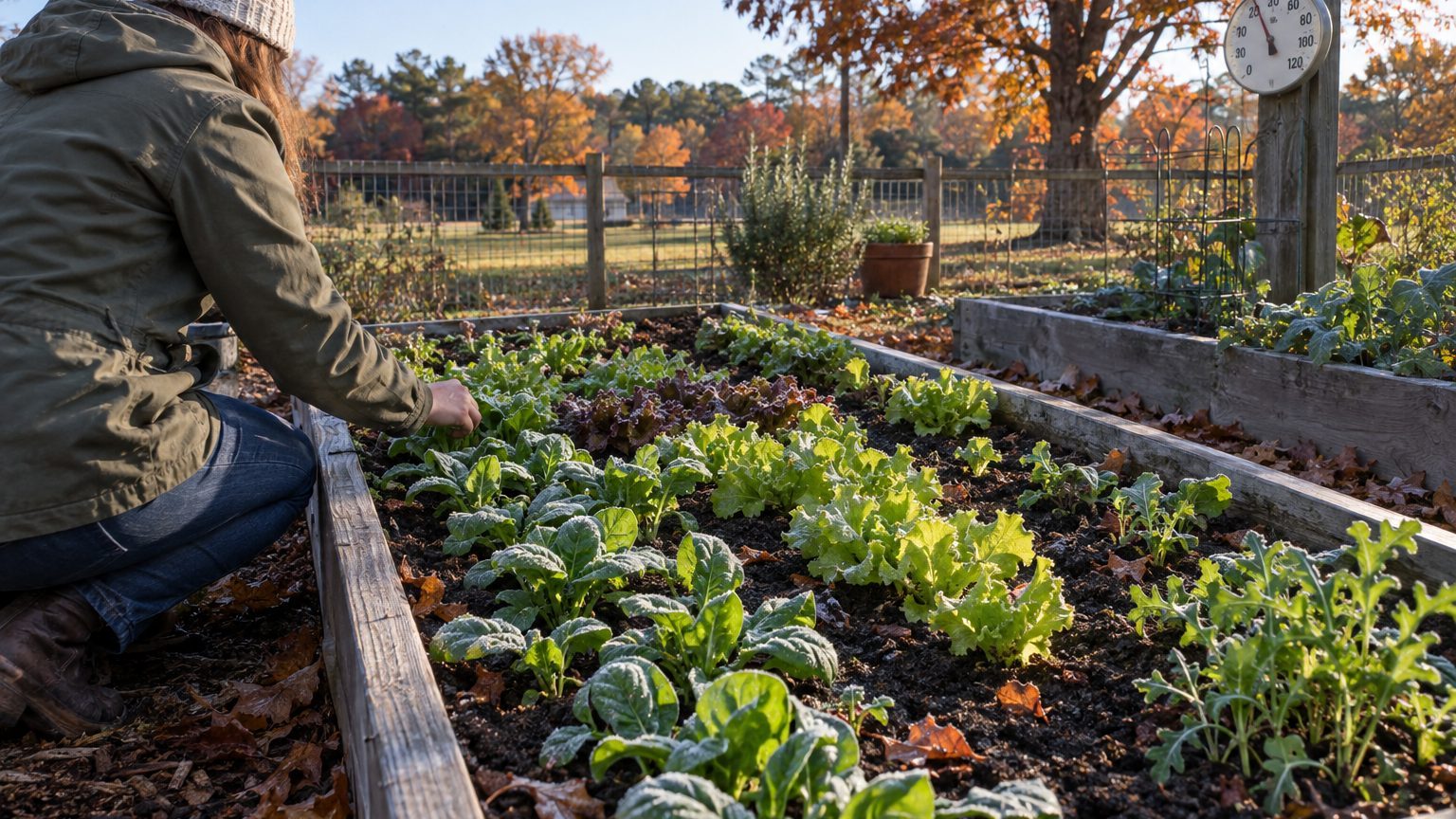

Sow winter salads in Virginia from late summer into early fall, timed to finish ahead of your first fall frost. At the coastal reference station that frost arrives November 10 to November 24, so sowing runs earlier the farther inland and higher you garden. A smaller late-winter sowing follows the spring frost window of March 20 to April 3.
The short answer for Virginia
The dates above come from NOAA’s 1991-2020 Climate Normals for NAS Oceana, in Virginia Beach. They are not calendar deadlines. Each is a probability: the window in which the chance of a 32°F freeze falls between 30 and 70 percent. Before the window, a freeze is less likely than not. After it, a freeze is more likely than not. Nothing is guaranteed on either side.
| Marker | Window at the Virginia Beach reference station | What it means |
|---|---|---|
| Last spring frost | March 20 to April 3 | Chance of a 32°F freeze sits in the 30-70% band |
| First fall frost | November 10 to November 24 | Chance of a 32°F freeze sits in the 30-70% band |
This page does not have a dated sowing calendar from a Virginia source, so it gives you the logic instead. For the fall crop, count backward from your own first-frost window. Greens need to be well established, not just sprouted, when growth slows. A seedling that is two weeks old when the cold arrives will sit there and wait. A plant with a full rosette of leaves will keep giving you cut-and-come-again harvests.
The cold itself is mild at the coast. The mean daily minimum of the coldest month at Virginia Beach is 31.6°F. That is the average overnight low, not the record low, so some nights will run colder. Still, an average just under freezing is why hardy greens such as spinach and kale can stay in the ground there through winter with little more than a row cover. Tender lettuces are a bigger gamble.
For the spring sowing, the logic runs the other way. Hardy greens can go in as soon as the soil can be worked, ahead of the March 20 to April 3 band. Tender types should wait until the band passes, or you should be ready to cover them. Between the two windows, the frost-free stretch at this station runs roughly seven to eight months, which gives you plenty of room to start fall seedlings in warm weather.
For variety choices that match these windows, see The Best Winter Salads for Virginia. For the wider picture of how winter salad growing works in the state, start with Winter Salads for Virginia Gardens.
What will not work here
The biggest mistake is borrowing the coastal dates. Virginia Beach is the mild end of the state. The Blue Ridge and southwest Virginia run weeks later in spring and earlier in fall. A gardener in those areas who sows on a November 10 schedule is sowing into frost, and the seedlings will not size up before the cold arrives. The calendar on this page is a ceiling for the coast, not a promise for the mountains.
Late sowing fails in a predictable way. Seed that goes in just before the first fall frost germinates, makes a pair of small leaves, and stalls. Light and temperature both drop through November and December, and growth slows to almost nothing. You end up with a bed of living but unharvestable plants. The slowest-maturing salad crops are the first to disappoint, especially heading types that need a long stretch of growth before they are worth picking.
Heat is the other side of the problem. Because fall sowing begins in late summer, the soil can still be too warm for some seed. Lettuce is the usual casualty, since warm soil can stop it from germinating at all. Sowing in afternoon shade, watering the row before and after, and holding the seed in a cool place until sowing day all help. Spreading the sowing across several weeks is cheap insurance, because a hot week then costs you one batch, not the whole crop.
Virginia’s humidity punishes tight spacing. Crowded leaves stay damp, and damp leaves invite mildew and rot, especially in the long mild stretches of fall and again in a warm, wet late winter. Give each plant room, thin early, and water the soil rather than the foliage. Row cover helps against cold, but if you never lift it on mild days, the trapped moisture can cause the very disease you are trying to avoid.
Finally, do not assume the coastal average protects you from a cold snap. A mean low of 31.6°F says nothing about the single hard night. Cold-sensitive salads left uncovered on a clear, still night can be lost in one go. Keep a cover on hand rather than guessing from the average.
What changes across Virginia
Virginia has no single answer. The USDA Plant Hardiness Zone Map 2023, built on 1991-2020 normals, places the state in zones 5a to 8b. That is four full zones, and the zone number rests on one variable: the average annual extreme minimum temperature. The Virginia Beach reference figures above describe the warm end of that range. Other parts of the state differ, sometimes by a lot.
If you garden in the north or at altitude
Move everything earlier in fall and later in spring. Count back from a first-frost date that is weeks ahead of the coastal one, and expect the spring sowing to open weeks later. Elevation does the same job as latitude. A garden on a ridge or in a mountain valley can sit in a colder zone than a town a few miles away, and cold air pools in low spots, so frost may reach a hollow before it reaches the slope above.
Hardiness zone also matters differently here. The zone rating tells you whether a perennial survives winter, which matters little for an annual salad crop. For salads, frost dates and the depth of winter cold matter more. In colder zones, expect to protect with a cold frame or low tunnel, not just a light cover, and to treat tender lettuces as a fall-only crop.
Do not trust this page to tell you your zone. Look up your location on the USDA Plant Hardiness Zone Map and read the zone for your own address. Then shift your sowing dates earlier or later by comparing your local frost dates with the coastal ones given above.
Where to check this for your own county
Your state extension service is the next stop. Virginia’s is Virginia Cooperative Extension, run through Virginia Tech, with offices that serve individual counties and cities. Its staff and Master Gardener volunteers know local frost patterns, soil, and pests in a way no statewide page can.
Look for two things. The first is a local planting calendar or vegetable planting guide, ideally one that lists fall and winter sowing dates for your area. The second is any information on varieties trialled in your county, which tells you what has actually grown there, not just what a seed catalog promises. If your county office does not publish either, call or message it and ask what local gardeners sow for fall greens and when.
A county recommendation beats a state one. This page is the state one, built from a single coastal station and a statewide zone range, and it cannot know about your hillside, your valley, or your neighborhood’s cold pocket. Use it for the logic and the outer limits, then let your county office set the dates.
Checking this against your own garden
Your own observations outrank every date here. Three are worth watching, and none needs equipment.
- Soil warmth by feel. Push your hand into the bed in the morning. Soil that feels warm, not merely cool, may still be too hot for lettuce seed. If it feels cool and damp, germination should be easy. A bed that stays warm longer than your neighbor’s tells you it gets more sun or holds more heat.
- First true leaves. The first pair of leaves a seedling shows are seed leaves. The next pair, the true leaves, mean the plant is working. If your fall seedlings have not reached that stage as cold weather arrives, you sowed late for your spot.
- Where frost shows first. Walk the yard on the first cold, clear morning and note where the grass is white. That spot is your frost pocket. A bed there needs earlier sowing and earlier cover than one that stays green.
Write the dates down for a season or two. Your own record of when seedlings reached true leaves and when frost first hit will quickly be more accurate than any calendar.
Common questions
Can I sow winter salads after the first frost?
You can, but the odds fall quickly. Seed sown after your first-frost window may germinate, yet the seedlings will grow very little through the coldest months. Hardy greens fare best, and a cover helps. Treat these as a bonus crop for spring, not a winter harvest.
Do the Virginia Beach dates apply to the whole state?
No. They come from a coastal station and mark the mild end of the state. The Blue Ridge and southwest Virginia run weeks later in spring and earlier in fall, so inland gardeners should sow earlier in fall.
What does the frost date actually mean?
It marks the window in which the chance of a 32°F freeze sits between 30 and 70 percent. It is not a guarantee that frost will or will not arrive on a given day.
Is the USDA zone enough to plan my sowing?
Not by itself. The zone rests on the average annual extreme minimum temperature, while sowing dates depend on frost timing. Use the Winter Salads for Virginia Gardens guide with your local frost dates for a better plan.