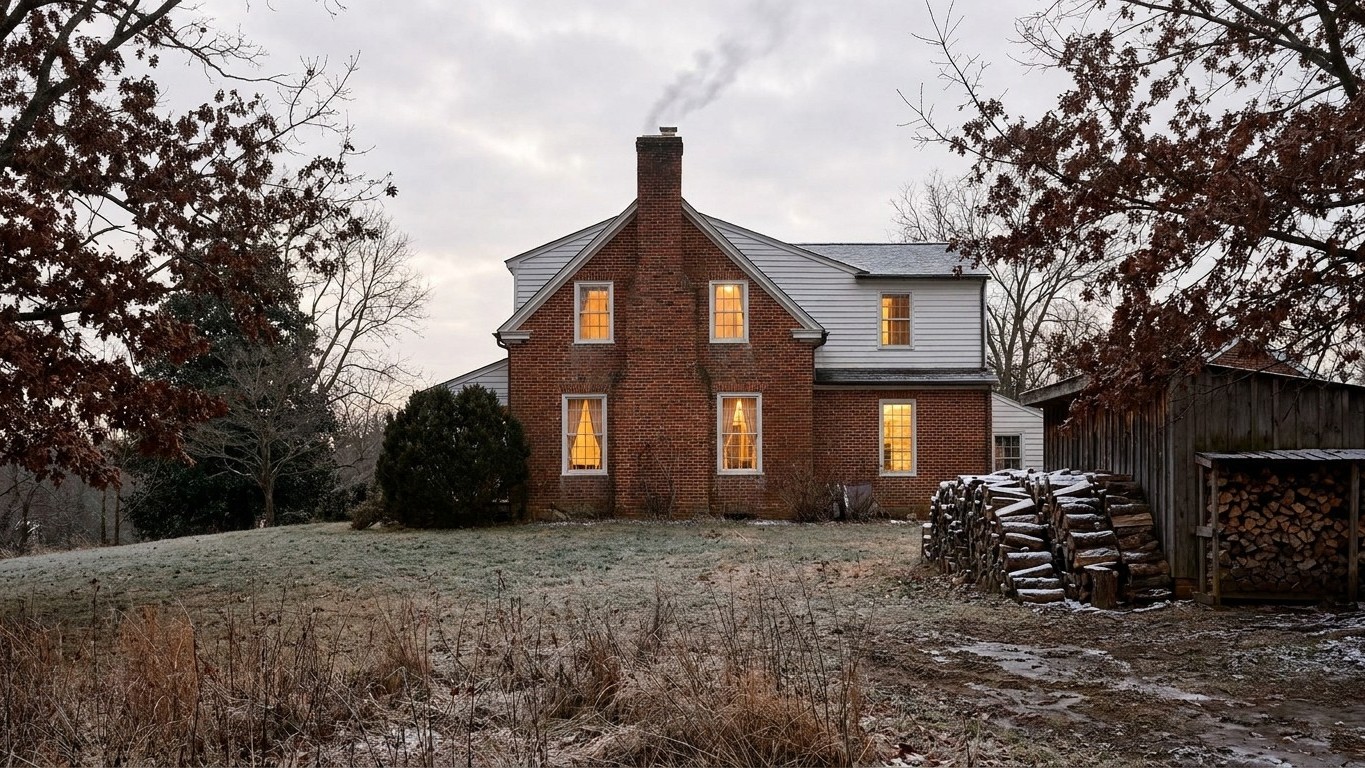

Winters in Virginia don’t punish a furnace the way New England does, but they don’t let it coast either. Between the mean cold snaps of the Piedmont and the milder coast, the state sits in a middle zone where heating costs hinge less on brutal lows and more on how long the system has to run, and on whether the wood stacked out back is actually ready to burn.
How cold it gets, and for how long

At Virginia Beach, the reference station for NOAA’s 1991-2020 climate normals, the coldest month averages a daily minimum of 31.6°F. That’s the number that matters for heating math, not the record low that makes the evening news once a decade. It’s the temperature a heating system faces night after night, for weeks at a stretch, and it sits right at the freezing line rather than deep below it.
That threshold tells a household two things. First, the coldest stretch of the year isn’t the kind of cold that cracks pipes on contact or forces a furnace to run flat-out around the clock. Second, and this is the part people underestimate, a winter that hovers near 32°F for months asks for steady, sustained output more than raw firepower. A furnace or wood stove here isn’t fighting a two-week Arctic blast. It’s grinding through a long, damp, chilly season where the thermostat rarely gets a break.
Inland and at higher elevation, away from the coastal reference station, that minimum drops further and the heating season stretches longer on both ends. A house in the Blue Ridge foothills or the western valleys is going to burn more wood, or run the furnace more hours, than one near the water, even though both are technically the same state and the same climate normals period.
What this means in practice: sizing a heating system or a wood supply around a single statewide number is a mistake. The 31.6°F figure is a solid baseline for the coastal and central parts of the state, but it’s a floor, not a ceiling, for anyone farther from Virginia Beach. When Does the Heating Season Start in Virginia? Built around that 31.6°F baseline, it runs roughly from late fall into early spring, with the coldest stretch concentrated in January, and it’s that duration, not any single frigid night, that drives the total cost of staying warm.
What a cord of wood is worth here
A cord is a volume, not a weight, and that distinction is where most firewood buyers get shortchanged. The standard measure is a stack 4 feet high, 4 feet deep, and 8 feet long, which works out to 128 cubic feet. Nothing about that definition says what species is inside the stack, and species is what decides how much actual heat you’re buying.
| Measurement | Value |
|---|---|
| Cord dimensions | 4 ft x 4 ft x 8 ft |
| Cord volume | 128 cubic feet |
| Heat content (seasoned hardwood) | about 20 million BTU |
According to Michigan State University Extension, a cord of well-seasoned hardwood delivers roughly 20 million BTU, which the extension service compares to about 145 gallons of #2 fuel oil or 215 gallons of LP gas. Given how long the Virginia heating season runs, especially away from the coast, that comparison is useful for thinking about how many cords a season actually eats through, without pretending to give a dollar figure that would be stale by next winter.
The 20 million BTU number is an average, not a guarantee. Denser species pack more mass into the same 128 cubic feet, so a cord of oak or hickory puts out more sustained heat than a cord of a lighter wood, even though both measure the exact same stack size. That’s the whole trick of buying firewood by the cord: the volume is fixed, but what’s inside it isn’t.
Moisture cuts into that heat value just as much as species does. Wood that hasn’t seasoned properly spends a chunk of its potential energy boiling off water trapped inside its cells before it ever throws heat into the room. Seasoning time, covered next, is what determines whether a cord delivers close to that 20 million BTU figure or falls well short of it.
How long wood takes to dry in Virginia
Firewood needs to reach roughly 20 percent moisture or less before it burns efficiently, according to MSU Extension. Green wood, fresh off the tree, can carry over 60 percent moisture, which means more than half its weight is water that has to be driven out before the wood gives up any real heat.
Split and stacked correctly, so air moves through the pile, green wood typically reaches that 20 percent mark after one full summer of drying. That “split and stacked” condition isn’t a footnote. Rounds left whole, or wood piled without airflow, dry far slower and unevenly, regardless of how many months pass. Virginia’s humid summers don’t help matters the way a dry Western climate would, so the seasoning clock here depends heavily on how the wood was handled after it was cut, not just on the calendar.
Red oak is worth flagging by name. MSU notes that its cell structure makes it dry more slowly than most hardwoods, so a red oak stack often needs more than a single summer to hit that 20 percent threshold. Anyone burning red oak on the same timeline as ash or maple is likely burning it too soon.
Burning wood before it’s ready has consequences beyond a weaker fire. Wet wood produces less usable heat because so much energy goes into vaporizing water instead of warming the room, and that incomplete combustion leaves more creosote deposited in the flue. Over a season, that buildup means a chimney needs sweeping sooner than it would with properly seasoned wood, which is a maintenance cost and a safety issue, not just an efficiency one. The fix isn’t complicated: split it, stack it loosely enough for air to pass through, and give it a full summer, longer for red oak.
Where to check before you buy
Virginia stretches from tidewater flats to mountain ridges, and the figures above describe conditions at Virginia Beach, the reference station behind the climate normals. A homestead in Highland County or up in the Alleghenies is going to see a colder, longer heating season than the coast, even under the same statewide climate dataset.
Species availability shifts with the terrain too. Oak, hickory, and other dense hardwoods that season slowly but burn hot aren’t distributed evenly across the state, and what’s locally abundant, and locally cheap to source, varies by region.
Burn restrictions add another layer that a statewide figure can’t capture. Some localities set seasonal or air-quality-driven limits on open burning, and those rules are set at the local level and can change from year to year. Before assuming a fireplace or outdoor burn is unrestricted this winter, checking local rules is worth the five minutes it takes.
For guidance specific to a county, the Virginia Cooperative Extension is the resource built for exactly this: local species advice, seasoning tips suited to regional humidity, and current information on any burn restrictions in effect. It’s a better source than a statewide average for anyone making a real purchasing decision this season.
What each heat source costs to run in Virginia
At Virginia’s average residential prices, this is what one million Btu of heat delivered into the house costs with each system. It compares fuels on the same unit: it is not a yearly bill, and it leaves out the price of the equipment.
| System | Cost per million Btu delivered |
|---|---|
| Electric resistance (baseboard, 100% efficient) | $49.33 |
| Heat pump at 8.1 HSPF2 (seasonal COP about 2.4) | $20.78 |
| Natural gas furnace at 95% AFUE | $17.04 |
Cheapest to run in Virginia: natural gas furnace, $3.74 less per million Btu than the heat pump.
Prices: U.S. Energy Information Administration (EIA), average residential prices. Efficiencies: ENERGY STAR criteria. A heat pump’s figure is a seasonal average; in the coldest weather its efficiency drops.