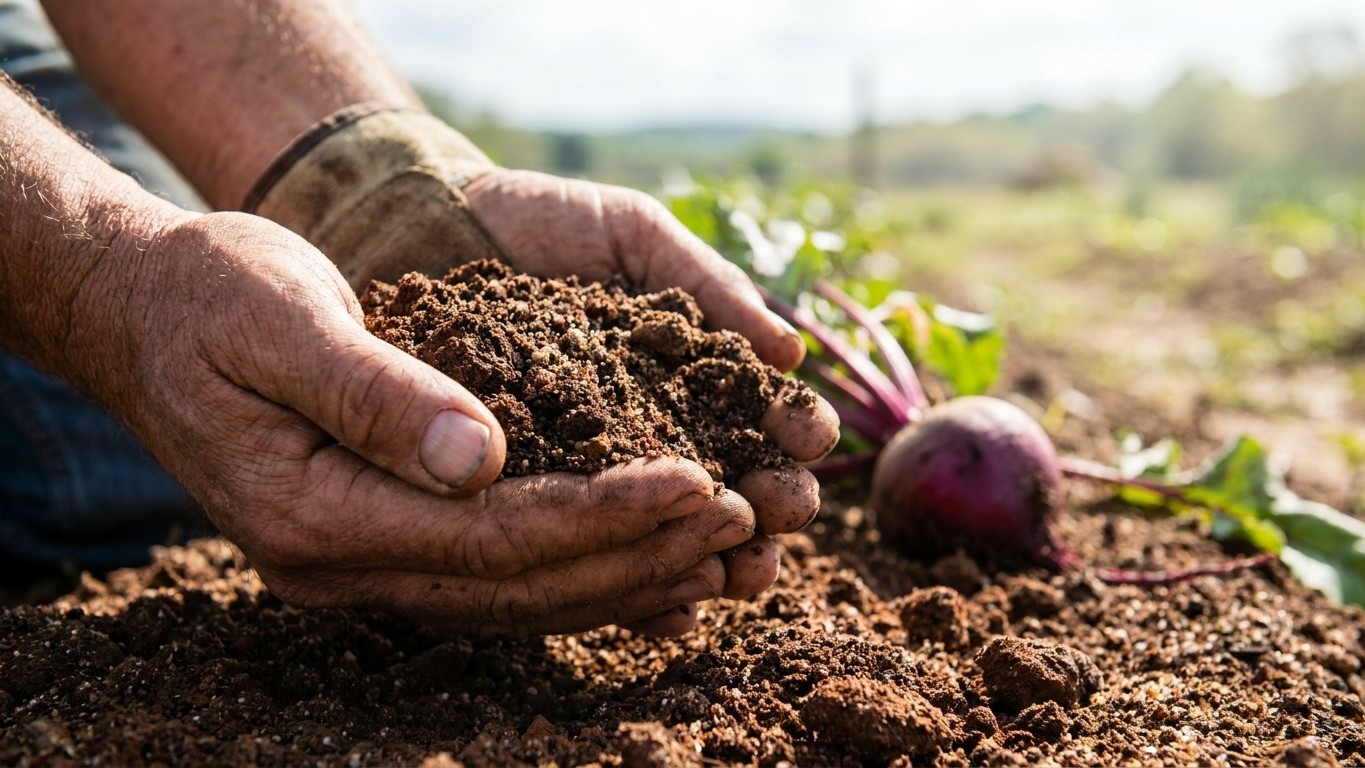

Virginia’s representative ground, the Pamunkey series, is a well-drained loam with enough sand to let beet roots push down easily but only about 1.2 percent organic matter, which is thin for a crop that wants richer, moisture-holding soil. That means most Virginia gardeners are amending before they plant, and timing sowing so the first six weeks don’t run dry.
The short answer
The soil that USDA lists as representative of Virginia, the Pamunkey series, is an Alfisol: a forest-derived soil of moderate fertility that holds nutrients reasonably well without being especially rich. The surface horizon runs about 50 percent sand, 11 percent clay and 39 percent silt, which puts it solidly in loam-to-silt territory, and it’s classified well drained. Surface pH sits around 6.2, slightly acid. Organic matter averages about 1.2 percent.
For a beet, that profile is a mixed bag. Utah State University Extension is blunt about what the root wants: deep, sandy, well-drained soil rich in organic matter. The Pamunkey series checks the sand and drainage boxes reasonably well. It falls short on the organic matter, and 1.2 percent is a long way from “rich.” Extension guidance caps compost additions at 1 inch per 100 square feet, so the fix isn’t to dump in bagged compost by the truckload. It’s a modest, repeated top-dressing over seasons, not a one-time overhaul.
The pH matters too, though less dramatically. A reading near 6.2 is on the acid side of neutral but still within a range most root vegetables tolerate. It’s not the kind of number that demands lime before you plant a single seed, but it’s worth knowing before you assume your garden bed matches this figure exactly.
On the heat side, Utah State’s threshold for beet trouble is temperatures above 85 F combined with water stress, which together turn roots woody and unpleasant to eat. Virginia’s climate data on how many days a year the reference coastal station passes 90 F isn’t published in the sources behind this page, so no specific day count belongs here. What can be said plainly is that Virginia summers regularly clear 85 F for extended stretches, and that’s the temperature band where the woodiness risk described by Utah State becomes real if the soil has also dried out.
None of this is a diagnosis for any one backyard. Virginia spans hundreds of mapped soil series, from the clay-heavy Piedmont to sandy Coastal Plain flats to mountain soils in the southwest that have nothing in common with the Pamunkey profile. The state soil is a reference point, not a stand-in for a soil test. Treat these numbers as the starting assumption you check against your own dirt, not the final word on it.
The six weeks that decide it here
Beets get sown 2 to 3 weeks before the last frost, which puts the first six weeks of root development squarely inside Virginia’s early spring. NOAA’s 1991-2020 climate normals for the NAS Oceana station in coastal Virginia Beach put the last spring freeze in the window of March 20 to April 3. That’s the mild end of the state. Inland and westward, especially toward the Blue Ridge and into southwest Virginia, spring runs weeks later, and any grower there should shift the sowing calendar accordingly rather than borrowing the coastal date.
What matters more than the date itself is what that stretch of Virginia spring tends to do. Early spring here is not a steady, predictable ramp into warmth. It swings. A week of dry, windy days can pull moisture out of a loam-to-silt bed like the Pamunkey profile faster than a new gardener expects, especially in raised beds or containers that drain quickly by design. Then a wet system rolls through and the same bed sits saturated for days. That back-and-forth is normal for Virginia’s spring pattern, and it’s exactly the condition Utah State flags as the trigger for premature flowering, what gardeners call bolting, when it happens during those first six weeks after sowing.
This is where the two failure modes need to stay separate in your head. Bolting is an early-season problem, driven by water stress in roughly the first six weeks after the seed goes in. Woodiness is a later problem, driven by heat above 85 F layered on top of water stress once the root is already developing. Treating them as the same issue, “just keep it watered,” misses the point that the spring swing and the summer heat are different threats arriving at different growth stages. A bed that gets babied through a dry April can still turn woody in July if watering lapses during a heat run.
Practically, that means the six weeks right after sowing deserve the closest attention of the whole season. A consistent watering schedule through that window, rather than reactive watering after the soil has already dried past the point of stress, is doing more work against bolting than almost anything else in the beet-growing routine.
What goes wrong here
- Bolting from a dry spring swing. Virginia’s early spring alternates dry stretches with wet systems, and a dry week landing in the first six weeks after sowing pushes beets into premature flowering. The remedy is steady moisture through that window specifically, checked by hand in the top few inches of soil rather than assumed from rainfall totals.
- Woody roots from summer heat plus dry soil. Once temperatures push past 85 F, any water stress on top of that heat toughens the root. This shows up later in the season than bolting does, so it needs its own watering vigilance rather than being lumped in with spring care.
- Thin organic matter limiting root development. At roughly 1.2 percent organic matter, the representative Virginia soil doesn’t hold moisture or nutrients the way beets prefer. Utah State’s guidance of up to 1 inch of composted organic matter per 100 square feet, worked in before sowing, addresses this without overdoing it.
- Assuming your garden matches the state soil. The Pamunkey series describes a mapped surface horizon, not a worked garden bed, and Virginia’s Piedmont clay, Coastal Plain sand, and mountain soils in the southwest can differ completely from it. A basic soil test for texture and pH is the only way to know what you’re actually amending.
- Sowing on a single statewide date. The March 20 to April 3 last-frost window applies to coastal Virginia Beach. Gardeners farther inland or in the Blue Ridge and southwest regions who sow on that coastal timeline risk seeding into ground that’s still weeks from its own last freeze.
Common questions
Does Virginia’s state soil tell me what’s in my backyard?
No. The Pamunkey series is the soil USDA lists as representative of Virginia, but the state contains hundreds of mapped soil series. Clay-heavy Piedmont ground, sandy Coastal Plain flats, and mountain soils in the southwest can all differ from this profile. Use it as a starting reference, then confirm your own texture and pH with a soil test.
How much compost should I add before sowing beets in Virginia soil?
Utah State University Extension recommends no more than 1 inch of composted organic matter per 100 square feet. Given the representative Virginia soil’s organic matter of about 1.2 percent, working in that amount before sowing helps close the gap without over-amending.
Is bolting the same problem as woody roots?
No, and treating them as one issue is a common mistake. Bolting comes from water stress in roughly the first six weeks after sowing. Woodiness comes later, when temperatures climb above 85 F while the soil is also dry. Both call for consistent watering, but at different points in the season.
Should I sow on the same date if I live away from coastal Virginia?
No. The March 20 to April 3 last-frost window comes from a coastal Virginia Beach station. Inland areas and especially the Blue Ridge and southwest Virginia see spring arrive weeks later, so the sowing window (2 to 3 weeks before your local last frost) needs to shift accordingly rather than following the coastal calendar.