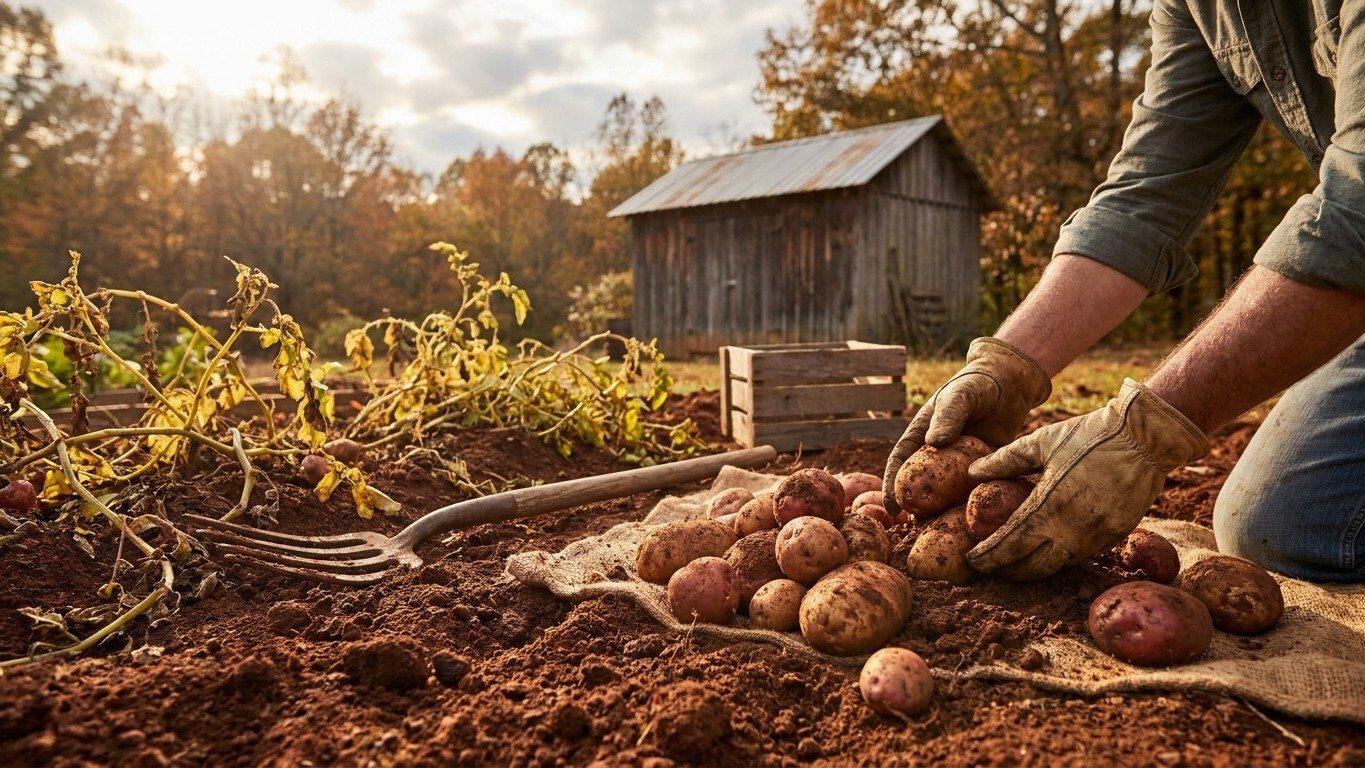

Dig maincrop potatoes once the vines have died back, typically right around the first fall frost window of November 10 to November 24 in the milder, coastal parts of Virginia. Curing needs 55-60 F for two to three weeks, and long-term storage needs 40-45 F in the dark. An unheated garage or shed here will get close in October and November, but by the coldest stretch of winter it can drop below that target, sometimes near freezing.
The short answer
Two numbers set the calendar for Virginia growers: a first fall frost that arrives between November 10 and November 24 at the coastal reference station, and a coldest-month mean minimum of 31.6 F. Those figures come from NOAA’s 1991-2020 Climate Normals at the NAS Oceana station near Virginia Beach, and they matter because a potato crop left in the ground has no frost tolerance in its foliage, and a stored crop has almost no tolerance for temperatures much below the low 30s.
Practically, that frost window tells you the outer edge of the digging season for gardeners near the coast. Vines usually die back from natural senescence before frost ever touches them, but if a hard freeze arrives first, it blackens the foliage overnight and signals that it’s time to get tubers out of the ground. Waiting past that point risks the soil itself dropping into a range where digging becomes difficult and where tubers sitting in wet, cooling ground start to lose quality.
The 31.6 F figure answers a different question: what happens after harvest, once the crop is sitting in a shed or garage for the winter. That number is the average low temperature during the coldest month, not the record low and not the daily average. It tells you that on a typical night in the depths of winter, an unheated space that isn’t insulated or partly underground will sit close to or below freezing. That’s colder than the 40-45 F storage target, which means an uninsulated outbuilding in Virginia can freeze potatoes solid during a normal cold snap, not just during a rare arctic outbreak.
The caution built into the frost data matters as much as the number itself. The November frost window applies to the coastal plain and Tidewater, the mildest part of the state. Move west into the Piedmont, and further into the Blue Ridge and southwest Virginia, and frost arrives weeks earlier in fall. Gardeners in those inland and mountain counties should treat the coastal date as a floor, not a forecast, and expect to be digging potatoes and setting up curing space well before the calendar suggests.
None of this changes how the potato itself behaves. It changes when Virginia growers hit each stage, and how much buffer they have between “cured and ready to store” and “the storage space itself turns into a freezer.”
Curing, and where
Curing exists to heal the cuts, bruises, and skin breaks that happen during digging, and Utah State University Extension is specific about the conditions it takes: 55-60 F with high humidity, held for two to three weeks. Below that temperature, the skin barely thickens. Above it, or in dry air, the tubers are more likely to shrivel or rot before they ever reach the root cellar.
Finding a spot that holds 55-60 F in Virginia at harvest time isn’t automatic, and it changes depending on where in the state you’re digging. Coastal and Piedmont growers harvesting in the weeks before that November frost window often still have warm afternoons, so a shaded porch or an open garage with the door cracked can run too warm during the day and too cool at night, swinging around the target rather than holding it. A basement, particularly one that’s partly below grade, tends to be more stable and is usually the better bet for that two-to-three-week stretch.
- Dig on a dry day and let the tubers sit on top of the soil for an hour or two so loose dirt dries and falls away; don’t wash them.
- Move them out of direct sun immediately. Direct light greens the skin and that green tissue should be trimmed away before storage or eating.
- Set them in single layers, or in shallow crates, somewhere that holds 55-60 F. A basement or an interior room away from windows works better in Virginia than an open porch, which tracks the outdoor swing too closely during a mild fall.
- Keep humidity high around the tubers, a damp burlap cover or a lightly misted room, without letting water sit directly on the skins.
- Leave them undisturbed for two to three weeks, then check a few tubers for firm, set skin before moving the batch into winter storage.
Storing through this winter
Once cured, potatoes want a dark space at 40-45 F, according to Utah State University Extension, while the University of Maine Cooperative Extension gives a slightly different long-term target of 38 F combined with 95 percent humidity. Both figures sit well above the 31.6 F mean minimum for Virginia’s coldest month, and that gap is the whole problem for anyone storing potatoes in an outbuilding here rather than a climate-controlled cellar.
An unheated garage or shed in coastal Virginia will likely track close to outdoor air on the coldest nights, which means it can dip near or below freezing during a normal winter cold snap, not just an unusual one. That’s below both the USU range and the Maine target, and it’s cold enough to freeze tubers outright, turning the flesh soft and eventually black once it thaws. A basement, especially one that isn’t heated but is buffered by surrounding soil and the house above it, tends to run warmer and steadier than a detached structure, and is generally the more reliable option for holding the 40-45 F window through a Virginia winter.
The inland gradient matters again here. Growers in the Blue Ridge and southwest Virginia are working with a colder winter overall than the coastal reference point, even though only the coastal figures are published in the data above. That means a storage space that just barely holds the target near the coast may not hold it at all further west or at higher elevation, and it’s worth checking an actual thermometer in the storage room itself rather than assuming a shed is “cool enough” because it feels that way at the door.
Darkness matters as much as temperature. Light exposure during storage, not just at digging, triggers greening and the bitter-tasting compounds that come with it, so wrapping crates in burlap or storing in a windowless room does real work even in a space that’s already at the right temperature.
What goes wrong here
- Digging too late, after a hard freeze hits the ground. Frost blackens vines fast in a Virginia fall, and if digging is delayed, tubers sitting in cooling, wet soil start to lose quality even before they’re lifted. Dig within a few days of vine die-back rather than waiting for a convenient weekend.
- Curing on an open porch during a warm fall stretch. A porch that swings from 70s in the afternoon to 40s overnight never holds the 55-60 F window Utah State University Extension calls for. Move the curing batch indoors, to a basement or interior room, where the temperature swing is smaller.
- Storing in a detached, unheated shed once real winter arrives. With a coldest-month mean minimum of 31.6 F, an uninsulated outbuilding in Virginia can freeze potatoes on an ordinary cold night, not just during a rare deep freeze. Move stored crates to a basement or another space that reliably tracks 40-45 F.
- Skipping the humidity side of storage. Even a properly cool space that’s too dry will shrivel tubers over the winter. The University of Maine Cooperative Extension figure of 95 percent humidity at 38 F is a reminder that temperature alone doesn’t guarantee good storage; a damp burlap cover or a humidity source in the storage room helps close that gap.
- Leaving disease or insect damage unmanaged before storage. Tubers with unaddressed pest damage or fungal blemishes going into the curing period tend to break down in storage regardless of temperature. Treating the standing crop earlier in the season with an appropriate fungicide or an appropriate insecticide, as needed, reduces how much damaged stock ever reaches the cellar.
Common questions
Do I need to dig potatoes before the first frost in Virginia?
Not necessarily before it, but close to it. Vines usually die back naturally before frost, and that’s the real signal to dig. If a frost arrives first within the November 10 to November 24 window near the coast, treat blackened vines as the cue to get tubers out within a few days.
Will an unheated garage keep potatoes cold enough over a Virginia winter?
It depends on the garage and the winter, but the risk runs the other direction from what many gardeners expect: with a coldest-month mean minimum of 31.6 F, an uninsulated garage is more likely to freeze the crop than to keep it too warm. A basement is generally the safer bet.
Is curing really necessary, or can I go straight to storage?
Utah State University Extension recommends two to three weeks at 55-60 F with high humidity before storage. Skipping that step leaves cuts and bruises from digging unhealed, and those spots are where rot typically starts during the winter.
How is storage different in the Blue Ridge or southwest Virginia compared to the coast?
The published frost and cold-month figures here come from a coastal Virginia Beach station, the mildest part of the state. Growers further west and at higher elevation should expect earlier fall frosts and a colder winter overall, which means less margin in any storage space that isn’t fully insulated or below grade.